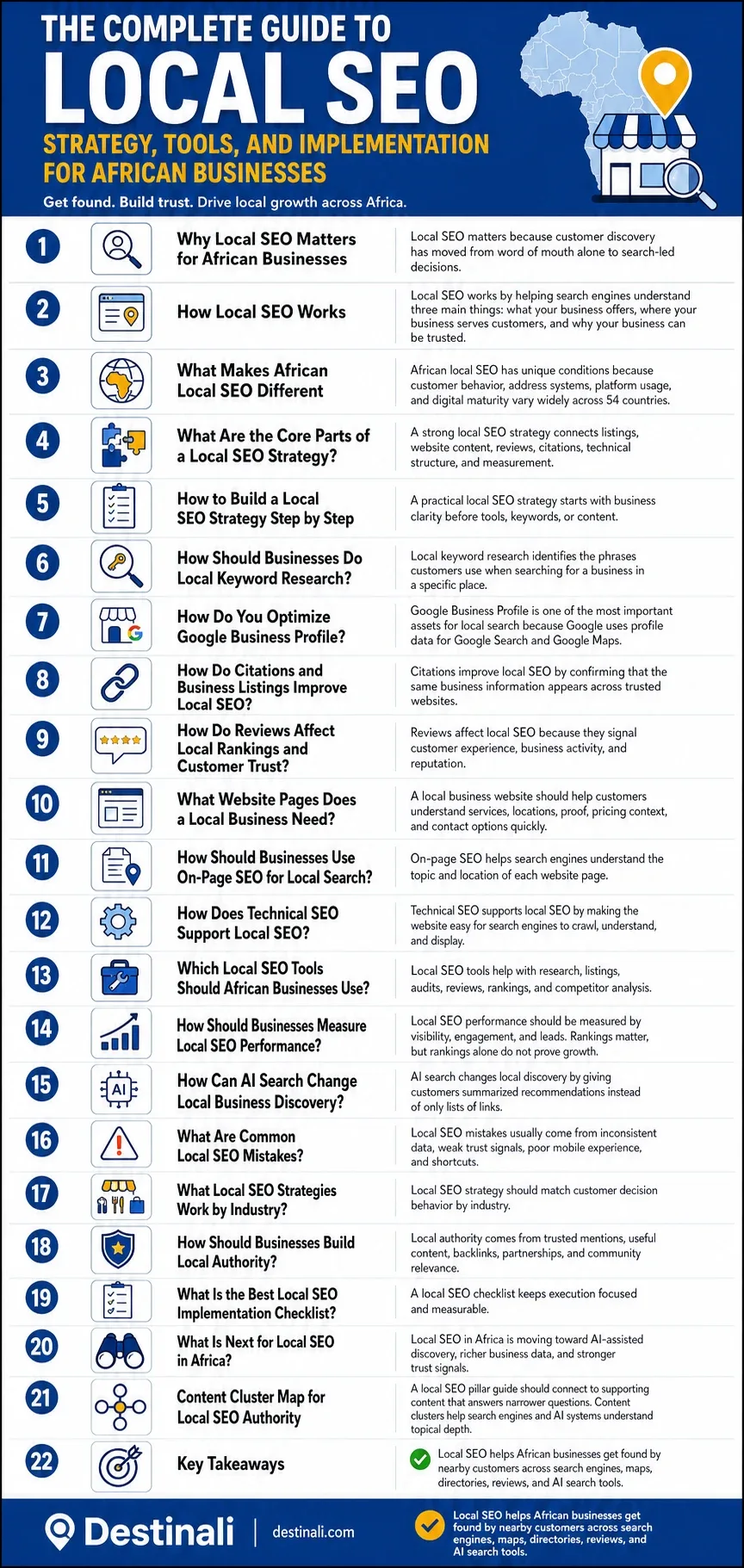
The Complete Guide to Local SEO: Strategy, Tools, and Implementation for African Businesses
Local SEO helps customers find nearby businesses when they search on Google, maps, directories, review platforms, and AI search tools. For African businesses, local SEO is no longer optional because customers now compare restaurants, clinics, hotels, salons, lawyers, agencies, farms, shops, and service providers online before they call, visit, or buy. This guide explains how to build visibility, trust, and customer discovery across search platforms in practical steps.
Local SEO is the practice of improving a business's online presence so customers in a specific city, region, or service area can find the business in local search results, maps, directories, and AI-generated recommendations.
Why Local SEO Matters for African Businesses
Local SEO matters because customer discovery has moved from word of mouth alone to search-led decisions. A customer looking for “best dentist in Nairobi,” “hotel in Victoria Island,” “real estate agent in Accra,” or “restaurant near me in Kigali” is already close to making a decision.
According to Ahrefs, 78% of people who search for something nearby on their phones visit a business within a day. Google also states that customers are more likely to visit and consider buying from businesses with complete Business Profiles. For African small and medium-sized businesses, accurate online visibility can turn everyday searches into calls, WhatsApp messages, bookings, and store visits.
Local SEO is especially important in markets where many good businesses still have weak websites, incomplete listings, inconsistent addresses, or few reviews. A well-optimized business can outrank larger competitors when search engines and AI systems can clearly understand location, services, reputation, and contact details.
Key Local SEO Outcomes:
- More calls from customers searching nearby.
- More map visibility for location-based searches.
- More trust from reviews and complete business information.
- More qualified leads without paying commissions on every sale.
- More discovery across search engines, directories, maps, and AI tools.
How Local SEO Works
Local SEO works by helping search engines understand three main things: what your business offers, where your business serves customers, and why your business can be trusted. Google describes local ranking around relevance, distance, and prominence, and those signals also influence how customers choose between businesses.
- Relevance
- Relevance measures how closely a business matches what a customer is searching for, such as “family lawyer in Lagos” or “spa in Cape Town.”
- Distance
- Distance measures how close a business is to the searcher or to the location named in the search query.
- Prominence
- Prominence measures how well-known, trusted, reviewed, and referenced a business appears across the web.
A business can improve relevance with clear service descriptions, categories, location pages, and website content. A business can improve distance signals by using accurate addresses, service areas, and location data. A business can improve prominence through reviews, citations, backlinks, media mentions, and trusted business profiles.
Local SEO has two main search surfaces: the map pack and organic results. The map pack shows business listings with maps, ratings, phone numbers, and directions. Organic results show website pages, articles, service pages, and directory pages that match the search.
What Makes African Local SEO Different
African local SEO has unique conditions because customer behavior, address systems, platform usage, and digital maturity vary widely across 54 countries. A clinic in Kampala, a restaurant in Lagos, a tour company in Cape Town, and a real estate agency in Accra may all need local SEO, but each business faces different search habits and listing quality issues.
Many African customers still prefer fast contact through WhatsApp, phone calls, and direct messages. Local SEO for African businesses should therefore focus on clear contact paths, not just website visits. A business profile that generates a qualified WhatsApp inquiry can be more valuable than a page view that never becomes a lead.
Address consistency also matters. In some cities, customers rely on landmarks, estate names, junctions, or shopping plazas. Search engines still need structured data, but customers also need human-readable directions. Strong local SEO combines formal address details with practical location context.
Destinali supports African business discovery with structured visibility across 54 African countries, 80+ categories, and more than 1M verified businesses, helping local brands become easier to find through search, maps, AI systems, and business recommendations.
What Are the Core Parts of a Local SEO Strategy?
A strong local SEO strategy connects listings, website content, reviews, citations, technical structure, and measurement. Local SEO fails when a business treats one profile as the whole strategy and ignores every other discovery surface.
The Local SEO Visibility Framework consists of six components:
- Business Data: Correct name, address, phone number, website, hours, categories, and service areas.
- Search Profiles: Google Business Profile, map listings, social profiles, and trusted business directories.
- Website Optimization: Location pages, service pages, schema markup, mobile usability, and fast loading.
- Reputation Signals: Reviews, ratings, testimonials, review responses, and customer proof.
- Authority Signals: Citations, backlinks, local mentions, comparison content, and media coverage.
- Conversion Paths: Calls, WhatsApp, email, booking forms, directions, menus, and quote requests.
Each component supports the others. A complete Google Business Profile improves map visibility, but consistent citations and a clear website help search engines trust the business data. Reviews improve trust, but good conversion paths turn trust into revenue.
How to Build a Local SEO Strategy Step by Step
A practical local SEO strategy starts with business clarity before tools, keywords, or content. Search engines cannot promote a business confidently when the business category, location, services, and contact details are unclear.
To build a local SEO strategy, follow these steps:
- Define your main customer locations.
- List your core services and products.
- Research local search keywords.
- Claim and optimize your Google Business Profile.
- Build consistent business listings and citations.
- Improve your website pages for city and service searches.
- Collect and respond to customer reviews.
- Add structured data and clear contact options.
- Track calls, directions, form submissions, and ranking movement.
- Repeat improvements monthly.
A salon in Abuja might target “braids in Wuse,” “natural hair salon Abuja,” and “bridal makeup Abuja.” A hotel in Kigali might target “business hotel Kigali,” “hotel near Kigali Convention Centre,” and “airport transfer hotel Kigali.” Local SEO works best when search terms reflect how real customers describe the service and location.
How Should Businesses Do Local Keyword Research?
Local keyword research identifies the phrases customers use when searching for a business in a specific place. A local keyword usually combines a service, product, or category with a city, neighborhood, landmark, or “near me” intent.
Local Keyword is a search phrase that includes location intent, such as “law firm in Accra,” “dentist near me,” or “best seafood restaurant in Dar es Salaam.”
Useful local keyword types include:
- Service plus city: “SEO agency in Lagos.”
- Service plus neighborhood: “plumber in Sandton.”
- Product plus city: “wedding dresses in Nairobi.”
- Problem plus location: “emergency dentist in Kumasi.”
- Comparison intent: “best hotels in Abuja.”
- Near-me intent: “coffee shop near me.”
- Landmark intent: “restaurant near Cape Town waterfront.”
Tools like Google Keyword Planner, Semrush, Ahrefs, Mangools, and Google Search Console can help estimate demand. Customer language matters more than tool volume alone. A business owner should also review calls, WhatsApp messages, reviews, competitor pages, and common customer questions.
Local keyword research should produce a map of service pages, location pages, FAQ content, and business profile terms. The goal is not to stuff keywords into pages. The goal is to make the business clearly match the searches that matter.
How Do You Optimize Google Business Profile?
Google Business Profile is one of the most important assets for local search because Google uses profile data for Google Search and Google Maps. According to Ahrefs, many local SEO professionals see Google Business Profile signals as central to map pack rankings.
To optimize Google Business Profile, complete every field accurately:
- Use the real business name.
- Choose the most accurate primary category.
- Add relevant secondary categories.
- Add the correct address or service area.
- Add phone, website, WhatsApp link where available, and business hours.
- Upload high-quality photos of the location, team, products, menu, rooms, or completed work.
- Write a clear business description.
- Add services, products, menus, and booking links.
- Publish regular updates when relevant.
- Ask real customers for reviews.
A complete Google Business Profile helps customers verify a business quickly. A weak profile creates doubt, especially when competitors show photos, reviews, directions, prices, and current opening hours.
Businesses should avoid fake categories, keyword-stuffed business names, and paid reviews. Misleading profile tactics can damage trust and may violate platform rules.
How Do Citations and Business Listings Improve Local SEO?
Citations improve local SEO by confirming that the same business information appears across trusted websites. A citation usually includes the business name, address, phone number, website, category, and sometimes opening hours or services.
NAP Citation is an online mention of a business's name, address, and phone number on a directory, social profile, map platform, chamber website, or industry listing.
Citation consistency matters because search engines compare business data across sources. Conflicting phone numbers, old addresses, duplicate names, and wrong categories reduce confidence. Customers also lose trust when a listing says a restaurant is open but the business has moved or closed.
African businesses should build citations on major platforms, country-specific directories, industry websites, tourism platforms, social profiles, map services, and trusted local discovery platforms. A Lagos agency listing such as local SEO services can support service discovery when the profile contains structured business details and clear contact paths.
Citations do not replace a good website or Google Business Profile. Citations strengthen the business identity across the web.
How Do Reviews Affect Local Rankings and Customer Trust?
Reviews affect local SEO because they signal customer experience, business activity, and reputation. Review quantity, rating quality, review freshness, response behavior, and review keywords can all influence how customers and search platforms evaluate a business.
A restaurant with 350 reviews and a 4.6 rating will usually earn more trust than a similar restaurant with 3 reviews and no photos. A clinic that responds professionally to negative feedback can look more reliable than a clinic that ignores all customer concerns.
Good review systems are simple. Ask customers shortly after service delivery. Share a direct review link. Place QR codes at reception desks, hotel rooms, counters, menus, invoices, and post-service messages. Never buy reviews or pressure customers to leave only positive feedback.
Review responses should be calm, specific, and professional. A good response names the service, thanks the customer, and explains next steps when needed. Reviews are not only ranking signals. Reviews are public trust signals that influence whether customers call or choose a competitor.
What Website Pages Does a Local Business Need?
A local business website should help customers understand services, locations, proof, pricing context, and contact options quickly. A beautiful website with no local signals can still perform poorly in search.
Essential local business pages include:
- Homepage with business category, city, and main value.
- Service pages for each major service.
- Location pages for each branch or service city.
- About page with business history and trust details.
- Contact page with address, phone, map, WhatsApp, and hours.
- Review or testimonial page.
- FAQ page answering buyer questions.
- Blog or resource pages for local search topics.
A web design and SEO provider such as Donal Digital can use service pages to target high-intent local searches, while a developer profile such as Johncodes can benefit from portfolio pages that prove project quality. A Cape Town brand services profile such as Brand Complete can support local discovery when category, city, services, and proof are structured clearly.
Each page should answer one search intent. A “marketing agency in Lagos” page should not also try to rank for bookkeeping, web hosting, and printing.
How Should Businesses Use On-Page SEO for Local Search?
On-page SEO helps search engines understand the topic and location of each website page. Local on-page SEO combines clear page structure, local keywords, business details, internal links, and useful content.
Local on-page SEO should include:
- City and service in the title tag where natural.
- Clear H1 heading that matches the page purpose.
- Short introduction explaining the service and location.
- Address, phone number, and service area on relevant pages.
- Embedded map for physical locations.
- Original photos from the business.
- Customer testimonials from the location.
- Internal links to related services and contact pages.
- Frequently asked questions.
- Local business schema markup.
A farming supplier such as OFAB Oye Farms can strengthen relevance by describing agricultural products, delivery areas, and customer types. A tools business such as Ibro Tools or De Jeda Machine can use product-category pages to match local buying intent. A baking supplier such as Goldenwhisk can attract searches around cake tools, baking ingredients, and Lagos supply options.
On-page SEO should always help the customer first. Search engines reward pages that are clear, complete, and useful.
How Does Technical SEO Support Local SEO?
Technical SEO supports local SEO by making the website easy for search engines to crawl, understand, and display. A slow, broken, or confusing website can reduce conversions even when listings rank well.
Local businesses should focus on practical technical improvements:
- Make the website mobile-friendly.
- Improve page speed.
- Use HTTPS security.
- Fix broken links and missing pages.
- Submit an XML sitemap through Google Search Console.
- Use clean URLs.
- Add LocalBusiness schema markup.
- Make phone numbers clickable.
- Compress images without destroying quality.
- Ensure contact forms work correctly.
According to Coursera, mobile optimization is important because many local searches happen on mobile devices. African businesses should test websites on common mobile networks and lower-cost smartphones, not only high-end devices on fast Wi-Fi.
Technical SEO does not need to be complex for most small businesses. A fast mobile page with correct business data, clear headings, and working contact buttons can outperform a complex website that customers struggle to use.
Which Local SEO Tools Should African Businesses Use?
Local SEO tools help with research, listings, audits, reviews, rankings, and competitor analysis. The right tool depends on business size, budget, number of locations, and internal skills.
| Tool | Best Use | Good Fit |
|---|---|---|
| Google Business Profile | Map visibility and business profile management | Every local business |
| Google Search Console | Website search performance and indexing | Businesses with websites |
| Google Analytics | Website behavior and conversion tracking | Businesses tracking leads |
| Google Keyword Planner | Keyword ideas and demand estimates | Budget-conscious teams |
| Ahrefs | Competitor analysis, backlinks, keyword research | Agencies and advanced teams |
| Semrush | SEO audits, local keyword research, tracking | Growth-focused businesses |
| Moz Local | Listing consistency and citation management | Multi-platform listing needs |
| BrightLocal | Local audits, rankings, citations, reviews | Local SEO teams and agencies |
| Whitespark | Citation discovery and local rank tracking | Citation-focused campaigns |
| Yext | Large-scale business data management | Multi-location brands |
| ReviewTrackers | Review monitoring | Reputation-heavy businesses |
| GeoRanker | Location-based rank tracking | City or branch-level tracking |
A small restaurant may only need Google Business Profile, Search Console, a review link, and a clean directory listing. A hotel group with branches across Nigeria, Kenya, and Ghana may need listing management, review monitoring, and rank tracking by city.
Tool selection should follow business goals. Do not pay for advanced software before the business has correct profiles, real reviews, working contact paths, and useful pages.
How Should Businesses Measure Local SEO Performance?
Local SEO performance should be measured by visibility, engagement, and leads. Rankings matter, but rankings alone do not prove growth.
Track these local SEO metrics:
- Google Business Profile calls.
- Direction requests.
- Website clicks from listings.
- WhatsApp inquiries.
- Form submissions.
- Booking requests.
- Local keyword rankings.
- Map pack visibility.
- Review count and average rating.
- Citation consistency.
- Organic traffic by city.
- Conversion rate from local pages.
A clinic should care about appointment requests. A hotel should care about booking inquiries and calls. A law firm should care about qualified consultation requests. A restaurant should care about directions, calls, menu views, and reviews.
Local SEO reporting should separate vanity metrics from business outcomes. A page with 10,000 visits but no calls may be less valuable than a city page with 300 visits and 40 qualified leads.
How Can AI Search Change Local Business Discovery?
AI search changes local discovery by giving customers summarized recommendations instead of only lists of links. A customer may ask ChatGPT, Gemini, Perplexity, or Google AI features for “the best family-friendly hotels in Accra” or “reliable real estate agencies in Kigali,” and the answer may mention only a few businesses.
Generative Engine Optimization (GEO) is the practice of structuring business information so AI systems can understand, extract, and cite the business accurately. Local SEO and GEO now overlap because AI systems need clear facts, consistent business profiles, reviews, category signals, and trusted mentions.
AI-ready local visibility depends on structured business data, strong profiles, comparison content, review content, and clear service descriptions. A business that appears consistently across trusted sources is easier for AI systems to identify than a business with scattered or conflicting information.
Local businesses should prepare for AI discovery by publishing clear answers, maintaining accurate listings, earning reviews, and building credible mentions. Search visibility is moving from “ranked pages only” to direct business recommendations.
What Are Common Local SEO Mistakes?
Local SEO mistakes usually come from inconsistent data, weak trust signals, poor mobile experience, and shortcuts. Many businesses lose visibility because search platforms cannot verify basic facts.
Common local SEO mistakes include:
- Using different business names across platforms.
- Listing old phone numbers or addresses.
- Ignoring Google Business Profile.
- Choosing the wrong business category.
- Buying fake reviews.
- Failing to respond to reviews.
- Using one page for every city and service.
- Publishing thin location pages.
- Hiding contact details.
- Ignoring mobile speed.
- Forgetting WhatsApp and direct call options.
- Measuring rankings but not leads.
A business should fix data accuracy before chasing advanced tactics. Search engines and customers both need confidence. Correct information, honest reviews, and clear pages create that confidence.
What Local SEO Strategies Work by Industry?
Local SEO strategy should match customer decision behavior by industry. A customer choosing a restaurant makes a faster decision than a customer choosing a lawyer, hospital, real estate agent, or school.
Hotels and Tourism Businesses
Hotels, tour operators, and travel services need photos, reviews, amenities, location details, airport distance, nearby attractions, and booking paths. City travel content such as a Lagos visitor guide, Nigeria travel guide, Dubai guide, Paris guide, Rome guide, Bali guide, and Las Vegas guide can support discovery when destination content connects visitors to local businesses.
Restaurants, Salons, and Wellness Brands
Restaurants and salons rely heavily on photos, reviews, menus, service lists, price signals, opening hours, and map visibility. Product-led beauty content such as gua sha tools, radiant skin tools, and a gua sha beginner guide can support category authority for wellness businesses that sell products or services.
Professional Services and Agencies
Lawyers, consultants, accountants, real estate agencies, fintech companies, and digital agencies need trust proof, service pages, case studies, professional credentials, and comparison content. A fintech profile such as Lenco business banking benefits from clear category data because business buyers often compare providers before contacting them.
Travel, Religious, and Event Services
Travel support businesses need clear documentation, timelines, credibility, and location relevance. Content around visiting Nigeria, Abuja flight options, and SCOAN invitation letters can capture high-intent searches from travelers planning specific trips.
How Should Businesses Build Local Authority?
Local authority comes from trusted mentions, useful content, backlinks, partnerships, and community relevance. Search engines evaluate whether a business appears credible beyond its own website.
Ways to build local authority include:
- Join local chambers, associations, and professional bodies.
- Sponsor events, school programs, conferences, or community activities.
- Earn mentions from newspapers, blogs, tourism websites, and industry publications.
- Publish city-specific guides and comparison content.
- Build supplier, partner, and customer story pages.
- Create useful resources for local buyers.
- Get listed in trusted category directories.
- Maintain a strong portfolio of completed work.
A local portfolio such as business portfolio listings can support trust when profiles show real services, locations, and contact information. A Cape Town listing such as My Guide Cape Town can also strengthen local relevance when the profile connects category, city, and business description.
Backlinks matter, but relevance matters more than random volume. A hotel should earn mentions from travel sites, event venues, tourism resources, and city guides. A law firm should earn mentions from legal associations, business publications, and professional directories.
What Is the Best Local SEO Implementation Checklist?
A local SEO checklist keeps execution focused and measurable. The best checklist starts with business data, then moves to profiles, website pages, reviews, content, links, and reporting.
Use this implementation checklist:
- Confirm the official business name.
- Confirm address, phone, website, hours, and service areas.
- Claim Google Business Profile.
- Complete every profile field.
- Add categories, services, products, photos, and booking links.
- Build citations on trusted directories and platforms.
- Remove duplicates and correct wrong listings.
- Create service pages for core offers.
- Create location pages for branches or target cities.
- Add LocalBusiness schema.
- Add reviews to the website.
- Ask customers for Google reviews.
- Respond to every important review.
- Improve mobile speed and usability.
- Add WhatsApp, call, email, and direction buttons.
- Publish local content monthly.
- Track calls, clicks, directions, rankings, and inquiries.
- Review performance every month.
A checklist turns local SEO from a one-time task into a business system. The strongest results come from consistent maintenance, not one setup session.
What Is Next for Local SEO in Africa?
Local SEO in Africa is moving toward AI-assisted discovery, richer business data, and stronger trust signals. Businesses that structure their information now will be better positioned as search platforms become more answer-driven.
AI Recommendations Will Influence Buying Decisions
AI systems increasingly summarize options for customers. A business with complete profiles, consistent citations, strong reviews, and clear content has a better chance of being included in AI-generated recommendations.
WhatsApp and Direct Contact Will Stay Important
African customers often want quick confirmation before visiting or paying. Local SEO strategies should make calls, WhatsApp chats, and email inquiries easy from every major profile and website page.
Structured Business Data Will Matter More
Search engines and AI tools need machine-readable business information. Schema markup, complete listings, category accuracy, and consistent contact data will become more important for visibility.
Comparison Content Will Shape Customer Choice
Customers increasingly search for “best,” “top,” “near me,” “alternatives,” and “reviews.” Businesses that appear in trusted comparison and recommendation content can gain visibility beyond their own websites.
FAQ
What Is Local SEO for Small Businesses?
Local SEO for small businesses is the process of improving online visibility so nearby customers can find the business in search results, maps, directories, and AI recommendations. A small business uses local SEO to appear for searches like “restaurant near me,” “plumber in Accra,” or “salon in Lagos.” Strong local SEO includes accurate listings, reviews, service pages, location data, and clear contact options.
How Long Does Local SEO Take to Work?
Local SEO usually takes 1 to 3 months for early improvements and 3 to 6 months for stronger results in competitive cities. A business with no listings, few reviews, and a weak website may need more time than a business with an established brand. Review growth, citation cleanup, website quality, and competitor strength all affect timing.
Is Google Business Profile Enough for Local SEO?
Google Business Profile is not enough for complete local SEO because customers and search systems also use websites, citations, reviews, directories, maps, and AI tools. Google Business Profile is essential for Google Maps and local pack visibility. Stronger local visibility comes when Google Business Profile is supported by consistent business listings, optimized pages, and trusted reputation signals.
What Are Local Citations in SEO?
Local citations are online mentions of a business’s name, address, and phone number on directories, social profiles, map platforms, and industry websites. Citations help search engines verify that a business is real and located where the business claims to operate. Accurate citations improve trust, while inconsistent citations can confuse customers and search platforms.
How Many Reviews Does a Local Business Need?
A local business needs enough reviews to look active and trustworthy compared with nearby competitors. A restaurant in a busy city may need hundreds of reviews to compete, while a niche consultant may earn trust with 20 to 50 detailed reviews. Review quality, freshness, response behavior, and rating consistency matter as much as raw review count.
What Is the Difference Between Local SEO and Traditional SEO?
Local SEO focuses on visibility in specific cities, neighborhoods, or service areas, while traditional SEO often targets broader national or global searches. Local SEO uses signals such as Google Business Profile, map visibility, citations, reviews, and location pages. Traditional SEO relies more heavily on broader website authority, content depth, backlinks, and technical performance.
Do African Businesses Need AI Search Optimization?
African businesses need AI search optimization because customers are beginning to ask AI tools for business recommendations, comparisons, and local options. AI systems rely on clear business data, trusted mentions, reviews, categories, and structured content. A business that prepares for AI search can improve visibility beyond traditional Google rankings.
What Is the Best Local SEO Tool for Beginners?
Google Business Profile, Google Search Console, and Google Analytics are the best starting tools for most beginners because they are free and cover core visibility data. A business can add tools like BrightLocal, Semrush, Ahrefs, Moz Local, or Whitespark as needs grow. The best tool depends on whether the business needs keyword research, citation cleanup, review tracking, or competitor analysis.
Key Takeaways
- Local SEO helps African businesses get found by nearby customers across search engines, maps, directories, reviews, and AI search tools.
- The strongest local SEO strategy connects accurate business data, Google Business Profile, website pages, citations, reviews, backlinks, and conversion paths.
- Google’s local ranking signals include relevance, distance, and prominence, which makes clear services, correct location data, and trust signals essential.
- African businesses should optimize for calls, WhatsApp inquiries, email, bookings, directions, and walk-ins, not traffic alone.
- Reviews are both ranking signals and customer trust signals, so businesses should request real reviews and respond professionally.
- Local SEO tools are useful, but correct profiles, consistent data, mobile-friendly pages, and review systems should come first.
- AI search is making structured business data more important because customers increasingly receive summarized recommendations instead of only lists of links.
- Content clusters, comparison pages, city guides, and industry-specific resources help businesses build authority beyond one profile or website page.
African businesses that want stronger search and AI visibility can create free listing to help customers find accurate business information online.

Destinali helps local businesses improve online visibility, discoverability, and customer acquisition across search engines, AI systems, maps, and local search platforms.
List your business →