Local SEO for Law Firms and Professional Services in Africa: A Step-By-Step Guide
Local SEO for law firms and professional services in Africa helps nearby clients find, evaluate, and contact a firm when they search for services like “lawyer near me,” “tax consultant in Nairobi,” or “best architect in Accra.” The practical work involves improving your Google Business Profile, website pages, citations, reviews, and structured data so search engines and AI tools can understand where you operate and who you serve.
Local SEO is the process of improving a business’s online presence so nearby customers can find that business in maps, local search results, directories, and AI-generated recommendations.
For African law firms, clinics, accountants, estate agents, consultants, and other professional service providers, local visibility is a trust problem as much as a ranking problem. A client searching for legal help in Lagos, family mediation in Cape Town, or audit services in Kigali wants proof that the provider is real, nearby, qualified, and responsive.
Step 1: Define Your Local Service Market
Start by deciding exactly which clients, cities, and services your firm wants to be found for. Local SEO works best when every page, listing, and citation sends the same clear signal about your practice area and location.
A law firm should not target only “lawyer in Africa.” A stronger target is “commercial lawyer in Nairobi,” “immigration lawyer in Johannesburg,” or “family law firm in Accra.” The same principle applies to accountants, architects, consultants, clinics, and real estate agencies.
To define your local service market, follow these steps:
- List your main services, such as litigation, conveyancing, tax advisory, immigration support, audit, valuation, or business consulting.
- Match each service to a city, district, suburb, or region.
- Identify the client intent behind each search, such as urgent help, comparison, consultation, or document preparation.
- Choose one primary city or service area per important website page.
Local SEO for law firms and professional services in Africa becomes easier when each service has a clear location, a clear audience, and a clear next action.
Step 2: Optimize Your Google Business Profile
A complete Google Business Profile is one of the strongest local search assets for a professional service business. Google uses business profile information to understand relevance, distance, and prominence in Maps and local results.
Your profile should include your exact business name, address, phone number, website, opening hours, services, categories, photos, and appointment options. For legal and professional services, accuracy matters because clients often compare several providers before making contact.
Optimize your profile with these actions:
- Use your real business name, not a keyword-stuffed version.
- Choose the most accurate primary category, such as “Law Firm,” “Legal Services,” “Accountant,” or “Business Management Consultant.”
- Add secondary categories only when they match real services.
- Write a plain-language business description that mentions your city and core services.
- Add photos of your office, reception area, team, signage, and professional environment.
- Update holiday hours and contact details whenever they change.
Destinali helps African businesses improve discovery across 54 countries by organizing verified business data, categories, and visibility signals beyond one search platform. That broader visibility matters because clients increasingly compare firms through search engines, maps, directories, and AI-assisted recommendations.
Step 3: Create City and Service Pages That Match Real Searches
Your website should have dedicated pages for important service and location combinations. A single homepage cannot rank well for every practice area, every city, and every client need.
A law firm in Ghana might need separate pages for “corporate law in Accra,” “property lawyer in Kumasi,” and “family lawyer in Tema.” An accounting firm in Kenya might need pages for “tax advisory in Nairobi,” “payroll services in Mombasa,” and “audit services in Kisumu.”
Each local service page should include:
- A clear H1 heading with the service and city.
- A short explanation of who the service is for.
- A list of common client problems.
- A description of your process.
- Local details, such as courts, agencies, business districts, or regulations where appropriate.
- Contact options, including phone, email, WhatsApp, and appointment forms.
- Frequently asked questions specific to the service and location.
Strong location pages connect services to real cities without copying the same text across every page. Search engines reward useful local detail, not duplicated city-name swaps.
Step 4: Build Consistent Citations Across Trusted Directories
Citations are mentions of your business name, address, phone number, website, and category on external platforms. Consistent citation data helps search engines confirm that your firm is legitimate and located where you claim.
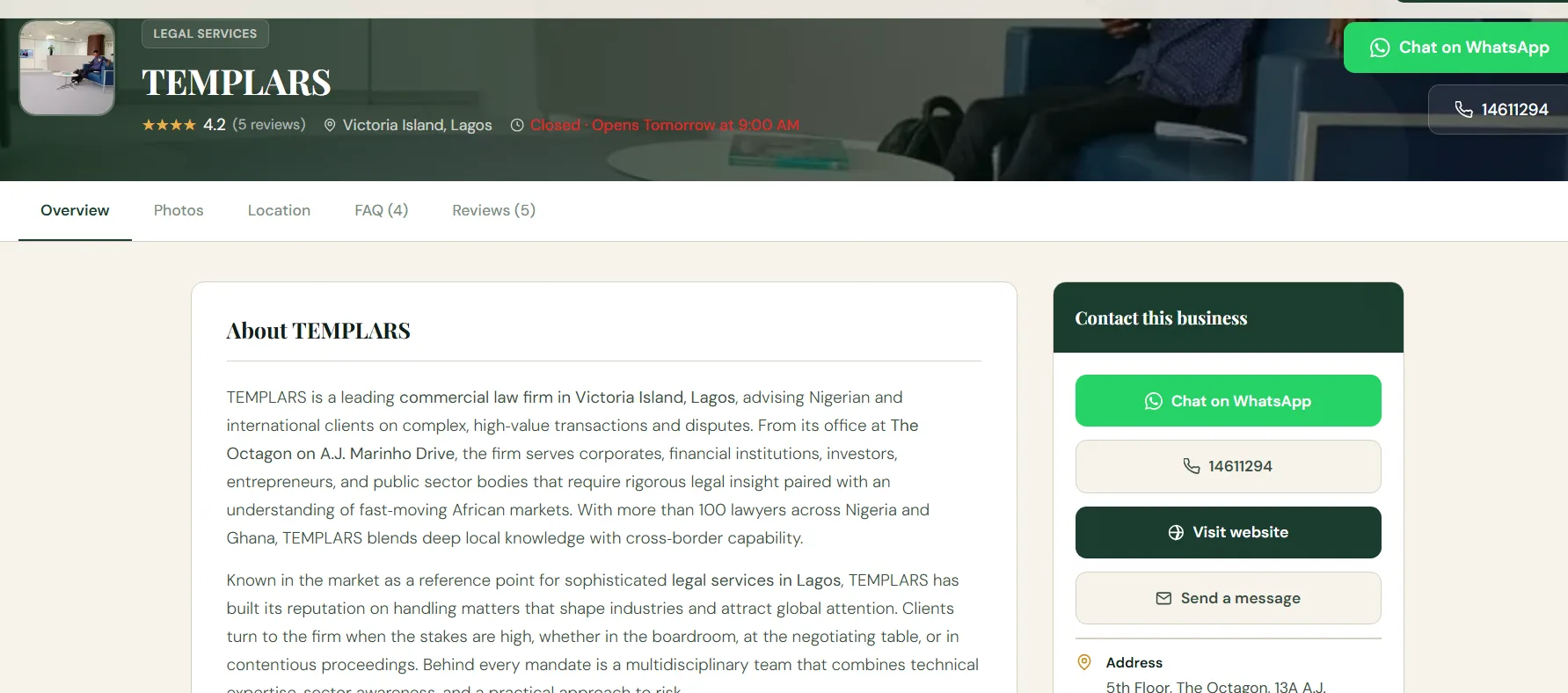
A local citation is an online mention of a business’s core contact details, usually including its name, address, phone number, website, and category.
Professional service firms should prioritize directories that customers actually use. These may include legal directories, chamber of commerce listings, accounting bodies, local business directories, industry associations, and African discovery platforms.
Use the same format everywhere:
- Business name: Match your signage and legal trading name.
- Address: Use one consistent spelling and format.
- Phone number: Use the same primary number.
- Website: Link to your homepage or relevant location page.
- Category: Choose the closest real category.
- Description: Explain services clearly without exaggerated claims.
Reliable business directories in Africa improve discovery because they give search platforms more consistent evidence about a firm’s location, category, and credibility.
Step 5: Earn Reviews Without Crossing Ethical Lines
Reviews influence local rankings, but reviews also influence trust before a client contacts your firm. For law firms and regulated professionals, review requests must respect confidentiality, advertising rules, and client consent.
A good review strategy asks satisfied clients to describe the service experience without revealing private facts. A divorce client, criminal defense client, tax client, or corporate advisory client should never feel pressured to disclose sensitive details.
Use a safe review process:
- Ask only clients who have had a positive experience.
- Make the request optional and pressure-free.
- Provide a direct review link.
- Avoid offering discounts, gifts, or rewards for reviews.
- Never ask clients to reveal confidential case details.
- Respond professionally to both positive and negative reviews.
- Do not argue online about facts related to a matter.
Local SEO for law firms should never sacrifice professional responsibility for rankings. Ethical reviews build trust because they show credibility without exposing clients or overstating outcomes.
Step 6: Add Local Content That Answers Client Questions
Local content helps search engines understand your expertise and helps clients decide whether to contact you. The best content answers specific questions people ask before hiring a professional.
A law firm can publish pages about tenancy disputes in Lagos, company registration in Rwanda, employment contracts in South Africa, or land documentation in Ghana. A consultant can write about business licensing, local compliance, funding readiness, or procurement documents.
Useful local content includes:
- Service explainers for common problems.
- City-specific guides.
- Comparison pages, such as “mediation vs litigation.”
- FAQs about costs, timelines, and documents.
- Reviews of common process mistakes.
- Articles tied to seasons, local events, or regulatory deadlines.
Well-structured local content gives search engines more reasons to rank your firm for practical, city-based searches. Clear educational content also helps AI tools quote your business as a relevant source.
Step 7: Add Schema Markup for Local and Professional Signals
Schema markup gives search engines structured information about your business, services, address, reviews, and website content. Schema.org provides the shared vocabulary that search platforms use to read structured data.
Schema markup is structured code added to a webpage so search engines can understand business details, services, locations, reviews, and page content more accurately.
For law firms and professional services, the most useful schema types usually include LocalBusiness, LegalService, ProfessionalService, Organization, FAQPage, Review, and BreadcrumbList. Use only accurate information that appears on the visible page.
To add schema safely:
- Add LocalBusiness or ProfessionalService schema to your homepage.
- Add service schema to important practice area pages.
- Add FAQPage schema to pages with genuine question-and-answer sections.
- Add review schema only when reviews are visible and compliant.
- Test the markup before publishing.
- Update schema when your address, phone number, or services change.
The free schema generator from AuthorityStack.ai can create JSON-LD schema for local businesses without technical skill. Structured data improves machine readability, which matters more as search shifts toward AI-generated answers.
Step 8: Improve Mobile Experience and Contact Paths
Most local service searches happen when a client needs fast answers. A slow website, hidden phone number, or confusing contact form can cost a firm qualified leads even when rankings improve.
Your website should make contact simple from every important page. Phone, WhatsApp, email, directions, and booking options should be easy to find on mobile screens.
Check these items:
- Pages load quickly on mobile connections.
- Phone numbers are tap-to-call.
- WhatsApp links open correctly.
- Contact forms ask only necessary questions.
- Office address links open in maps.
- Service pages include clear consultation steps.
- The website uses HTTPS.
- Text is readable without zooming.
Mobile usability supports both rankings and conversion. Local SEO produces better business results when visitors can contact the firm within seconds of finding the right page.
Step 9: Track Rankings, Calls, Messages, and Leads
Local SEO should be measured by business outcomes, not only rankings. A firm needs to know whether visibility is turning into calls, emails, WhatsApp messages, directions requests, consultations, and signed clients.
Track performance across your Google Business Profile, website analytics, call logs, CRM, and enquiry forms. Professional service firms should also track lead quality because not every enquiry is a good fit.
Measure these signals monthly:
- Local keyword rankings by city and service.
- Google Business Profile views and actions.
- Calls from search and maps.
- Website form submissions.
- WhatsApp enquiries.
- Direction requests.
- Review count and review rating.
- Consultation bookings.
- Client acquisition by service type.
The goal is not to rank for every possible keyword. The goal is to appear for the searches that bring serious clients in the locations your firm serves.
Step 10: Refresh and Expand Your Local SEO System
Local SEO is not a one-time setup. Competitors publish new pages, clients leave new reviews, directories update records, and search engines change how they display local results.
Review your local SEO system every month. Correct outdated citations, answer new reviews, add fresh questions to service pages, and create content for services that are receiving demand.
Use a simple monthly workflow:
- Check profile accuracy across major platforms.
- Review new rankings and lost rankings.
- Add one useful local content asset.
- Request reviews from recent satisfied clients.
- Update photos and business profile posts.
- Fix pages with low enquiries or weak engagement.
- Compare your firm against top local competitors.
- Improve pages that rank but do not convert.
Consistent improvement is the difference between having an online presence and becoming a trusted local option. Professional service buyers compare credibility before they make contact, so every visibility signal should support trust.
FAQ
Does SEO Work for Law Firms in Africa?
Yes, SEO works for law firms in Africa when the strategy targets specific services, cities, and client intent. A firm is more likely to attract qualified enquiries by ranking for searches like “property lawyer in Accra” or “immigration lawyer in Johannesburg” than by targeting broad national terms. Local SEO also supports trust through reviews, citations, accurate business data, and helpful service pages.
What Is the Best Local SEO Strategy for African Professional Services?
The best local SEO strategy for African professional services combines Google Business Profile optimization, city-specific service pages, consistent citations, ethical reviews, and structured data. A clinic in Kigali, law firm in Lagos, or accountant in Nairobi needs accurate business information across platforms and useful content that answers local client questions. Strong local SEO connects visibility with real contact actions like calls, emails, WhatsApp messages, and bookings.
How Long Does Local SEO Take for a Law Firm?
Local SEO for a law firm usually takes a few months to show clear movement, especially in competitive cities. Faster gains can come from fixing incomplete Google Business Profiles, correcting citation errors, and adding service pages for underserved locations. More competitive searches, such as “best personal injury lawyer near me,” often require stronger reviews, content, and backlinks over time.
Can a Small Law Firm Compete With Larger Firms in Local Search?
Yes, a small law firm can compete with larger firms in local search by focusing on specific practice areas, neighborhoods, and client questions. Large firms often target broad terms, while smaller firms can win searches like “tenant lawyer in Ikeja” or “family lawyer in Mombasa.” Accurate listings, strong reviews, and helpful local content can narrow the visibility gap.
Should Professional Service Firms Use WhatsApp for Local SEO Leads?
Yes, professional service firms should use WhatsApp when clients in their market prefer quick mobile communication. WhatsApp links on service pages, business profiles, and directory listings can increase enquiries from mobile searchers. A firm should still use intake controls so confidential legal, medical, or financial information is handled properly.
Are Reviews Important for Law Firm Local SEO?
Reviews are important for law firm local SEO because they influence trust, local visibility, and client decision-making. Reviews should be authentic, voluntary, and compliant with professional conduct rules. A safe review request asks clients to comment on service quality without revealing private case details or confidential outcomes.
Next Steps
- Audit your Google Business Profile for accuracy, categories, services, photos, and contact options.
- Create or improve one city-specific service page for your highest-value practice area.
- Correct your business name, address, phone number, and category across major directories.
- Ask recent satisfied clients for ethical reviews without incentives or pressure.
- Add schema markup to your homepage, service pages, and FAQ sections.
- Track calls, WhatsApp messages, form submissions, and consultation bookings every month.
African law firms and professional service businesses that treat local SEO as a trust system will earn better visibility, stronger enquiries, and more qualified clients over time.
To improve your local discovery presence, you can create a free listing and make your business easier for clients to find online.