How Online Reviews Impact Local Search Rankings in African Markets
Online reviews are one of the most direct factors shaping how prominently a local business appears in search results across Africa. Search engines like Google treat reviews as live signals of credibility, relevance, and customer satisfaction. For a restaurant in Lagos, a clinic in Nairobi, or a guest house in Kigali, review volume, recency, and quality can be the difference between appearing in the top three local results or being invisible to customers actively searching nearby.
This guide walks through exactly how reviews affect local search rankings in African markets and what you can do to build a review strategy that drives real visibility.
Step 1: Understand What Reviews Actually Signal to Search Engines
Before asking customers for reviews, it helps to understand why reviews move rankings.
Search engines use reviews to evaluate three things: trust, activity, and relevance. A business with recent, detailed reviews signals to Google that it is actively operating and genuinely serving customers. A profile with no reviews, or with reviews that stopped two years ago, signals stagnation.
Reviews account for roughly 16% of local search ranking factors, making them one of the most influential signals a business can actively control. Unlike backlinks or domain authority, reviews are something any business owner can build with consistent effort.
This matters especially across African markets, where many businesses have strong offline reputations but thin digital footprints. The businesses that translate their word-of-mouth credibility into verified online reviews gain a measurable advantage in local search and AI-powered discovery.
Step 2: Claim and Complete Your Business Profiles
Reviews only help you if they land on a profile that is fully set up and verified. An unclaimed profile cannot be managed, and incomplete profiles rank lower regardless of review count.
Google Business Profile
Claim and verify your Google Business Profile first. This is the primary profile that powers Google Maps and local search results across all African countries. Fill in every available field: business name, address, phone number, website, operating hours, and business category. Accurate business Name, Address, and Phone number (NAP) information is critical – inconsistency across platforms confuses search engines and suppresses rankings.
Local and Continental Directories
Beyond Google, list your business on reputable African business directories. Destinali, which covers verified businesses across all 54 African countries and 80+ categories, is one platform where consistent structured business data amplifies your presence beyond Google alone. Consistent NAP data across multiple platforms reinforces your local authority.
African businesses that struggle to rank locally often share a common problem: their information is inconsistent or missing across platforms, leaving search engines without enough signal to confidently surface them in results.
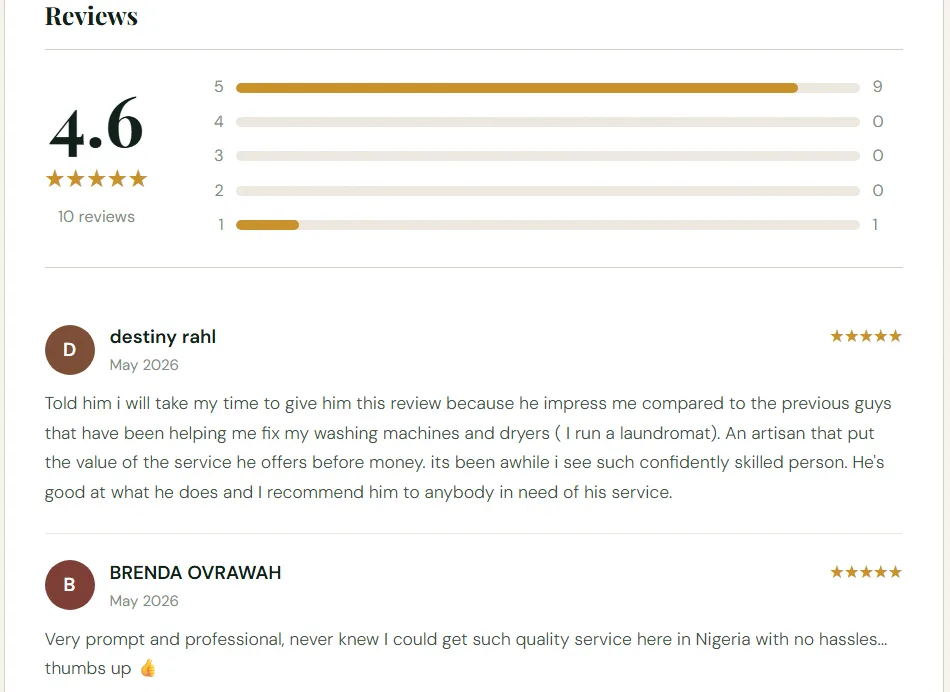
Step 3: Build a System for Collecting Reviews
Most businesses in Africa have satisfied customers who simply never leave a review. The gap between offline satisfaction and online reputation is a visibility gap. Closing it requires a proactive and repeatable system, not occasional requests.
Make It Easy to Leave a Review
Friction kills follow-through. Generate a direct Google review link and share it at the point of greatest customer satisfaction – after a completed service, after checkout, or at the end of a positive interaction.
Methods that work across African markets:
- QR code at your premises – Print and display a QR code that links directly to your review page. Hotels, clinics, and salons can place these at reception desks or checkout points.
- WhatsApp follow-up message – Send a brief thank-you message via WhatsApp and include the review link. WhatsApp penetration across Africa makes this one of the most effective post-service channels.
- Email confirmation link – For service businesses that confirm appointments or bookings by email, add a review request to the post-service message.
- Staff verbal request – Train customer-facing staff to mention reviews as part of the goodbye interaction. A spoken request, followed by a WhatsApp link, dramatically increases conversion.
Consistent customer review acquisition is a skill, not a one-time campaign. Build it into your standard operating process.
Step 4: Respond to Every Review – Positive and Negative
Review responses are visible to every potential customer who reads your profile. They are also a signal to search engines that your business is active and engaged.
Responding to Positive Reviews
Thank the reviewer by name where possible. Reference something specific from their comment. A generic "Thanks for the review!" adds little value. A response like "Thank you, Amara – we're glad the consultation was helpful and look forward to seeing you again" shows authenticity and encourages others to leave detailed reviews.
Responding to Negative Reviews
A negative review handled well often does more for your reputation than a string of unchallenged five-star ratings. Respond calmly, acknowledge the concern, and offer to resolve the situation offline. Never argue, deflect, or delete complaints.
Potential customers read negative reviews and judge your business by how you responded – not just by the complaint itself. A professional, solution-focused response signals to both customers and search engines that your business is accountable and trustworthy.
Step 5: Focus on Review Quality, Not Just Quantity
A hundred low-effort reviews with only star ratings carry less weight than fifty detailed reviews describing specific services, staff names, locations, and outcomes. Search engines can parse review content for relevance signals.
Encourage customers to mention:
- The specific service they received
- The location or branch they visited
- Any staff member who helped them
- The outcome or result they experienced
A review that reads "Great experience at the Westlands branch – Dr. Osei explained everything clearly and the clinic is clean and well-managed" is far more valuable than "5 stars. Good service."
A Nairobi clinic that built visibility this way used detailed patient reviews alongside consistent listings to rank prominently in local health searches – demonstrating how structured online presence for a clinic translates directly to patient discovery.
Step 6: Monitor and Maintain Review Momentum
Recency matters. A business with fifty reviews from three years ago ranks below a competitor with twenty reviews from the past three months. Search engines interpret recent reviews as evidence that a business is currently active and relevant.
Set a monthly review target appropriate to your business type:
| Business Type | Suggested Monthly Target |
|---|---|
| Restaurant or café | 8–15 new reviews |
| Clinic or pharmacy | 4–8 new reviews |
| Hotel or guest house | 5–10 new reviews |
| Salon or barbershop | 6–12 new reviews |
| Law firm or agency | 2–5 new reviews |
Track your review count, average rating, and response rate monthly. Use Google Business Profile Insights to see how many customers found you via search versus maps, and how reviews correlate with profile visits and calls.
FAQ
How Much Do Online Reviews Affect Local Search Rankings in Africa?
Reviews account for approximately 16% of local search ranking factors on Google. For African businesses, this is significant because review management is one of the few ranking signals entirely within a business owner's control. Volume, recency, and the quality of review content all contribute to how prominently a business appears in local search results and on Google Maps.
Do AI Search Tools Like ChatGPT and Perplexity Also Use Reviews to Rank Businesses?
AI search platforms increasingly factor in online reputation signals when deciding which local businesses to surface in generated responses. A business with strong, consistent reviews across Google and reputable directories is more likely to be cited by AI tools than one with sparse or outdated feedback. Structured business data and review signals work together to build the kind of entity authority that AI systems recognise.
How Many Reviews Does a Local Business in Africa Need to Rank Well?
There is no fixed minimum, but businesses appearing in the local top three results typically have more recent reviews than their competitors in that category and location. For competitive categories in cities like Lagos, Nairobi, or Johannesburg, 30 or more reviews with an average rating above 4.2 is a reasonable benchmark. In smaller cities or niche categories, fewer reviews with high quality can still secure a strong ranking position.
Is It Acceptable to Ask Customers Directly for Reviews?
Yes. Proactively requesting reviews is standard practice and encouraged by platforms like Google, provided you do not offer incentives in exchange for positive reviews. Asking via WhatsApp after a service, adding a review link to receipts or emails, or displaying a QR code at your premises are all legitimate and effective methods across African markets.
What Should I Do If a Competitor Has Fake Reviews?
Report suspected fake reviews through the platform's official flagging process. On Google Business Profile, you can flag reviews for policy violations directly from the review interface. Focus more energy on generating genuine reviews from real customers – a consistent flow of authentic reviews is more durable than any artificial inflation and will eventually outperform it in rankings.
Does Responding to Reviews Improve Search Rankings?
Yes. Responding to reviews signals activity and engagement to search engines, which contributes to local ranking. More practically, review responses are visible to every potential customer reading your profile. A business that responds to every review – positive and negative – builds more trust than one that is silent, and trust signals drive both rankings and conversions.
Do Reviews on Platforms Other Than Google Count for Local SEO?
Reviews on platforms like TripAdvisor, Facebook, local directories, and industry-specific sites contribute to your overall online reputation and entity authority, even if they do not feed directly into Google's ranking algorithm. Search engines index review content from third-party platforms and use it as additional evidence of business credibility. For African businesses, reviews on continental platforms and regional directories add local citation authority that supports ranking across multiple channels.
What to Do Now
Start with the actions that have the highest return for the least complexity:
- Claim and fully complete your Google Business Profile and any directory listings where your business appears
- Create a direct Google review link and share it with your ten most recent satisfied customers this week
- Set up a WhatsApp follow-up message template for post-service review requests and send it consistently
- Respond to every existing review on your profile – today, before new ones arrive
- Set a monthly review target for your business type and assign someone to track it
African businesses that list their business for free on Destinali gain structured visibility across search engines, maps, and AI discovery platforms – putting their reviews and business data in front of customers searching across 54 African countries.