How to Do Local SEO for Restaurants and Food Businesses in Africa
Millions of people across Africa search for places to eat online every day. They type phrases like "best suya spot in Lagos," "restaurant near me in Nairobi," or "seafood in Cape Town" into Google, Google Maps, or AI tools and they choose from what appears at the top. If your food business is not structured to appear in those results, you are invisible to those customers regardless of how good your food is.
Local Search Engine Optimization (SEO) for restaurants is the practice of making your business discoverable to nearby customers who are actively searching for what you serve. This guide walks through each step, in order, so that any restaurant or food business in Africa – from a suya stall in Abuja to a fine-dining restaurant in Accra – can begin ranking where it counts.
Step 1: Claim and Complete Your Google Business Profile
Google Business Profile (GBP) is the single most important local SEO asset a restaurant can have. It controls how your business appears in Google Search and Google Maps – the two places most customers look first.
To get started:
- Go to google.com/business and claim your listing.
- Enter your exact business name, address, and phone number.
- Select the most accurate category – "Restaurant," "African Restaurant," "Fast Food Restaurant," or whichever fits.
- Add your opening hours, including public holidays.
- Upload at least ten high-quality photos of your food, interior, and exterior.
- Write a business description that includes your city, cuisine type, and what makes you different.
Consistency matters. The name, address, and phone number on your Google Business Profile must exactly match what appears on your website and every other directory. Even small differences – "Rd" versus "Road," or a missing floor number – can weaken your local ranking signals.
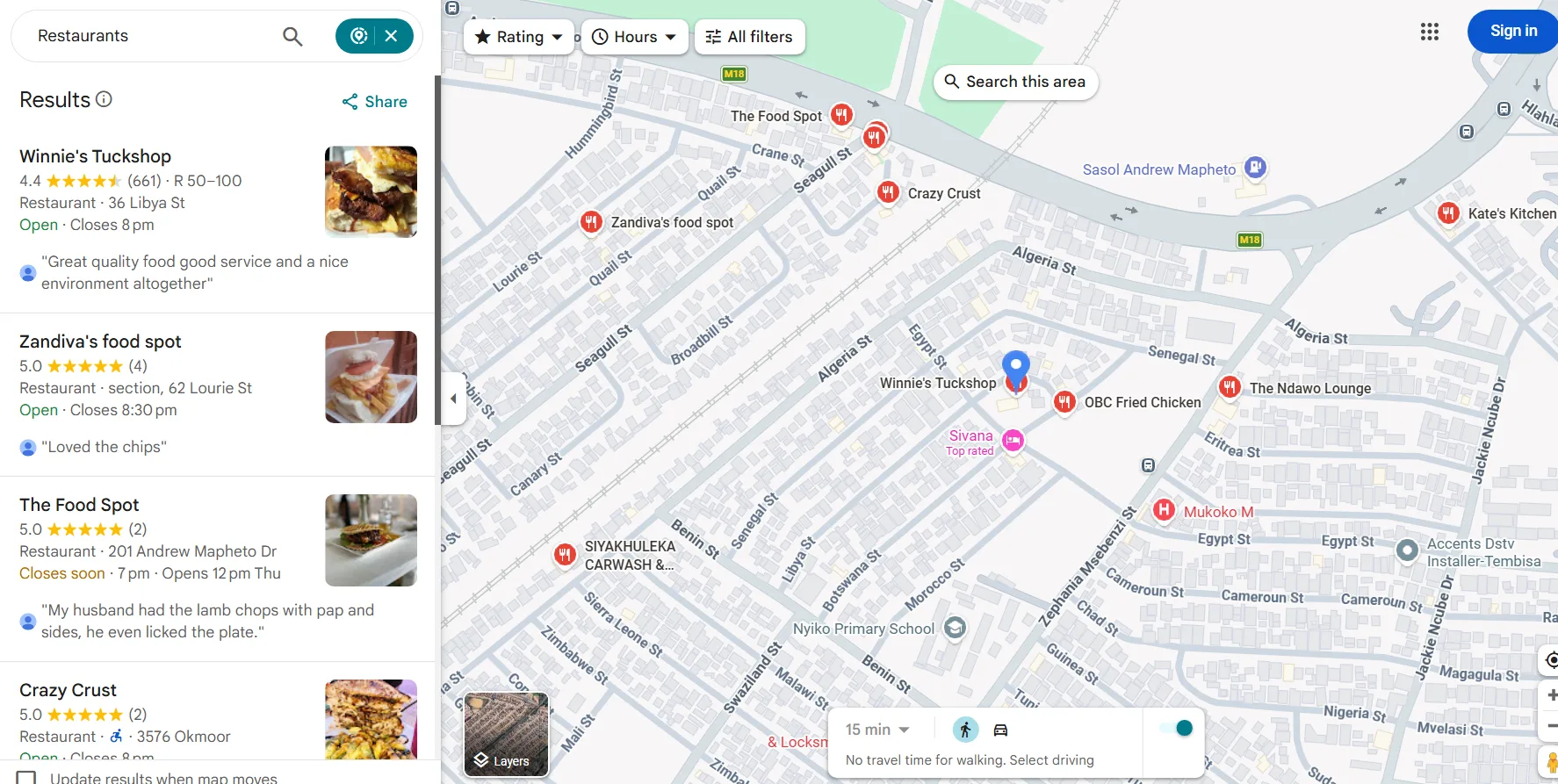
Step 2: Use Location-Specific Keywords Across Your Website
Ranking in local search requires matching the exact language your customers use. A restaurant in Kumasi that only uses the word "restaurant" on its website will lose to a competitor that uses "restaurant in Kumasi" or "best Ghanaian food in Kumasi Adum."
How to Find the Right Keywords
Start with what you already know: your city, your neighborhood, your cuisine type, and the dishes you are known for. Combine these into phrases your customers would actually type:
- "Jollof rice restaurant in Ikeja"
- "best nyama choma in Westlands Nairobi"
- "vegan food in Sandton"
- "Ethiopian restaurant in Cairo"
Several free local SEO tools for small businesses in Africa can help you identify which keyword variants have the most search demand in your city.
Where to Place Keywords
- Page titles and meta descriptions
- Your homepage heading (H1)
- Your "About" page
- Each menu category page
- Image file names and alt text
- Footer address block
Do not stuff keywords unnaturally. One well-placed keyword phrase in a heading and two or three natural mentions in the body text of a page is enough.
Step 3: Build a Website That Works on Mobile
More than 60 percent of restaurant searches happen on mobile devices, and in many African cities that figure is higher. A website that loads slowly or breaks on a smartphone loses customers before they even see the menu.
A restaurant website built for local SEO should:
- Load in under three seconds on a mobile connection
- Display the menu clearly without requiring a PDF download
- Show the address, phone number, and WhatsApp link on every page
- Include an embedded Google Map
- Have a click-to-call button visible above the fold
Mobile responsiveness also directly affects search rankings. Google uses mobile-first indexing, which means it ranks the mobile version of your site – not the desktop version. A site that works well on a phone will rank above one that does not, all else being equal.
Step 4: List Your Business in African Directories and Platforms
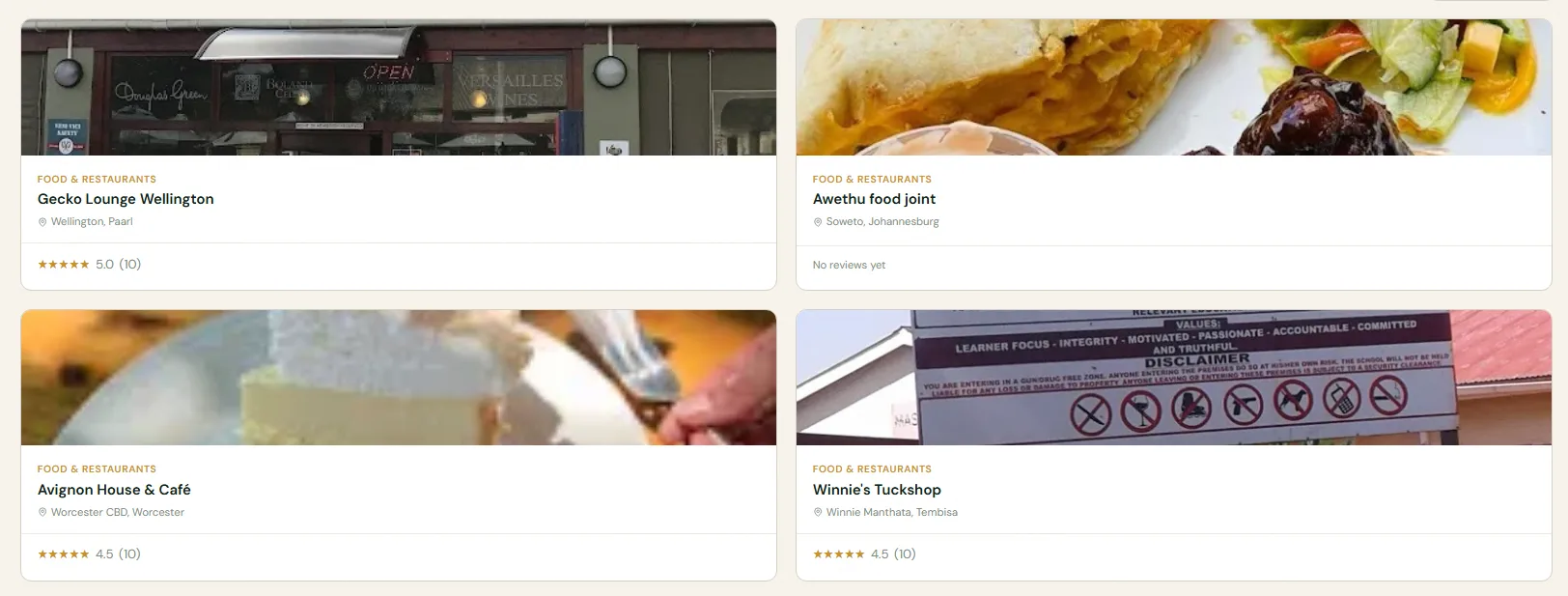
Google is not the only place customers discover restaurants. People search on platforms like TripAdvisor, Yelp, and Africa-specific discovery tools. Getting listed consistently across these platforms builds what SEO practitioners call citation authority – a measure of how well-established your business appears across the web.
Destinali lists verified businesses across all 54 African countries in more than 80 categories, making it one of the most comprehensive discovery platforms on the continent for food businesses looking to reach customers beyond Google alone.
When listing your business on any directory, the following information must be identical everywhere:
- Business name
- Physical address
- Phone number
- Website URL
- Opening hours
Inconsistent local citation data weakens your authority in search algorithms because platforms cannot confidently match and verify that all the listings refer to the same business. Audit your listings every few months and correct any discrepancies.
Step 5: Add Structured Data Markup to Your Website
Structured data, also called schema markup, is a block of code that tells search engines exactly what your business is, where it is, what it serves, and when it opens. Without it, search engines must guess. With it, your restaurant becomes far easier to understand and display correctly.
For restaurants, the most important schema types are:
- Restaurant (type within LocalBusiness)
- Menu and MenuItem
- OpeningHoursSpecification
- Review and AggregateRating
You do not need a developer to generate this code. The free schema generator from AuthorityStack.ai creates the correct JSON-LD markup for local businesses without requiring any technical skill. Paste the output into your site's header and your structured data is live.
Schema markup also increases the chance that your restaurant appears as a rich result – a search listing that shows your star rating, opening hours, or price range directly in Google's results page, before the customer even clicks.
Step 6: Generate and Manage Customer Reviews
Reviews are one of the strongest ranking signals in local SEO. A restaurant with 80 genuine four-star reviews will almost always outrank one with 10 reviews, even if the second restaurant has better food. Search engines treat volume, recency, and rating as trust signals.
How to Get More Reviews
- Ask satisfied customers directly, in person, after a good meal
- Add a QR code to your receipt or table card that links to your Google review page
- Follow up with repeat customers via WhatsApp with a polite review request
- Respond to every review – positive or negative – within 48 hours
Responding to reviews signals to both customers and search engines that your business is active and attentive. A thoughtful reply to a negative review often does more for your reputation than ten five-star reviews.
Avoid incentivizing reviews with discounts or gifts. This violates Google's review policies and can result in reviews being removed.
Step 7: Create Local Content That Attracts Search Traffic
Most restaurants stop at the basics: a homepage, a menu page, and a contact page. That is enough to be found by people who already know your name. To attract new customers who have never heard of you, you need content that answers the questions they are already searching.
Content that works well for food businesses includes:
- "Best [cuisine type] in [city]" articles
- Seasonal menus tied to local events and holidays
- Behind-the-scenes posts about ingredient sourcing or chef profiles
- Comparisons of dining options in your area
- Neighborhood food guides featuring your restaurant
AI search tools like ChatGPT, Perplexity, and Google AI Overviews increasingly pull answers about local businesses from well-structured online content. Understanding how AI search engines decide which local businesses to cite helps you write content in the format these systems prefer – direct answers, clear structure, and specific local detail.
Publishing content consistently also builds topical authority. A restaurant blog that covers Lagos food culture, seasonal Nigerian ingredients, and local event dining will rank for far more searches than a site with no content at all.
Step 8: Track Your Visibility and Fix What Is Underperforming
Local SEO is not a one-time task. Rankings change, competitors improve their listings, and customer behavior shifts. Tracking your performance regularly tells you what is working and where to focus next.
Key things to monitor:
- Google Business Profile Insights – how many people searched for your business, how many clicked for directions, and how many called
- Google Search Console – which search queries bring visitors to your website
- Review volume and average rating – are you getting more reviews over time?
- Ranking position – search your own keywords and see where you appear
Businesses that appear in common ranking mistakes – such as inconsistent addresses, zero reviews, or no structured data – consistently underperform even when the food and service are excellent. A monthly audit of these signals takes less than an hour and often reveals quick wins.
FAQ
What Is Local SEO and Why Does It Matter for African Restaurants?
Local SEO is the practice of optimizing a business's online presence so it appears when nearby customers search for relevant products or services. For restaurants in Africa, it determines whether your business shows up when someone searches "restaurant near me" or "best [cuisine] in [city]." Without it, a restaurant can have excellent food and no digital foot traffic at all.
How Long Does It Take to See Results From Local SEO?
Most restaurants see measurable improvements in Google Business Profile views and local ranking within 60 to 90 days of completing the foundational steps: a verified GBP, consistent citations, structured data, and at least ten recent reviews. Competitive markets like Lagos, Nairobi, or Johannesburg may take longer. Content-driven improvements compound over three to six months.
Does My Restaurant Need a Website to Rank Locally?
A website significantly improves local SEO, but it is not strictly required to appear in Google Maps. A fully optimized Google Business Profile can rank without a website in low-competition areas. For competitive cities and cuisine categories, a mobile-friendly website with local keywords and schema markup is a meaningful advantage.
What Are the Most Important Local SEO Signals for Restaurants?
The strongest local SEO signals are: a complete and verified Google Business Profile, consistent name-address-phone (NAP) data across all directories, a high volume of recent positive reviews, mobile-friendly website speed, and structured data markup. Reviews and GBP completeness tend to have the largest immediate impact.
How Do I Rank for "Restaurant Near Me" Searches in Africa?
"Near me" searches are resolved by proximity and relevance signals, not by the phrase appearing on your website. To rank for them, ensure your Google Business Profile is verified with an accurate address, your GBP category is set correctly, your listing has recent reviews, and your website includes your city and neighborhood name naturally in headings and body text.
Should I List My Restaurant on Multiple Directories?
Yes. Consistent listings across multiple directories – Google Business Profile, TripAdvisor, Yelp, and Africa-specific platforms – build citation authority that strengthens your local ranking. The key is consistency: every listing must show the exact same name, address, and phone number. Contradictory information across directories confuses search algorithms and can suppress your ranking.
Can Small or Informal Food Businesses Benefit From Local SEO?
Yes. A food stall, supper club, or home catering business can benefit from local SEO through a Google Business Profile, a WhatsApp business link, and a few well-placed directory listings. The investment is low and the return – being found by customers who are actively looking – is direct. Many informal food businesses in cities like Kampala, Accra, and Nairobi have grown their customer base significantly through basic local SEO steps alone.
What to Do Now
- Claim or update your Google Business Profile today – complete every field and add at least ten photos.
- Audit your business name, address, and phone number across every directory where you are listed and fix any inconsistencies.
- Add Restaurant schema markup to your website using a free tool like the AuthorityStack.ai schema generator.
- Ask your next ten satisfied customers to leave a Google review.
- Write one piece of local content this month – a neighborhood food guide, a seasonal menu post, or a behind-the-scenes story and publish it on your website.
African food businesses that invest in local SEO now are building discoverability that compounds over time. Customers are already searching – the question is whether they find you or a competitor. Create a free listing on Destinali and make sure your restaurant is part of the answer.