Local SEO for Salons and Beauty Businesses: A Beginner's Guide
When a potential client in Lagos, Nairobi, or Accra picks up their phone and searches "hair salon near me," three names appear at the top of the results. Those salons get the bookings. Everyone else is invisible. Local SEO – Search Engine Optimization focused on a specific geographic area – is what determines which salons appear in that top position. For beauty businesses across Africa, getting this right is not a technical luxury. It is how new clients find you.
What Is Local SEO and Why Does It Matter for Salons?
Local SEO is the process of improving your business's visibility on search engines so that customers in your area find you when they search for services you offer.
For salons, that means appearing when someone types "braiding salon in Victoria Island" or "nail technician near Westlands." The search engine reads signals from across the internet to decide which businesses are relevant and trustworthy enough to show first.
Most beauty clients make decisions quickly and locally. They are not comparing salons in different cities – they want someone nearby, available, and well-reviewed. That is exactly the kind of search local SEO is built to win. Salons that invest in local SEO consistently see more phone calls, more walk-ins, and more appointment bookings without spending on paid advertising.
How Search Engines Decide Which Salons to Show
Search engines like Google use three main signals to rank local businesses: relevance, distance, and prominence.
Relevance measures how well your business matches what someone searched for. A salon that clearly lists "natural hair services" on its website and profiles is more relevant to someone searching for that than a salon whose online presence only says "beauty salon."
Distance is straightforward: how close is the business to the person searching, or to the location they named in their search.
Prominence is the most complex signal. It reflects how well-known and trusted your business appears online – based on reviews, mentions across websites, and the quality of your digital presence.
Understanding these three signals tells you exactly where to focus your energy. Controlling distance is not possible, but building relevance and prominence absolutely is.
Step 1: Claim and Optimize Your Google Business Profile
A Google Business Profile (GBP) is a free listing that appears in Google Search and Google Maps when someone searches for your salon. It shows your address, phone number, hours, photos, and reviews. For most salons, this single profile drives more new client inquiries than any other online asset.
To set one up, go to business.google.com, search for your business, and claim ownership. Google will ask you to verify the listing, usually by post or phone.
Once verified, fill out every section completely:
- Business name: Use your exact salon name as it appears on your signage
- Category: Choose "Beauty Salon" or "Hair Salon" as the primary category, then add secondary categories for each service – nail salon, waxing service, bridal hair, and so on
- Address and phone number: These must be accurate and consistent everywhere online
- Services: List every treatment you offer, from a basic trim to a full color correction
- Photos: Upload at least 10 to 20 high-quality images showing your interior, your team, and your work – before-and-after photos are especially effective. Salons with strong photo libraries on their GBP report significantly higher client inquiries than those without
Update your profile regularly. Google rewards active profiles with better visibility. Post new photos weekly, update your hours for public holidays, and respond to every review – positive or negative.
Step 2: Keep Your Business Information Consistent Everywhere
NAP consistency refers to the practice of keeping a business's Name, Address, and Phone number identical across every platform where the business appears online.
Search engines cross-reference your information across directories, social media profiles, and websites to verify that your business is real and accurately located. When information conflicts – for example, your Instagram says "Glamour Studio" but your Google profile says "Glamour Studios" – search engines lose confidence in your listing and rank it lower.
Consistent NAP data across platforms helps search engines confirm your business location and boosts your ranking in local results. Check your information on Google, Facebook, Instagram, WhatsApp Business, and any directories where you appear. Fix every discrepancy, including small ones like "Rd" versus "Road."
Step 3: Build Your Presence on Online Directories and Listings
Beyond Google, search engines look at mentions of your business across the wider web. These mentions are called citations – any place your salon's name, address, and phone number appear online.
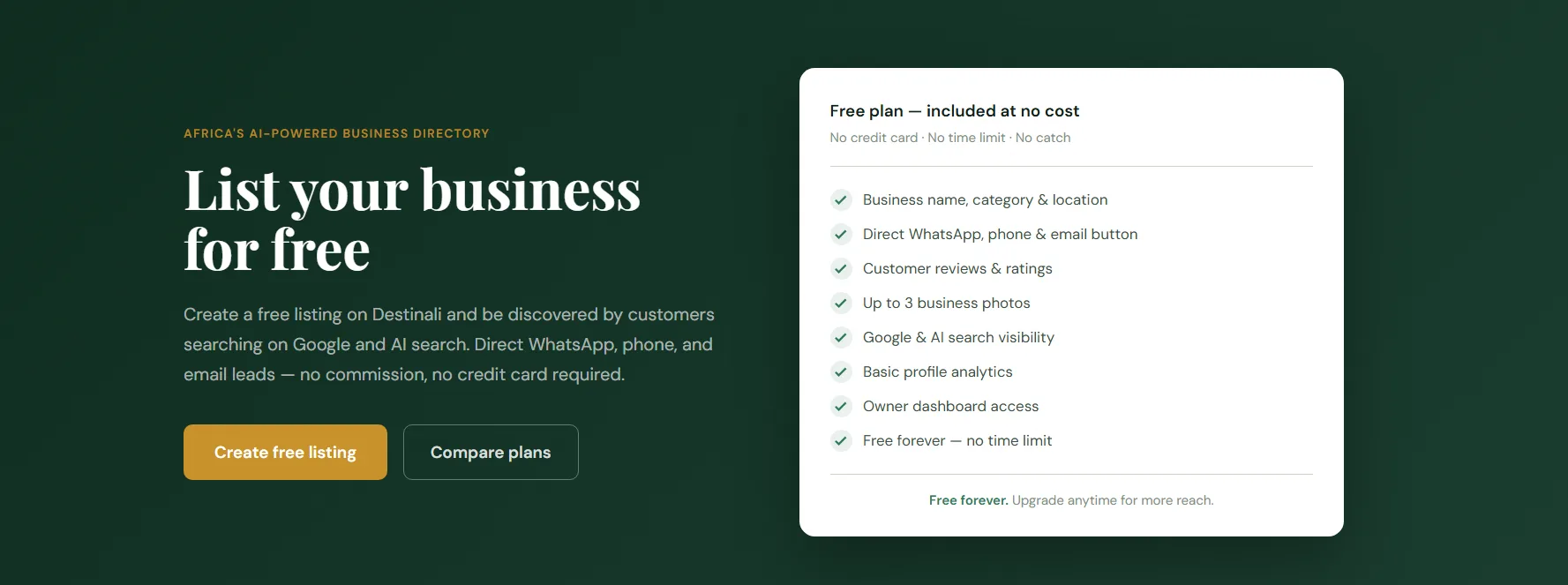
Getting listed on trusted directories strengthens your prominence signal. For African beauty businesses, useful directories include general platforms like Destinali, Facebook Business pages, and category-specific booking platforms relevant to your country and city.
Destinali lists over one million verified businesses across 54 African countries and 80+ categories, making it a practical starting point for salon owners looking to build a credible digital footprint across the continent. A listing there contributes to the citation signals that search engines use to rank local businesses.
The most important rule with directories: your NAP information must be identical on every platform. Submit accurate details once and audit them periodically.
Step 4: Use Location-Specific Keywords on Your Website
Keywords are the words and phrases people type into search engines. For a salon, the most valuable keywords combine your service with your location: "locs specialist in Kampala," "eyebrow threading in Sandton," or "bridal makeup artist Abuja."
Using these phrases naturally across your website tells search engines exactly who you serve and where. Place them in your page titles, your service descriptions, and the main headings on your homepage.
Avoid the mistake of cramming keywords unnaturally into text. Write for the client first. A sentence like "Our Nairobi salon specializes in natural hair care, from twist-outs to full protective styles" serves both purposes: it reads clearly and signals location and services to search engines.
Salons with multiple service types benefit from creating separate pages for each major service. A dedicated page for "bridal hair in Accra" will rank more effectively for that search than a general services page that mentions it in passing. The same principle applies to businesses in other service industries – restaurants, clinics, and law firms and professional services all use dedicated service and location pages to appear in specific local searches.
Step 5: Collect and Manage Client Reviews
Reviews are one of the most powerful ranking signals for local businesses. A salon with 50 positive reviews will consistently outperform one with five, even if the second salon has a better website. Beyond rankings, reviews build the trust that converts a search into a booking.
According to data cited by Clicks Geek, 88% of potential clients will skip a salon with less than a four-star rating on Google. That figure makes reviews a commercial priority, not just a reputation concern.
Build a simple system for collecting reviews. Ask satisfied clients before they leave. Send a follow-up message with a direct link to your Google review page. Make it easy. Most clients are willing to leave a review – they just need to be asked and given the shortest possible path to do it.
Respond to every review. Thank clients for positive feedback. Address concerns in negative reviews professionally. Search engines notice engagement, and potential clients read these responses closely.
Step 6: Make Sure Your Website Works on Mobile
Most people searching for a salon are using a smartphone. A website that loads slowly or is difficult to navigate on a small screen loses those visitors before they have a chance to become clients.
Mobile traffic now accounts for more than 58% of global internet traffic. A mobile-friendly website is not optional for salons competing in local search. Google uses mobile performance as a ranking factor, meaning a slow or poorly formatted site will rank lower than a faster, cleaner competitor.
Practical checks for your salon website: ensure pages load in under three seconds, text is readable without zooming, buttons are easy to tap, and your phone number is clickable so a visitor can call with one touch. These are achievable improvements even for small businesses without a dedicated web team.
How AI Search Is Changing Local Discovery
Search behavior is shifting. Platforms like ChatGPT, Perplexity, and Google's AI-powered search features now answer local queries directly, recommending specific businesses by name rather than simply showing a list of links. When someone asks "which salon in Cape Town does keratin treatments?", an AI tool may generate a direct answer based on the content and signals it finds online.
Salons that get cited by AI search tools need the same foundations as traditional local SEO – accurate listings, strong reviews, consistent information, and clear service descriptions but they also need content that is structured in a way AI systems can extract and repeat. That means writing plainly, defining services clearly, and being specific about location and expertise.
This is where local SEO and AI visibility begin to overlap. The salons that invest in their digital presence now will be the ones AI tools recommend tomorrow.
FAQ
What Is Local SEO for Salons?
Local SEO for salons is the process of improving how easily a salon appears in search results when nearby clients look for beauty services. It involves optimizing a Google Business Profile, keeping business information consistent across platforms, collecting client reviews, using location-specific keywords on the salon website, and building listings across trusted directories. The goal is to appear prominently when someone searches for a salon in a specific city or neighborhood.
How Long Does Local SEO Take to Show Results?
Most salons begin seeing meaningful improvements in local rankings within three to six months of consistent effort. Google Business Profile updates – such as adding photos, responding to reviews, and completing all profile fields – can produce visible results in a matter of weeks. Local SEO is a compounding strategy: the work done in the first few months builds a foundation that grows stronger over time.
Do I Need a Website to Rank Locally as a Salon?
A website helps, but it is not the only factor. A fully optimized Google Business Profile with accurate information, strong reviews, and regular photo updates can generate significant local visibility without a website. That said, a website with dedicated service pages and location-specific content gives a salon more opportunities to appear in a wider range of relevant searches.
Why Are Online Reviews so Important for Salon SEO?
Reviews are a direct ranking signal for local search results. Search engines treat a high volume of positive reviews as evidence that a business is trusted and actively serving clients. Salons with consistent four-star and five-star reviews appear more prominently in local results and in the map listings that appear at the top of Google searches. Reviews also influence whether a visitor decides to book – a strong review profile converts search visibility into actual appointments.
What Keywords Should a Salon Use for Local SEO?
The most effective keywords for salons combine a specific service with a location – for example, "natural hair salon in Nairobi" or "nail technician in Lekki." These phrases match how clients actually search when they are ready to book. A salon should identify its most profitable services and pair each one with the city, district, or neighborhood it serves. Using these phrases naturally in page headings, service descriptions, and the Google Business Profile helps search engines match the salon to relevant local queries.
How Does NAP Consistency Affect My Salon's Ranking?
NAP – Name, Address, and Phone number – consistency means your business details are identical across every platform where your salon appears. Search engines compare your information across Google, directories, social media, and other sites to verify your business is legitimate and correctly located. Even small differences, such as an abbreviated street name on one platform and the full name on another, create conflicting signals that reduce your ranking. Auditing and correcting these inconsistencies is one of the fastest ways to improve local search performance.
The Bottom Line
- Local SEO helps salons appear when nearby clients search for beauty services – it drives real bookings without ongoing ad spend
- A fully completed and regularly updated Google Business Profile is the single most important step for local visibility
- NAP consistency across every online platform is essential – even small differences in your business name or address hurt rankings
- Location-specific keywords on your website help search engines match your salon to relevant local searches
- Client reviews are a direct ranking signal and a trust signal for potential clients; building a steady review system is a commercial priority
- AI-powered search tools are increasingly recommending specific local businesses – the salons with clear, structured, consistent digital presences will be cited first
Salon owners across Africa ready to improve their discoverability online can create a free listing on Destinali and start building the local presence that brings clients to the door.