What Is Local SEO and How Does It Work?
Local SEO is the process of improving your business visibility in location-based search results, such as “restaurant near me,” “dentist in Lagos,” or “hotel in Kigali.” Local SEO works by helping search engines, maps, directories, and AI search tools understand what your business does, where you operate, and why customers should trust you.
Local SEO is search engine optimization focused on helping a business appear when people search for products or services in a specific city, neighborhood, or service area.
For African small and medium-sized businesses, local SEO matters because many customers now discover businesses through Google Search, Google Maps, business directories, review platforms, and AI assistants before making contact. A clinic in Lagos, a salon in Nairobi, a hotel in Accra, or a law firm in Cape Town needs more than a website. The business needs accurate listings, strong reviews, useful local content, and trusted business data across the web.
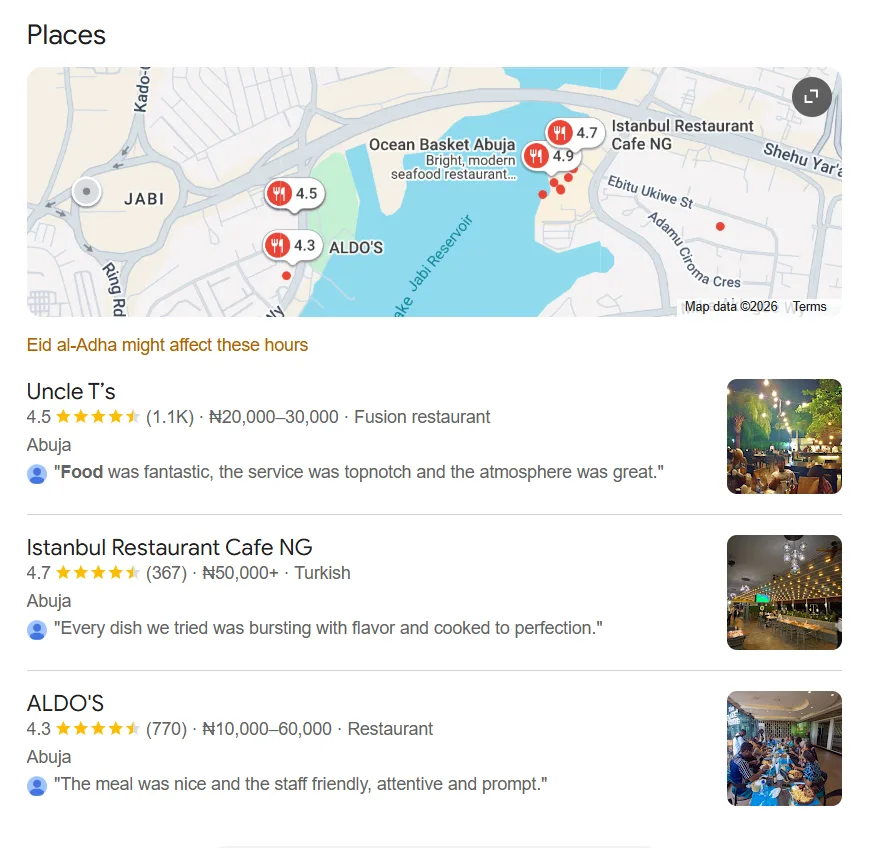
How Does Local SEO Work?
Local SEO works by connecting three signals: relevance, distance, and prominence. BrightLocal describes these as core parts of Google’s local search algorithm, and the same logic applies across maps and discovery platforms.
Relevance means your business matches the customer’s search. A customer searching “emergency plumber in Abuja” should find a plumbing company, not a general contractor. Distance means the business is near the searcher or serves the searched location. Prominence means the business appears credible through reviews, links, mentions, photos, and complete profile data.
Local SEO improves business discovery by making your location, services, reputation, and contact options clear to search systems and customers. A business with consistent information across Google, directories, maps, and trusted local platforms is easier to understand and recommend.
The main local SEO framework has five parts:
- Business data: Name, address, phone number, website, hours, and service areas.
- Search profiles: Google Business Profile, maps listings, and local directories.
- Local content: Pages and posts targeting city, area, and service keywords.
- Reputation signals: Reviews, ratings, responses, and customer trust.
- Authority signals: Citations, backlinks, mentions, and structured business data.
Step 1: Define Your Local Search Goals
Start by deciding which searches should bring customers to your business. A local SEO campaign fails when a business targets broad keywords instead of real buying intent in a specific location.
A restaurant may target “best lunch in Victoria Island,” while a clinic may target “family clinic in Ikeja.” A real estate agency may target “apartments for rent in Nairobi,” while a hotel may target “business hotel near Accra airport.” These searches combine a service, product, or category with a location.
To define your local search goals, write down:
- Your main services or products.
- Your city, town, district, or neighborhood.
- Nearby landmarks customers use.
- Customer problems that lead to bookings or calls.
- Search phrases customers might type before contacting you.
Local SEO works best when the target keyword reflects how customers actually search, not how the business describes itself internally. For example, customers may search “AC repair in Lagos” instead of “HVAC maintenance provider.”
Destinali supports this discovery process for African businesses through structured business visibility across 54 African countries, with more than 1M verified businesses and 80+ categories that help customers compare and contact local providers. A strong local SEO package can also create trusted content assets that point customers and search systems back to a business profile, website, product, or service.
Step 2: Optimize Your Google Business Profile
Your Google Business Profile is one of the strongest assets for local SEO because Google uses the profile in Google Search, Google Maps, and the local pack. According to Semrush, local SEO can help a Google Business Profile rank higher in map-based results.
Complete every important field in your profile. Add your exact business name, category, address, phone number, website, hours, services, business description, opening date, photos, and service areas. Choose the most accurate primary category because category selection affects relevance.
To optimize your profile, follow these steps:
- Claim or verify the business profile.
- Select the best primary category.
- Add secondary categories only when accurate.
- Use the same phone number and address shown on your website.
- Upload real photos of your premises, staff, products, or work.
- Add services with clear descriptions.
- Keep holiday hours and special hours updated.
A complete Google Business Profile helps customers make quick decisions because the profile can show calls, directions, reviews, photos, and opening hours in one place.
Step 3: Make Your Business Information Consistent Everywhere
Search engines compare your business details across the web. Inconsistent information creates doubt, especially when one directory shows an old phone number and another shows a different address.
Build and clean citations on platforms relevant to your market. For many African businesses, that can include Google Business Profile, Facebook, Instagram, industry directories, tourism platforms, professional associations, chamber listings, and local discovery sites.
A clinic listing such as Shogunle Health Clinic shows why structured local data matters: customers need location, category, and contact clarity before they trust a health provider. The same principle applies to law offices, restaurants, hotels, salons, real estate firms, and repair services.
Use one standard format for your business details. “12 Allen Avenue, Ikeja” should not become “12 Allen Ave, Lagos” on another platform unless the format still clearly identifies the same location.
Step 4: Research Local Keywords Customers Actually Use
Local keyword research means finding the exact phrases people use when searching for businesses like yours in your area. Mailchimp explains that local SEO targets proximity and geographic relevance, which makes city and neighborhood language important.
Start with simple combinations:
- Service plus city: “wedding photographer in Nairobi.”
- Service plus neighborhood: “salon in East Legon.”
- Service plus “near me”: “dentist near me.”
- Problem plus location: “blocked drain repair in Lagos.”
- Best or top plus category: “best hotel in Kigali.”
Do not chase only high-volume keywords. A phrase such as “immigration lawyer in Cape Town” may bring fewer searches than “lawyer,” but the searcher has clearer intent. Local SEO usually produces better leads when keywords match a specific service and place.
Use keyword research to plan pages, profile descriptions, service categories, FAQ answers, and business descriptions. A business targeting “local SEO GMB marketing in Lagos” can strengthen discovery with a specific city-based profile such as Lagos local marketing.
Step 5: Build Local Landing Pages for Your Services
A local landing page is a page on your website that explains one service in one specific location. Local landing pages help search engines understand where your business operates and what customers can contact you for.
A useful local landing page should include:
- A clear service title with the location.
- A short explanation of who the service helps.
- Specific neighborhoods or areas served.
- Contact details and opening hours.
- Customer proof, reviews, or project examples.
- Frequently asked questions.
- A clear call button for calls, WhatsApp, bookings, or directions.
Avoid copying the same page for every city and changing only the location name. Duplicate city pages look weak to search engines and unhelpful to customers. A page for “AC repair in Ikeja” should mention real service issues, local response times, common building types, and customer needs in that area.
Local landing pages improve visibility because each page gives search engines a focused answer for one service and one market.
Step 6: Collect and Respond to Customer Reviews
Reviews are one of the most visible trust signals in local SEO. Customers often compare ratings, review count, review recency, and owner responses before calling a business.
Ask satisfied customers to leave reviews after a completed service, meal, stay, appointment, or purchase. Make the request simple. Use a direct review link, a QR code at the reception desk, a WhatsApp message, or a follow-up email.
Respond to reviews in a professional tone. Thank positive reviewers and mention the service naturally. For negative reviews, acknowledge the issue, stay calm, and offer a practical next step. A good response shows future customers that the business takes feedback seriously.
Review management improves local SEO because active, recent, and credible customer feedback helps search platforms measure trust and customer satisfaction. A legal service listing such as Legal Aid SA Athlone also shows how important category and location clarity can be when customers compare serious service providers.
Step 7: Add LocalBusiness Schema to Your Website
Structured data helps search engines read business information in a machine-friendly format. LocalBusiness schema can describe your business name, address, phone number, opening hours, logo, website, reviews, and service area.
LocalBusiness Schema is structured data that tells search engines the official details of a local business in a standardized format.
Schema does not replace visible website content. Schema supports local SEO by confirming the business details already shown on the page.
Add LocalBusiness schema to your homepage, contact page, and key location pages. Use the most accurate business type where possible, such as Restaurant, Hotel, MedicalClinic, LegalService, RealEstateAgent, or LocalBusiness. Keep schema details consistent with your Google Business Profile and directory listings.
Structured business data also matters as AI search grows. AI systems prefer clear, verified, well-organized information when answering local recommendation questions.
Step 8: Build Local Authority Through Mentions and Links
Local authority grows when credible websites mention or link to your business. These signals help search engines understand that the business is active, known, and relevant in a specific market.
Useful local authority sources include:
- Local newspapers and media mentions.
- Industry associations.
- Event sponsorship pages.
- Hotel, tourism, or restaurant guides.
- Supplier and partner websites.
- Business directories.
- Review and comparison content.
A hotel in Zanzibar, a restaurant in Lagos, or a tour company in Arusha can earn mentions from tourism websites, travel blogs, local event pages, and hospitality directories. A clinic or law firm can earn authority through professional associations and community service mentions.
Local backlinks work best when the linking page is relevant to your category, city, or customer need. One trusted local mention can be more useful than dozens of low-quality directory links.
Step 9: Track Calls, Directions, Website Visits, and Leads
Local SEO should produce business outcomes, not only rankings. Track the actions that matter: calls, WhatsApp messages, contact form submissions, direction requests, bookings, and website visits.
Measure performance monthly. Look for changes in:
- Google Business Profile views.
- Phone calls and direction requests.
- Website clicks from local search.
- Ranking for priority local keywords.
- Review count and average rating.
- Leads by city, service, or category.
Local SEO is working when more qualified customers find and contact the business from local search and discovery platforms. Rankings matter, but revenue signals matter more.
Review the data and improve weak areas. Low profile views may mean poor keyword relevance. Low calls may mean weak photos, weak reviews, or unclear services. Low conversions may mean customers cannot quickly contact you.
What Is the Difference Between Local SEO and Traditional SEO?
Local SEO targets customers in a defined area, while traditional SEO targets broader search visibility that may not depend on location. A national blog can rank for “how to choose a mattress,” but a furniture store in Accra needs to rank for “mattress store in Accra.”
| Feature | Local SEO | Traditional SEO |
|---|---|---|
| Main Goal | Attract nearby or area-specific customers | Rank for broader topics or keywords |
| Key Search Results | Maps, local pack, directories, local pages | Organic website listings |
| Important Signals | Distance, reviews, citations, business profiles | Content depth, backlinks, technical SEO |
| Best For | Restaurants, clinics, salons, hotels, agencies, local services | Publishers, SaaS, ecommerce, national brands |
| Conversion Action | Calls, directions, visits, WhatsApp, bookings | Signups, purchases, downloads, inquiries |
Local SEO and traditional SEO should work together for most businesses. A strong website supports local rankings, and strong local profiles help customers trust the business before they contact it.
Where Local SEO Is Heading Next
Local SEO is expanding beyond Google alone. Customers now discover businesses through maps, social search, directories, review platforms, comparison pages, and AI assistants.
AI search is especially important for African SMEs because customers increasingly ask tools for recommendations such as “best family hotel in Nairobi” or “reliable AC repair company in Lagos.” AI systems need structured business data, strong category signals, trusted mentions, and clear customer proof before recommending a business.
Business comparison content will also become more important. Customers want to compare “best,” “top,” “near me,” and “alternatives” before choosing a provider. Businesses that appear in trusted lists, reviews, and category pages gain extra visibility beyond their own websites.
The future of local SEO belongs to businesses that keep accurate data, build real trust, and make their services easy to understand across every discovery platform.
FAQ
What Is Local SEO in Simple Words?
Local SEO is the process of helping your business appear when nearby customers search online for your products or services. A restaurant, clinic, hotel, salon, lawyer, or repair company can use local SEO to show up in Google Maps, local search results, directories, and AI-powered recommendations.
Is Local SEO Worth It for Small Businesses?
Local SEO is worth it for small businesses because local searches often come from people ready to call, visit, book, or buy. A customer searching “emergency plumber near me” or “hotel in Kigali tonight” usually has stronger intent than someone reading a general article.
How Do Beginners Start Local SEO?
Beginners should start local SEO by claiming their Google Business Profile, fixing business information across directories, collecting reviews, and creating service pages for their main locations. These four actions help search engines understand the business and help customers trust the listing.
How Long Does Local SEO Take to Work?
Local SEO can start producing small improvements within a few weeks, especially after fixing profiles, citations, and reviews. Stronger results usually take three to six months because rankings depend on competition, location, content quality, review growth, and authority signals.
Does Local SEO Work Without a Website?
Local SEO can work without a website because Google Business Profile and local directories can appear in search results. A website still improves trust and gives the business more control over service pages, location pages, structured data, and lead conversion.
What Are Examples of Local SEO?
Local SEO examples include a dentist ranking for “dentist in Nairobi,” a restaurant appearing in Google Maps for “lunch near me,” or a hotel showing up for “business hotel in Accra.” Local SEO also includes directory listings, reviews, local landing pages, and city-based comparison content.
Is SEO Dead or Still Useful?
SEO is still useful because customers continue to search before choosing businesses, products, and services. SEO has evolved from keyword placement alone into a broader visibility practice that includes search engines, maps, reviews, structured data, and AI-powered discovery.
Next Steps
- List your top services and the cities or neighborhoods you serve.
- Complete and update your Google Business Profile.
- Make your business name, address, and phone number consistent everywhere.
- Build or improve local service pages on your website.
- Ask satisfied customers for reviews and respond professionally.
- Add structured business data to your website.
- Track calls, direction requests, WhatsApp leads, bookings, and website visits every month.
Local SEO works when your business becomes easy to find, easy to trust, and easy to contact. African businesses that invest in accurate listings, strong reviews, useful content, and structured visibility will be better positioned for both today’s local searches and tomorrow’s AI-powered recommendations.
Businesses that want stronger local discovery across search, maps, and AI results can Get Local SEO Pack to build trusted visibility assets that point customers back to their business.
Destinali helps local businesses improve online visibility, discoverability, and customer acquisition across search engines, AI systems, maps, and local search platforms.
List your business →