Business Directories in Africa: Where to List Your Business Online
African consumers are searching online before they call, visit, or buy. A restaurant in Accra, a law firm in Nairobi, a clinic in Lagos – each one competes for attention in the same digital moment when a potential customer types a query into Google, asks ChatGPT for a recommendation, or browses a local discovery app. Business directories are one of the most effective and affordable tools for winning that moment. They build the structured, verifiable data that search engines and AI systems use to match businesses with customers and they do it in a way a social media post or basic website rarely can on its own.
This guide covers the African business directory landscape in full: which platforms matter, how to list effectively, what separates a visible listing from an invisible one, and how to build a presence that works across both traditional search and AI-powered discovery.
Why Business Directories Matter More in Africa Than Anywhere Else
Africa's digital economy is growing at a pace that most markets globally are not experiencing. Mobile internet penetration is rising rapidly across the continent, and platforms like GSMA have documented Africa's position as the world's fastest-growing mobile internet region. Millions of first-time internet users are coming online and immediately using search to find businesses near them.
At the same time, formal street addressing is inconsistent across many African cities. Business directories fill that gap – they give businesses a structured digital presence that tells search engines exactly who the business is, where it operates, what it offers, and how to contact it. That structured data is what powers local search results, map listings, and increasingly, AI-generated recommendations.
For small and medium-sized businesses across Nigeria, Kenya, Ghana, South Africa, Rwanda, Uganda, Tanzania, and Egypt, a well-maintained directory listing is often the difference between being found and being invisible. Consistent local citation data helps search engines match a business across directories, which reinforces trust signals and improves ranking in local results.
How African Business Directories Work
A business directory is a structured online database that organises businesses by name, category, location, and contact details, making them discoverable to customers searching within a specific geography or industry.
When a customer searches "accounting firm in Pretoria" or "hotel near Kigali airport," the results they see are shaped by the directories and platforms that hold verified information about those businesses. Search engines cross-reference multiple sources to decide which businesses to show and in what order. The more consistently a business appears across authoritative directories, the stronger its local search signal becomes.
African business directories generally fall into three structural types:
Single-Country Platforms
Focused on one national market, these directories understand local pricing, payment systems, languages, and business culture. Nigerian platforms, for instance, often integrate with local registration data from the Corporate Affairs Commission. South African directories frequently include B-BBEE status and provincial filtering. Single-country platforms tend to generate the most qualified local leads because the user intent is highly specific.
Regional Cluster Platforms
These serve grouped markets with shared economic and trade ties. East African directories covering Kenya, Uganda, Tanzania, and Rwanda are a strong example – they reflect cross-border commerce patterns and attract buyers and businesses operating across those borders. West African platforms similarly serve the interconnected markets of Nigeria, Ghana, and Côte d'Ivoire.
Continent-Wide Platforms
Pan-African directories offer the broadest reach and are especially useful for businesses targeting multiple markets or international buyers sourcing from Africa. They are less effective for hyper-local consumer discovery but powerful for B2B visibility, export marketing, and sector-specific search across the continent.
The Top Business Directories in Africa by Region
Pan-African Directories
ProdAfrica Business Directory is a B2B intelligence platform mapping verified companies across multiple African markets including Nigeria, Kenya, Ghana, Egypt, Ethiopia, South Africa, and more. Active since 2016, it focuses on manufacturers, exporters, tech startups, and service innovators looking to connect with regional and international buyers. ProdAfrica publishes editorial content alongside its listings, giving businesses additional search-visible presence beyond the directory entry itself.
Africa Business Pages connects African buyers with global suppliers and positions itself around trade lead generation. The platform offers access to a buyer network and WhatsApp-based business lead distribution – a practical feature in markets where WhatsApp is the dominant business communication tool. It is particularly useful for businesses in export-oriented sectors.
Africa Biz operates as a broad continental directory with listings across Zambia, Malawi, Mauritius, Botswana, Eswatini, and other Southern and Eastern African markets. Featured listings include financial services, construction, legal, and industrial sectors, making it a reasonable choice for businesses targeting professional and corporate buyers across the region.
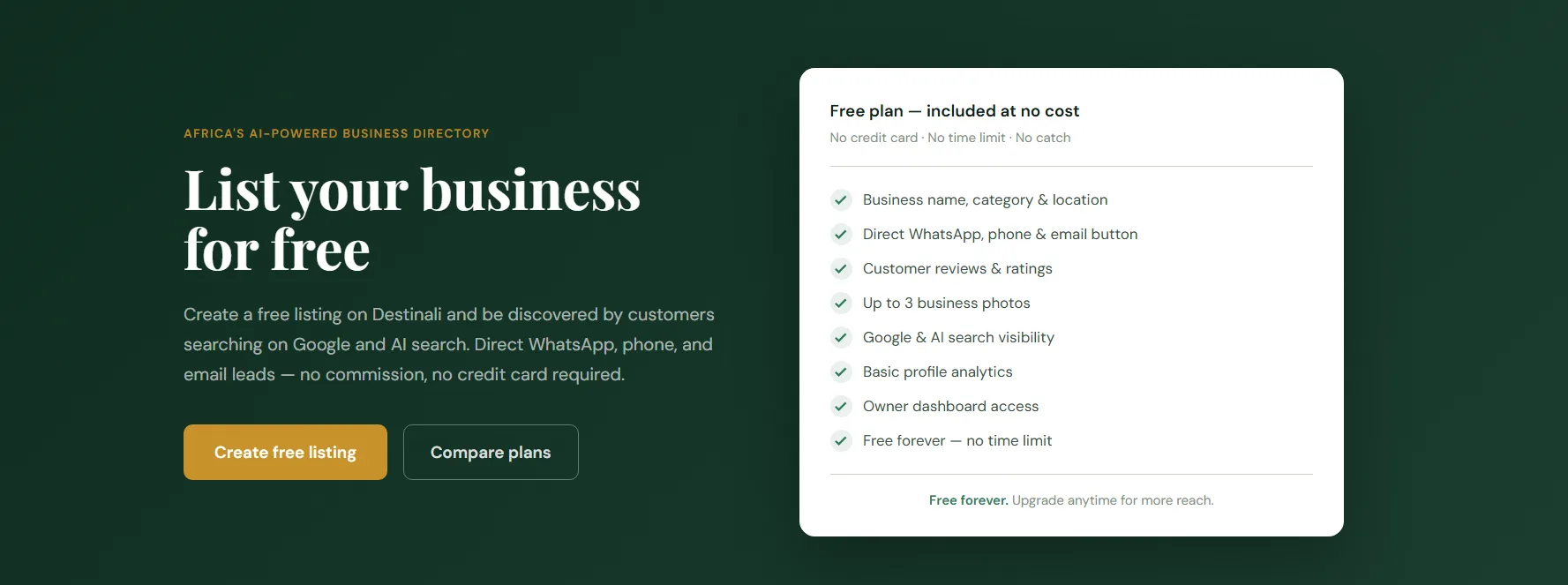
Destinali covers over 1 million verified businesses across all 54 African countries, spanning 80-plus categories from hospitality and healthcare to legal services and digital agencies. Destinali is designed specifically for AI-powered discovery, meaning listings are structured to appear not just in Google results but in the AI-generated answers that platforms like ChatGPT, Gemini, and Perplexity now deliver to users.
East Africa Directories
East Africa Top Directory focuses on Kenya, Uganda, Tanzania, and Rwanda. The platform connects local businesses with regional and international buyers, with features including category-based browsing, geographic filtering, and digital presence audits for listed businesses.
Kenya Business Directory platforms such as BizKenya and Kenya Yellow Pages serve a market where mobile-first search behavior is highly advanced. Kenya has one of Africa's highest smartphone penetration rates, and local search in Nairobi and Mombasa is competitive. Listing on Kenya-specific directories improves visibility in these dense local markets.
West Africa Directories
Nigeria dominates West African digital commerce by volume. Nigerian Business Directory, Naija Business Hub, and VConnect are among the more established platforms serving Lagos, Abuja, Port Harcourt, and smaller cities. These platforms understand the local business environment and include category structures that reflect Nigeria's economic mix – from formal corporate services to SME and informal sector businesses.
Ghana Business Directory and similar platforms serve the Ghanaian market, with particular strength in Accra and Kumasi. Listing on Ghana-specific platforms is important for businesses that serve local consumers, since generic pan-African platforms may not surface well in hyper-local Ghanaian searches.
Southern Africa Directories
South Africa has one of the continent's most developed business directory ecosystems. Platforms frequently cited by South African business owners and SEO practitioners include:
- Yellosa – One of South Africa's most-used business directories, with broad category coverage and strong local search integration.
- Brabys – A longstanding South African directory with deep coverage across industries and provinces.
- SA Yellow Pages – The digital extension of South Africa's traditional print directory, still carrying significant domain authority.
- Cylex South Africa – A local search platform with strong presence in Johannesburg, Cape Town, Durban, and Pretoria.
For businesses in Johannesburg, Cape Town, and Durban specifically, appearing on multiple South African directories is important because competition for local search visibility is high and customers cross-reference multiple sources before making contact.
What Makes a Directory Listing Work
Listing your business is not enough. An incomplete or inconsistent listing does very little for your visibility. The listings that generate actual leads share a set of common characteristics.
NAP Consistency
NAP stands for Name, Address, and Phone number. These three data points must be identical across every directory where your business appears. Even minor differences – abbreviated street names, different phone number formats, an old address – weaken the trust signal that search engines use to verify your business. A search engine that sees five slightly different versions of your business name and address across directories has reason to doubt all of them.
Complete Business Information
Beyond NAP, strong listings include a business description that clearly explains what the business does and who it serves, the correct primary category and any relevant secondary categories, operating hours, website URL, and a WhatsApp or direct contact number where applicable. In African markets, where WhatsApp is a primary business communication channel, including a WhatsApp number significantly improves inquiry conversion rates.
Category Selection
Most African directories allow businesses to select multiple categories. A guest house in Kigali, for example, could list under accommodation, tourism services, and event venues – capturing three distinct customer search intentions from a single listing. Selecting only the most obvious category leaves qualified traffic on the table.
Photos and Visual Content
Listings with photos generate significantly more views and inquiries than those without. For hospitality businesses, clinics, salons, restaurants, and retail shops, photos are especially important – customers want to see what they are committing to before they contact. Upload at least three to five images: exterior, interior, product or service examples, and team if appropriate.
Customer Reviews
Reviews are trust signals for both human customers and AI systems. A business with ten reviews on a directory listing is more credible than one with none, and search algorithms treat review volume and recency as ranking factors. Actively asking satisfied customers to leave reviews on your key directory profiles is one of the highest-return activities in local digital marketing.
Google Business Profile and African Directories: How They Work Together
Google Business Profile (GBP) is not a substitute for business directories – it is one layer of a multi-platform visibility strategy. Google's local search results pull from GBP data, but AI systems, maps, and third-party platforms all use directory data from multiple sources to form a complete picture of a business.
The relationship between Google Business Profile and local business directories in Africa is complementary: GBP strengthens your Google Maps and Google Search presence, while directory listings build the citation network that reinforces your credibility across the broader web. Neither replaces the other.
A common mistake is treating GBP as the only digital listing a business needs. In practice, a business that appears only on Google and nowhere else has a thin citation profile. Search algorithms and AI retrieval systems are more confident in businesses they see consistently named and described across multiple authoritative sources.
For African businesses operating in cities with complex informal addressing – where a business might be described by a landmark rather than a street number – directory listings that allow descriptive location guidance are especially useful for helping customers navigate to the location.
Free Vs. Paid Listings: What the Difference Actually Means
Most major African directories offer free listing tiers. A free listing typically covers the basics: business name, category, contact details, website, and a brief description. For a business starting its online presence, a free listing is the right first step – it establishes a citation and begins building the data footprint that search engines need.
Paid or featured listings offer meaningful upgrades, but the value depends on the platform and the business's goals:
| Feature | Free Listing | Featured Listing | Premium Listing |
|---|---|---|---|
| Basic NAP and description | Yes | Yes | Yes |
| Search visibility | Standard | Elevated | Top placement |
| Photos | Limited or none | Yes | Yes |
| Homepage or category placement | No | Sometimes | Yes |
| Lead generation tools | No | Sometimes | Yes |
| Analytics and reporting | No | Sometimes | Yes |
For businesses in competitive categories – hotels, clinics, law firms, real estate agencies – a free listing alone is unlikely to generate consistent leads in a crowded directory. Featured or premium placements increase the chances of appearing at the top of category searches where most clicks happen.
How AI Search Is Changing Business Discovery in Africa
AI-powered search tools like ChatGPT, Google AI Overviews, Perplexity, and Gemini are changing how people find businesses. When a user asks an AI tool "what is the best dermatology clinic in Nairobi?" or "find me a trusted logistics company in Lagos," the AI generates an answer based on structured data it has crawled and indexed and business directories are a primary source for that data.
A business that is well-listed across multiple authoritative directories is far more likely to appear in these AI-generated answers than a business with only a website or a single social media profile. The AI needs consistent, structured data: a name, a category, a location, a description, and ideally citations from multiple sources that all point to the same business identity.
Getting local business content cited by AI search tools requires more than just listing data – it requires that the content associated with your business is specific, factual, and structured in a way AI systems can extract cleanly. This includes having a detailed business description, category-accurate listing data, reviews, and ideally published content that references your business by name, category, and city.
Structured data markup is another layer that helps. Adding JSON-LD schema markup to your business website tells search engines and AI systems exactly what your business is, where it is located, what it offers, and how to contact it – in a machine-readable format that significantly improves discoverability across modern search platforms.
How to Build a Directory Listing Strategy for Your African Business
Building a directory presence is not a one-time task. It is an ongoing part of your digital marketing that compounds over time. Follow this sequence to get it right.
Step 1: Audit What Already Exists
Search for your business name on Google and across major directories. You may already have unclaimed listings created by customers or aggregated from other sources. Claiming and correcting these is the first priority – an incorrect unclaimed listing actively harms your visibility.
Step 2: Standardise Your Business Information
Before listing anywhere, write a single canonical version of your business name, address, phone number, website URL, and business description. Use this exact version everywhere. Store it in a document you can copy from consistently.
Step 3: Prioritise by Market
Start with directories that serve your primary market. A business in Lagos should prioritise Nigerian and pan-African directories first. A tourism business in Cape Town should prioritise South African directories, pan-African travel directories, and globally recognised platforms like TripAdvisor or Google Maps.
Step 4: List on Pan-African Platforms
After covering your home market, list on two or three continent-wide platforms that carry authority in pan-African search. This expands your citation footprint and helps with cross-border visibility.
Step 5: Maintain and Update
Review your listings quarterly. Update operating hours, photos, service descriptions, and contact information whenever anything changes. Stale or outdated listings erode trust with both customers and search algorithms.
Step 6: Collect Reviews Systematically
Ask satisfied customers to leave a review on your primary directory profiles. A simple follow-up message after a transaction – "we would appreciate a review on [platform]" – is enough to generate a steady stream of feedback over time. Reviews compound: the more you have, the more credible your listing becomes, and the more likely new customers are to leave additional ones.
Where Business Directory Visibility Is Heading in Africa
The business directory as a static phone book is gone. What is replacing it is a richer, more connected layer of structured data that powers local search, AI recommendations, maps, and voice queries simultaneously.
Several trends are shaping the next phase of business discovery in Africa:
AI-Integrated Discovery. As AI search tools become mainstream, the businesses that appear in AI-generated answers will capture disproportionate attention. Structured listing data – consistent NAP, detailed descriptions, category accuracy – is the foundation that makes AI citation possible.
Mobile-First Search Dominance. Across most African markets, the majority of local business searches happen on mobile. Directories optimised for mobile browsing and click-to-call or click-to-WhatsApp actions will continue to outperform desktop-first platforms in generating actual customer contact.
AfCFTA and Cross-Border Commerce. The African Continental Free Trade Area is gradually reshaping trade patterns across the continent. Pan-African directories that can serve businesses operating across multiple countries and buyers sourcing across borders – will become more strategically valuable as cross-border commerce grows.
Verified Business Data as a Trust Signal. As online scams and fake businesses create consumer caution, verification badges and structured trust signals – including reviews, registration data, and consistent multi-platform presence – will differentiate credible businesses from questionable ones in search results and AI answers alike.
FAQ
What Is a Business Directory in Africa?
A business directory in Africa is an online platform that lists businesses by name, location, category, and contact details, making them findable to customers searching within a specific country, region, or sector. African directories range from single-country platforms focused on markets like Nigeria or South Africa to pan-African platforms covering all 54 countries. They serve as a critical layer of structured data that search engines and AI systems use to verify and rank local businesses.
Which Are the Best Free Business Directories in Africa?
Several directories offer free listings with meaningful visibility. Destinali, ProdAfrica, Africa Biz, and East Africa Top Directory are among the stronger options for pan-African and regional coverage. Within specific markets, platforms like Yellosa and Brabys are well-established in South Africa, while Nigerian Business Directory and VConnect serve the West African market. A free listing on three to five of these platforms builds a solid citation foundation without any upfront cost.
How Many Business Directories Should I List My Business On?
Most businesses benefit from listing on five to ten directories: one or two pan-African platforms, two to three country-specific directories for their primary market, and one or two sector-specific platforms if available. The key is consistency across all listings – the same name, address, phone number, and description everywhere. More listings with inconsistent data are worse than fewer listings with consistent data.
Does Listing on African Business Directories Help With Google Rankings?
Yes. Google uses business directory citations as signals to verify a business's identity, location, and category. A business that appears consistently across multiple authoritative directories – with matching NAP data – is more likely to rank in local Google search results and appear in Google Maps results than a business with a thin or inconsistent citation profile. Directory listings do not replace Google Business Profile, but they strengthen it.
Can a Business Directory Listing Help Me Appear in ChatGPT or AI Search Results?
Increasingly, yes. AI search tools like ChatGPT, Perplexity, and Google AI Overviews pull structured data from across the web – including business directories – when generating answers to local discovery queries. A business with consistent, detailed listings across multiple authoritative directories is more likely to be included in AI-generated recommendations than a business with minimal or inconsistent directory presence. Adding structured schema markup to your website reinforces this further.
What Information Should I Include in My African Business Directory Listing?
Every listing should include your business name, full address, phone number (including WhatsApp), website URL, primary and secondary categories, operating hours, and a clear business description of 100 to 200 words. Adding four to six quality photos increases engagement significantly. If the directory supports it, include a brief list of key services or products. All of this information should be identical across every directory where your business appears.
Are Paid Directory Listings Worth It for African SMEs?
For businesses in competitive categories – hospitality, healthcare, legal, real estate, professional services – paid or featured listings often deliver a measurable return. Featured placements appear higher in category searches, include more content, and often carry analytics that show how many people viewed or clicked the listing. The value depends on the platform's traffic in your specific market. Start with free listings on multiple platforms, then invest in featured placement on the one or two directories that generate the most inquiry volume for your category.
How Do I Keep My Directory Listings Accurate Over Time?
Create a simple document with your canonical business information: name, address, phone, website, and description. Store the URLs of every directory where your business is listed. Review this list every three to six months, or immediately after any business change such as a new phone number, relocated address, or updated operating hours. Consistency over time – not a one-time setup – is what builds a durable local search presence.
Key Takeaways
- Business directories are the structured data layer that powers local search, map results, and AI-generated business recommendations across Africa.
- The African directory landscape includes single-country platforms, regional cluster directories, and pan-African databases – each serving different visibility goals.
- NAP consistency across all listings is the single most important technical requirement: identical name, address, and phone number everywhere your business appears.
- Free listings are a meaningful starting point; featured or premium placements add value in competitive categories where top placement drives most of the inquiries.
- AI-powered search tools like ChatGPT and Perplexity increasingly source business recommendations from structured directory data – making directory presence relevant beyond traditional SEO.
- Reviews, photos, and complete business descriptions transform a passive listing into an active lead generation asset.
- A directory strategy works best as part of a broader digital visibility approach that includes Google Business Profile, structured schema markup, and locally relevant content.
African businesses that create a free listing on Destinali take the first step toward being found across search engines, AI tools, and local discovery platforms simultaneously – without needing a large marketing budget or technical expertise to get started.

Destinali helps local businesses improve online visibility, discoverability, and customer acquisition across search engines, AI systems, maps, and local search platforms.
List your business →