Local Rank Tracking Tools Compared: What to Look for Before You Commit
Most local businesses assume that if they show up on Google, they are visible. They are not. Local search rankings shift block by block, neighborhood by neighborhood and a tool that reports your average national position tells you almost nothing about what a customer two streets away actually sees. Choosing the wrong rank tracker means making expensive decisions on incomplete data. This comparison cuts through the noise to show you which features matter, which tools deliver them, and which tool fits your business size and budget.
What Makes Local Rank Tracking Different
Standard rank tracking tools report a single average position for a keyword across a broad geography. Local rank tracking works differently because local search itself works differently.
Google's local rankings change based on the exact GPS coordinates of the person searching. A restaurant might appear first when someone searches from a block away, and drop to seventh position for someone searching from the next neighborhood. The same keyword, different location, completely different result. This is why local rank tracking tools use geo-grid technology: they simulate searches from a grid of coordinates spread across your service area, not from a single central point.
Local rank trackers also monitor three distinct search surfaces separately: organic results, the Local Pack (the map-based top-three listings), and Google Maps. Your performance varies across all three. A business can rank well in organic search while being entirely absent from the Local Pack – which matters enormously, because the Local Pack captures roughly 44% of all clicks in local search results.
For businesses across African markets, the US, UK, Canada, Australia, and the Philippines, this granularity is especially valuable. City-based searches in Lagos, Nairobi, Accra, or Johannesburg behave just as hyperlocally as searches in London or Toronto. A clinic in Lekki is not competing for the same search results as a clinic in Victoria Island, even if both serve Lagos.
The Five Features That Separate Good Tools From Basic Ones
Before comparing specific tools, it helps to know what you are actually evaluating. These five features determine whether a rank tracker will genuinely serve a local business or just produce numbers that feel useful but are not.
Geo-Grid Scanning
This is the foundational feature. The tool must simulate searches from real GPS coordinates distributed across a grid covering your service area. Grid size matters: a 3×3 grid gives you nine data points; an 11×11 grid gives you 121. Denser grids reveal more granular blind spots. For small businesses with a tight service radius, a 5×5 or 7×7 grid is usually sufficient. Agencies managing multi-location clients need larger grids and the ability to customize radius and spacing.
Scan Frequency
Some tools update rankings daily, others weekly or monthly. Frequency affects how quickly you can detect and respond to ranking changes. For businesses actively running local SEO campaigns, weekly scans are a minimum. Daily scans are valuable for competitive markets or businesses tracking the impact of recent changes to their Google Business Profile.
Keyword Volume and Flexibility
Entry-level tools limit you to five or ten keywords per location. This is workable for a single-location small business but restrictive for service providers targeting multiple service types or areas. Agencies need tools that support dozens of keywords per location without steep per-keyword pricing.
Reporting Quality
Visual reports that translate grid data into color-coded heatmaps are far more useful than raw position tables – both for your own analysis and for communicating results to clients or stakeholders. White-label reporting capability is essential for agencies. Share of Local Voice (SoLV), a single score measuring how often your listing appears across all grid points, is a particularly useful metric for tracking progress over time.
Pricing Model
Tools price by scan credits, keyword volume, locations, or flat monthly subscription. Credit-based pricing gives flexibility but makes costs unpredictable. Subscription pricing is easier to budget. For small businesses, the right pricing model is as important as the feature set.
Quick Overview: How the Main Options Compare
| Factor | Dedicated Geo-Grid Tools (e.g., Local Falcon, BrightLocal) | All-in-One Local SEO Platforms (e.g., Semrush, SE Ranking) | SMB-Focused Tools (e.g., Destinali Local Rank Tracking) |
|---|---|---|---|
| Geo-grid scanning | Core feature, highly customizable | Available, often secondary to broader suite | Available, built for simplicity |
| Grid size options | Up to 21×21 | Typically 5×5 to 9×9 | Designed for local service areas |
| Scan frequency | On-demand or scheduled | Weekly to daily | Scheduled, practical for SMBs |
| Keyword volume | High (agency-grade) | High, but costly at scale | Moderate, suited to single-location businesses |
| GBP integration | Strong | Strong | Included with listing management |
| White-label reporting | Yes | Yes | Limited or not applicable |
| Pricing model | Credit-based or subscription | Subscription (premium) | Affordable flat pricing |
| Best for | Agencies, SEO professionals | Agencies managing full SEO campaigns | Small businesses, local service providers |
| Citation and NAP tools | Separate purchase | Separate or add-on | Bundled in some plans |
The Tools: An Objective Head-to-Head
Local Falcon
Local Falcon introduced geo-grid rank tracking in 2018 and remains the benchmark for dedicated grid tools. It scans Google Maps rankings from precise coordinates and generates heatmaps showing where a business is visible and where it disappears across a service area.
Ten grid sizes ranging from 3×3 to 21×21 give users precise control over coverage density. The SoLV metric condenses grid performance into a single trackable number, making month-over-month comparisons straightforward. Falcon AI provides automated recommendations for underperforming grid areas rather than just reporting the problem.
Local Falcon now scans Apple Maps and major AI search platforms including ChatGPT and Perplexity, which matters as AI-powered discovery becomes a meaningful part of how customers find local businesses. Tools that help businesses track their local business visibility in AI search results are increasingly relevant as search behavior shifts.
Pricing is credit-based, meaning each scan consumes credits depending on grid size and frequency. This model works well for agencies running scans on demand but can feel unpredictable for small business owners who prefer flat monthly costs.
Best for: SEO agencies and professionals who need maximum grid customization and the most detailed geo-grid data available.
BrightLocal
BrightLocal offers two distinct tools within one platform: a Local Rank Tracker (LRT) for keyword-by-keyword position tracking across cities and neighborhoods, and a Local Search Grid (LSG) for geo-grid visualization. Most local SEO practitioners use both together.
Setup is structured and beginner-friendly. You enter your business location, select keywords, optionally add up to four competitors, and set reporting frequency. The platform covers Google organic, Google Maps, and Bing. White-label reporting is well-developed, making BrightLocal a practical choice for agencies that need client-ready outputs without heavy customization effort.
BrightLocal does not include citation management or NAP tools within the rank tracking plans, so businesses that need a full local visibility stack will need to purchase those separately.
Best for: Agencies that want structured, clean rank tracking with strong white-label reporting, and the option to add citation and GBP audit tools from the same provider.
Semrush (Map Rank Tracker)
Semrush is a full-suite SEO platform with a geo-grid Map Rank Tracker added to its local SEO feature set. The advantage is consolidation: keyword research, content analysis, backlink data, and local rank tracking sit in one dashboard. For agencies managing broad SEO campaigns alongside local visibility, this reduces tool sprawl.
The Map Rank Tracker provides visual heatmaps and competitor comparison. GBP integration allows profile management within the platform. The tradeoff is cost: Semrush plans start at a price point that is difficult to justify for a single-location small business whose primary need is local rank visibility. The platform is also feature-dense enough to feel overwhelming for users who only want simple rank data.
Best for: Agencies or larger businesses already using Semrush for broader SEO who want to fold local tracking into an existing workflow.
Destinali Local Rank Tracking
Destinali's local rank tracking tool is designed specifically for small and medium-sized businesses that need clear, actionable rank data without the complexity or cost of enterprise platforms. It tracks keyword rankings across cities, neighborhoods, and service areas, and is built to show where a business ranks and where it does not without requiring technical SEO expertise to interpret the results.
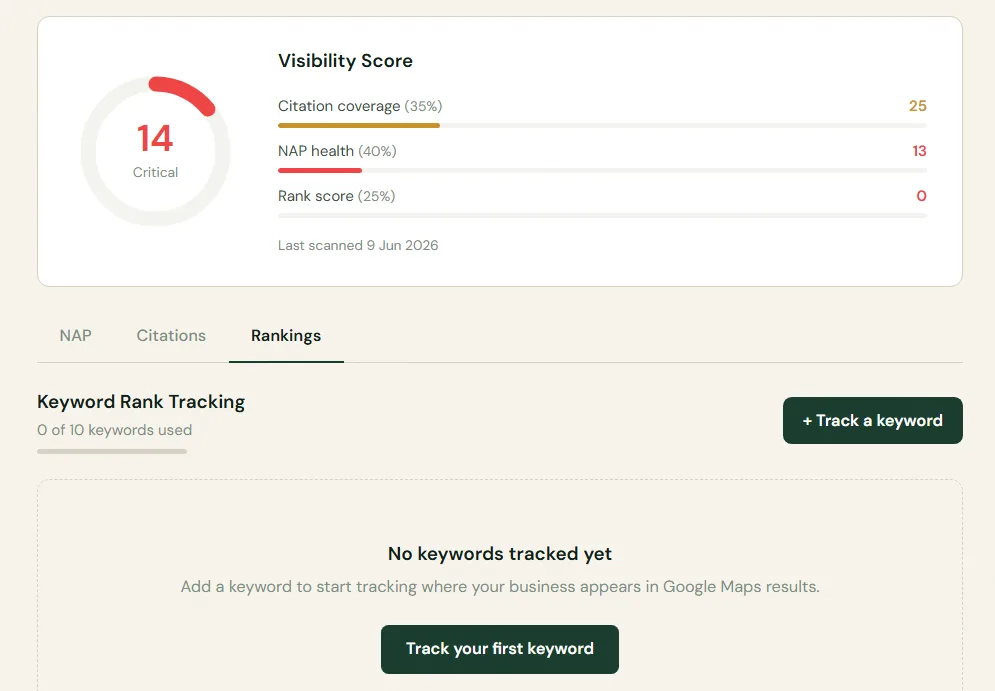
What distinguishes Destinali from standalone rank trackers is context. The Destinali Growth plan bundles local rank tracking with NAP management and citation scanning, so businesses can see their ranking performance alongside the citation health and business information accuracy that directly influence those rankings. A business listing, do-follow backlinks, and lead generation via phone, email, and WhatsApp are also included – making it a practical local visibility stack rather than a single-purpose tracking tool.
For businesses in African markets that often face unique challenges in consistent directory presence and structured data quality, this bundled approach reduces the number of separate tools needed and keeps costs manageable.
Best for: Small businesses, service providers, hotels, clinics, restaurants, and local brands that want rank tracking embedded in a broader local visibility system rather than as a standalone analytics tool.
Whitespark
Whitespark is known primarily for citation building but includes a capable local rank tracker. It tracks organic and Local Pack rankings for local keywords and provides competitor comparison data. The platform is particularly useful for businesses focused on citation-driven local SEO, since rank data and citation management share a single interface.
Grid-based heatmap visualization is less developed than Local Falcon or BrightLocal, making Whitespark a better fit for users who prioritize citation workflow over visual rank analysis.
Best for: Businesses or agencies with a strong focus on citation building who want rank tracking bundled with that workflow.
Use-Case Decision Matrix
| Situation | Winner | Why |
|---|---|---|
| Solo operator, single location, limited budget | Destinali | Affordable, bundled with listing and citation tools, no technical expertise required |
| Local SEO agency managing 20+ clients | Local Falcon or BrightLocal | Maximum grid customization (Local Falcon) or clean white-label reporting (BrightLocal) |
| Restaurant or hotel tracking visibility across multiple neighborhoods | BrightLocal or Destinali | Multi-location or multi-area tracking at a manageable cost |
| Clinic or service provider expanding to nearby cities | Destinali or Whitespark | Bundled citation and rank tools help manage consistency across new markets |
| Agency already using Semrush for full SEO | Semrush | Consolidation advantage outweighs cost at this usage level |
| African SMB needing low-cost local visibility stack | Destinali | Built for African markets, bundles NAP, citation, and rank tracking in one plan |
| Business tracking AI search visibility alongside Google Maps | Local Falcon | Currently one of the few tools scanning ChatGPT and Perplexity results |
| Real estate agency tracking multiple service areas | BrightLocal or Local Falcon | Multi-location competitor tracking and large grid sizes |
How to Allocate Your Tracking Budget by Business Stage
Rank tracking is not a fixed cost – it should scale with where your business is in its local SEO journey. A structured phased approach prevents overspending early and under-investing when it matters most.
Months 0–3 (Foundation Phase): 80% setup, 20% tracking. Prioritize getting your Google Business Profile complete and accurate, ensuring NAP consistency across directories, and setting a baseline. A lightweight tool at this stage is sufficient. Scanning a 5×5 grid monthly gives you a benchmark without burning budget on data you cannot yet act on.
Months 3–9 (Active Optimization Phase): 50% tracking, 50% citation and content work. Once baseline data exists, weekly scans become more useful. You want to correlate ranking changes with actions taken – a new batch of citations, a GBP post, updated categories. Tools with SoLV scoring or historical grid comparison are valuable here so you can see directional progress, not just point-in-time snapshots.
Months 9+ (Competitive Phase): 70% tracking and analysis, 30% maintenance. At this stage, you should be expanding keyword sets, tracking competitors in specific grid quadrants, and reporting results to stakeholders. This is where grid density and scan frequency matter most. Agencies at this stage benefit from daily scanning on competitive keywords and white-label reporting for client retention.
For most small businesses in a single market, a monthly budget of $30–$80 USD on rank tracking is appropriate across all phases. Agencies managing ten or more locations should budget $150–$400 USD monthly depending on grid size and scan frequency.
Five Steps for Choosing the Right Tool
Follow this sequence before committing to any rank tracking platform.
- Define your service area precisely. Measure the actual geographic radius your customers come from – not the city name, but the neighborhoods or districts. This determines the grid size you need.
- List your five most important keywords. Start with the terms that drive the most customer inquiries. You can expand later; starting too broad makes data hard to act on. Businesses targeting nearby cities and service areas benefit from including location-modified keywords from the start.
- Decide whether you need standalone tracking or a bundled stack. If you also need citation management or NAP corrections, a bundled platform costs less than buying three separate tools. If you only need grid data, a dedicated tool like Local Falcon offers more granularity.
- Run one free scan before committing. Most tools offer a trial scan or free tier. Use it on your actual business location and a keyword you care about. Evaluate whether the output is something you can act on or something that requires SEO expertise to interpret.
- Check how rankings have dropped locally for similar businesses and what the tracker would have revealed. The most common ranking drops – NAP inconsistency, GBP category changes, competitor citation surges – should be visible in a good tool's historical data. If the tool cannot show you what changed and when, it will not help you diagnose future drops either.
What Local Rank Tracking Cannot Do on its Own
Rank data tells you where you are, not why you are there or how to move. A business that tracks rankings without acting on citation gaps, NAP inconsistencies, or GBP quality issues will see the numbers without improving them.
Consistent citation data across directories is one of the primary signals Google uses to assess local business legitimacy. A rank tracker that shows you dropping in a specific neighborhood is most useful when paired with citation scanning that reveals whether a duplicate listing or incorrect address is suppressing your visibility in that area.
AI-powered search platforms are also beginning to surface local business recommendations. A rank tracker that only monitors Google Maps misses an emerging discovery channel. Businesses in competitive categories – hotels, restaurants, clinics, legal services – should be tracking AI visibility alongside traditional local search rankings.
FAQ
What Is a Geo-Grid in Local Rank Tracking?
A geo-grid is a matrix of GPS coordinates overlaid on a business's service area. A local rank tracker simulates searches from each point on the grid to reveal how the business ranks at different locations – not just from one central address. A 7×7 grid, for example, checks rankings from 49 distinct points. This method shows which neighborhoods a business dominates and where it is invisible to nearby customers.
How Often Should I Run Local Rank Scans?
Monthly scans provide a useful baseline for businesses just starting with local SEO. Weekly scans are appropriate once active optimization work is underway – for example, after updating your Google Business Profile, acquiring new citations, or launching a local content campaign. Daily scans are only necessary in highly competitive markets or when tracking the immediate impact of a specific change.
Does Local Rank Tracking Show Google Maps Rankings Separately From Organic?
Yes, most dedicated local rank trackers distinguish between organic search rankings, Local Pack rankings (the top-three map listings), and Google Maps rankings. These three surfaces often show different positions for the same keyword. A business might rank on the first organic page but be absent from the Local Pack entirely. Tracking them separately lets you prioritize where to focus your optimization effort.
What Is Share of Local Voice (SoLV)?
Share of Local Voice is a metric that measures how often a business appears across all grid points in a defined scan, expressed as a percentage. If a business appears in the Local Pack at 60 out of 100 grid points, its SoLV for that keyword is 60%. Local Falcon pioneered this metric. It simplifies month-over-month comparison without requiring users to analyze individual grid positions each time.
Can Small Businesses Afford Local Rank Tracking Tools?
Yes. Entry-level plans from tools like BrightLocal and Destinali start at a price point accessible to independent businesses. Credit-based tools like Local Falcon allow low-volume scanning at minimal cost. The key is matching scan frequency and grid size to actual need. A single-location bakery scanning five keywords monthly at a 5×5 grid does not need the same budget as an agency scanning 50 keywords daily across 15 locations.
Is Local Rank Tracking Useful for Businesses Without a Physical Storefront?
It is, with some adjustments. Service-area businesses that operate without a customer-facing address can still track rankings by setting their service area rather than a pin location. Most major local rank tracking tools support service-area businesses. The geo-grid approach works equally well for a plumber serving a metro area as for a restaurant tracking foot-traffic-ready customers nearby.
How Does Local Rank Tracking Differ for African Markets?
African markets often have lower directory density and less consistent citation data than markets in North America or Europe. This means local ranking data in cities like Lagos, Nairobi, or Accra can be more volatile and harder to interpret without also understanding the citation landscape. Tools that bundle rank tracking with citation scanning – such as Destinali's local visibility suite – are better suited to these markets because they connect ranking fluctuations to their most likely structural causes.
Do Any Local Rank Trackers Cover AI Search Platforms Like ChatGPT?
Local Falcon now includes scanning for AI search platforms including ChatGPT and Perplexity, alongside Google Maps and Apple Maps. This is currently unusual – most rank tracking tools focus exclusively on Google. As AI-powered discovery grows in influence, particularly for service and hospitality businesses, tracking AI visibility alongside traditional local rankings is becoming a more meaningful part of local SEO measurement.
Final Verdict: Which Tool Should You Choose?
The right local rank tracker depends on three things: your business size, whether you need tracking alone or a bundled visibility stack, and your tolerance for data complexity.
- Choose Local Falcon if you are an agency or SEO professional who needs the most flexible, detailed geo-grid tool available and values AI platform scanning.
- Choose BrightLocal if you manage multiple clients and need clean white-label reporting with reliable keyword and grid tracking.
- Choose Semrush if local tracking is one part of a broader SEO workflow and you are already paying for the platform's other capabilities.
- Choose Destinali if you are a small business, service provider, hotel, clinic, restaurant, or local brand that wants rank tracking embedded in a practical, affordable local visibility stack – without needing a separate tool for citations, NAP management, and business listing.
No tracker improves your rankings on its own. The data it produces is only as useful as the action it drives.
Businesses serious about local visibility can track their local rankings with Destinali's local rank tracking tool, built for small businesses that want clear data without the complexity.
Destinali helps local businesses improve online visibility, discoverability, and customer acquisition across search engines, AI systems, maps, and local search platforms.
List your business →