Local SEO Ranking Checklist for a New Business
Getting discovered online is no longer optional for a new business. Local SEO (Local Search Engine Optimization) is the process of improving your business's visibility in location-based searches – the queries people make when looking for services near them, whether typed into Google, spoken to a voice assistant, or asked through an AI tool like ChatGPT or Perplexity. For a new business with no existing online presence, the right starting steps can mean the difference between showing up in front of ready-to-buy customers and being invisible to them entirely.
This checklist covers each foundational step in sequence – from claiming your Google Business Profile to tracking your first rankings.
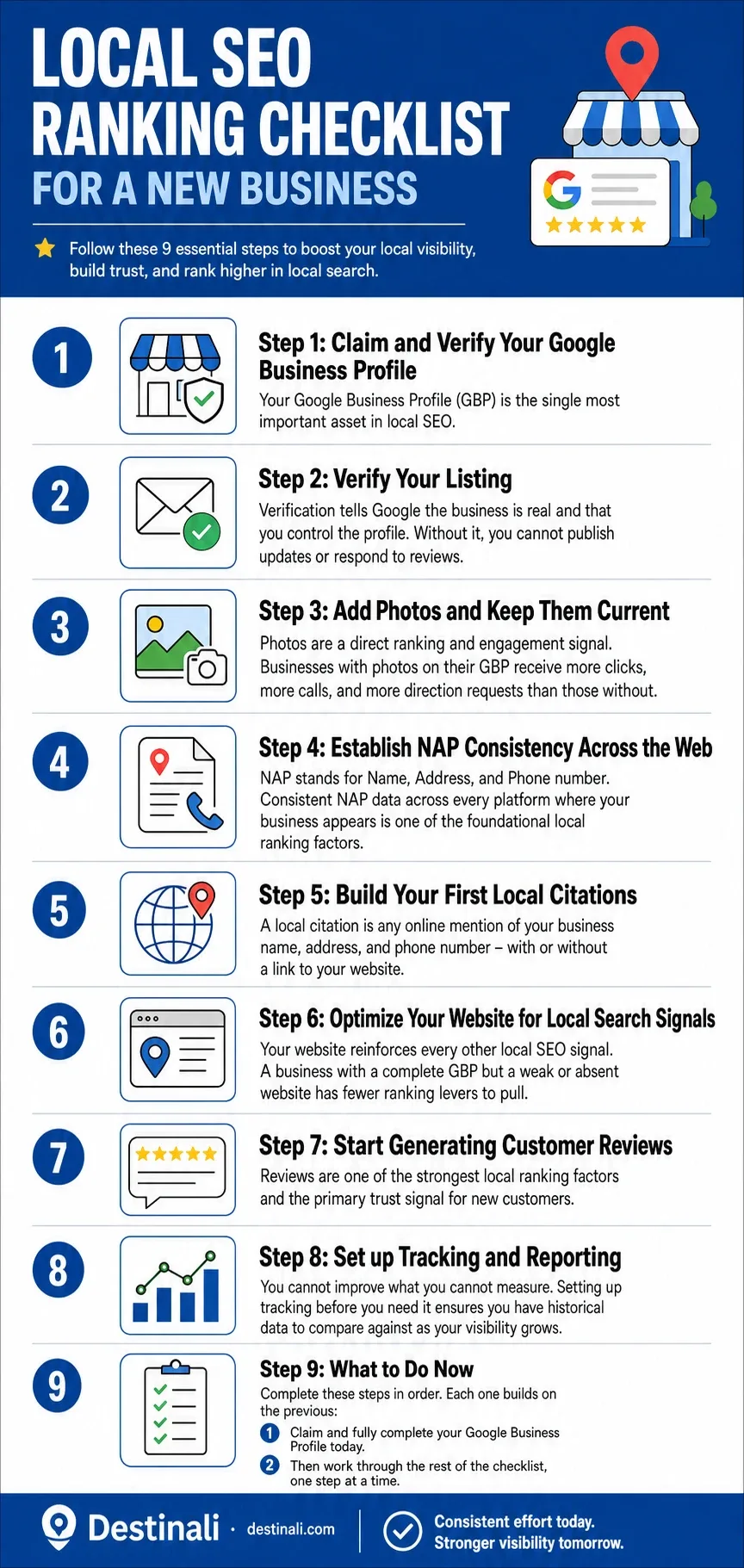
Step 1: Claim and Verify Your Google Business Profile
Your Google Business Profile (GBP) is the single most important asset in local SEO. It controls what appears in Google Maps, local search results, and the information panel that shows up beside your business name on desktop searches.
Go to google.com/business and search for your business name. If a listing already exists, claim it. If not, create one from scratch.
Fill out every field completely:
- Business name: Use your real business name, exactly as it appears on your signage or registration. Do not add keywords.
- Primary category: Choose the category that most accurately describes what you do. Add secondary categories where relevant.
- Address or service area: If customers visit your premises, list your address. If you travel to customers, hide your address and define your service area instead.
- Phone number: Use a local number where possible. Keep the format consistent across every platform.
- Business hours: Set accurate hours from day one. Update them for public holidays.
- Website URL: Link to your homepage or a relevant landing page.
- Business description: Write 250–750 characters describing who you serve, what you offer, and what sets you apart. Include your city or region naturally.
Google rewards fully completed profiles. Businesses with complete profiles receive significantly more clicks and direction requests than those with gaps. Every blank field is a missed ranking opportunity.
Step 2: Verify Your Listing
Verification tells Google the business is real and that you control the profile. Without it, you cannot publish updates or respond to reviews.
Google offers several verification methods depending on your business type and location:
- Postcard: Google sends a PIN to your business address. Enter it in GBP within 30 days.
- Phone or email: Available to some business types during setup.
- Video verification: Increasingly common, requires a short walkthrough of your premises.
Some businesses in certain markets can verify without a postcard using alternative methods. If the standard postcard process is unavailable or delayed, check your GBP dashboard for other options.
Do not attempt to use your profile for ranking until verification is complete.
Step 3: Add Photos and Keep Them Current
Photos are a direct ranking and engagement signal. Businesses with photos on their GBP receive more clicks, more calls, and more direction requests than those without.
Upload at minimum:
- A logo
- A cover photo (your storefront, office, or primary service environment)
- Interior and exterior shots
- Team photos or images showing your work in progress
Use high-resolution images. Blurry or poorly lit photos reduce trust rather than build it. Add new photos regularly – Google interprets ongoing activity as a signal that the business is open and engaged. A profile that has not been updated in months can appear inactive to both Google and customers.
Step 4: Establish NAP Consistency Across the Web
NAP stands for Name, Address, and Phone number. Consistent NAP data across every platform where your business appears is one of the foundational local ranking factors. Search engines use NAP signals to verify that your business is legitimate and that the information they surface is accurate.
Inconsistent NAP details – different phone number formats, abbreviated addresses, or slight variations in your business name – create conflicting signals that can suppress your rankings. Studies show that NAP inconsistency can reduce local search ranking potential by measurable margins, and 73% of users lose trust in a brand when they encounter incorrect business information online.
Define your canonical NAP before you submit to any directory:
- Use your full legal or trading business name with no keyword additions
- Write your address in full, including floor or unit numbers where applicable
- Choose one primary phone number and use the same formatting everywhere
Correct NAP consistency issues early. Fixing errors across dozens of directories later is far more time-consuming than getting it right from the start.
Destinali's NAP Management tool helps businesses maintain accurate business details across search engines, maps, and directories from a single dashboard.
Step 5: Build Your First Local Citations
A local citation is any online mention of your business name, address, and phone number – with or without a link to your website. Citations help search engines verify that your business exists and confirm its location.
For a new business, the priority is volume and accuracy across the most trusted directories. Start with:
- Google Business Profile (Step 1)
- Bing Places for Business
- Apple Maps Connect
- Facebook Business Page
- Yelp (where relevant to your market)
- Industry-specific directories relevant to your sector (legal, medical, hospitality, real estate, etc.)
- Local or regional directories relevant to your country or city
In African markets, local business directories carry meaningful weight for local discovery, both in traditional search and in AI-driven results. Prioritize directories with active user bases in your market.
When submitting to each directory, use your canonical NAP exactly. Do not abbreviate, rearrange, or reformat.
Step 6: Optimize Your Website for Local Search Signals
Your website reinforces every other local SEO signal. A business with a complete GBP but a weak or absent website has fewer ranking levers to pull.
Key on-page actions for a new business:
Add Location to Title Tags and Meta Descriptions
Every service page should include your primary service and location in the title tag. For example: "Wedding Photography Services in Lagos, Nigeria" or "Dental Clinic in Accra, Ghana." This tells search engines explicitly where you operate.
Create a Dedicated Contact Page
Your Contact page should display your full NAP, embedded Google Map, and business hours. This is the page search engines use to cross-reference your GBP information.
Add LocalBusiness Schema Markup
Schema markup is structured data that tells search engines and AI systems – exactly what your business is, where it is, and what it does. Adding LocalBusiness schema to your website makes your information machine-readable and increases the chance of appearing in AI-generated answers. The free schema generator from AuthorityStack.ai produces the correct JSON-LD markup without requiring technical knowledge.
Ensure Mobile Usability
Most local searches happen on mobile devices. Your website must load quickly and display correctly on small screens. A site that is difficult to navigate on a phone loses customers before they make contact.
For a more detailed treatment of on-page local SEO, focus on title tags, heading structure, and location-specific content as the three highest-impact areas for new business websites.
Step 7: Start Generating Customer Reviews
Reviews are one of the strongest local ranking factors and the primary trust signal for new customers. Google's algorithm weighs the quantity, recency, and quality of reviews when determining local rankings.
For a new business with no reviews, the first ten are the most important.
Build review generation into your customer process from day one:
- Ask every satisfied customer to leave a Google review immediately after a positive experience.
- Make it easy – send a direct link to your GBP review form via WhatsApp, SMS, or email.
- Respond to every review that comes in, positive or negative. A response shows that the business is active and engaged.
- Never incentivize or fabricate reviews. Google detects manipulation and the penalty far outweighs any short-term gain.
A steady flow of recent reviews matters more than a large number of old ones. Consistent review volume signals ongoing business activity. For practical tactics on getting more Google reviews, focus on timing – ask at the moment a customer is most satisfied, not days later.
Step 8: Set up Tracking and Reporting
You cannot improve what you cannot measure. Setting up tracking before you need it ensures you have historical data to compare against as your visibility grows.
At minimum, configure:
- Google Search Console: Shows which search queries are surfacing your website, which pages are indexed, and any technical errors. Free and essential.
- Google Analytics 4 (GA4): Tracks traffic sources, user behavior, and conversions on your website.
- Local rank tracking: Monitors where your business appears in search results for your target keywords across specific cities, neighborhoods, or service areas.
Local Rank Tracking from Destinali lets businesses track keyword rankings across cities and neighborhoods, so you can see which areas you rank in and where competitors are ahead of you.
Set a baseline reading when you complete the setup steps above. Your rankings on day one will be low – that is expected. The value of tracking is seeing consistent improvement over the following weeks and months.
FAQ
What Is the Most Important First Step in Local SEO for a New Business?
Claiming and fully completing your Google Business Profile is the single most impactful first action. A complete GBP gives Google the foundational information needed to surface your business in local searches, and it is free to set up. Every other local SEO action – citations, reviews, schema – amplifies a well-optimized GBP.
How Long Does It Take for Local SEO to Show Results?
Most new businesses begin to see measurable movement in local search rankings within 60 to 90 days of completing the core setup steps: a verified GBP, consistent NAP across directories, initial citations, and the first set of reviews. Competitive markets and heavily populated cities typically take longer.
What Is NAP and Why Does It Matter?
NAP stands for Name, Address, and Phone number. Search engines use NAP data across hundreds of directories and platforms to verify that a business is real and accurately described. Inconsistent NAP details – such as different phone number formats or abbreviated addresses – send conflicting signals that can suppress local rankings. Having consistent NAP data across all platforms can improve local search ranking potential by up to 16%.
How Many Citations Does a New Business Need?
There is no fixed number, but most local SEO practitioners recommend establishing at least 20 to 40 accurate citations across high-authority directories within the first three months. Prioritize the platforms your target customers actually use: Google, Bing, Apple Maps, Facebook, Yelp, and the top directories in your specific industry and country.
Do I Need a Website to Rank Locally?
Yes. While a Google Business Profile alone can drive some visibility, a website significantly strengthens your local SEO. It provides additional indexed pages, location-specific content, and schema markup that GBP cannot replicate. Research from BrightLocal shows that 81% of consumers research businesses online before purchasing, yet only 40% of small businesses have a dedicated website – making a website a clear differentiator for new businesses.
Does Local SEO Work for Businesses in African Markets?
Yes. Local SEO principles apply across all markets, and businesses in African cities such as Lagos, Nairobi, Accra, Johannesburg, and Kampala benefit from the same tactics: a complete GBP, consistent citations, reviews, and location-optimized website content. Local directories relevant to African markets carry additional weight for regional discovery. AI search tools like ChatGPT and Perplexity are also increasingly used to find local services, making structured content and schema markup more important across all markets.
What Is LocalBusiness Schema and Do I Need It?
LocalBusiness schema is a type of structured data added to your website's code that tells search engines and AI systems exactly what your business is, where it operates, and what it offers. It is written in JSON-LD format and placed in the <head> of your website. Adding schema markup increases the chance that your business information appears in AI-generated answers and rich search results. Free tools like the AuthorityStack.ai schema generator produce the correct code without requiring technical expertise.
What to Do Now
Complete these steps in order. Each one builds on the previous:
- Claim and fully complete your Google Business Profile today.
- Verify your profile and confirm your canonical NAP before submitting to any directory.
- Upload at least five photos to your GBP in the first week.
- Submit your business to 10–15 priority directories using your canonical NAP.
- Add a Contact page, location-specific title tags, and LocalBusiness schema to your website.
- Ask your first customers for Google reviews and respond to each one.
- Set up Google Search Console and a rank tracking tool to establish your baseline.
Local SEO for a new business is not about quick wins. Each step compounds over time. Businesses that get the fundamentals right in the first 90 days are far better positioned to compete as they grow.
To start building your local online presence, you can create a free business listing on Destinali and be found across the platforms where your customers are already searching.

Destinali helps local businesses improve online visibility, discoverability, and customer acquisition across search engines, AI systems, maps, and local search platforms.
List your business →