10 Free Customer Acquisition Methods That Actually Work for African Businesses
Growing a business without a marketing budget is not a disadvantage – it is a discipline. Free customer acquisition forces clarity: you cannot waste money on channels that do not work, so you learn faster which ones do. For small businesses across Africa, where margins are tight and customer trust is earned one interaction at a time, free methods are not a fallback plan. They are often the best plan.
This list covers ten methods that generate real customers without ad spend. Each one builds something durable: visibility, credibility, or relationships that compound over time.
1. Optimise Your Business Listing for Local Search
The single fastest free action any business can take is claiming and optimising its listing on local discovery platforms. When someone searches "accountant in Accra" or "hotel near me in Nairobi," search engines and AI tools pull from structured business data – name, address, phone number, category, hours, and photos. Businesses with complete, accurate listings consistently appear above those with incomplete profiles.
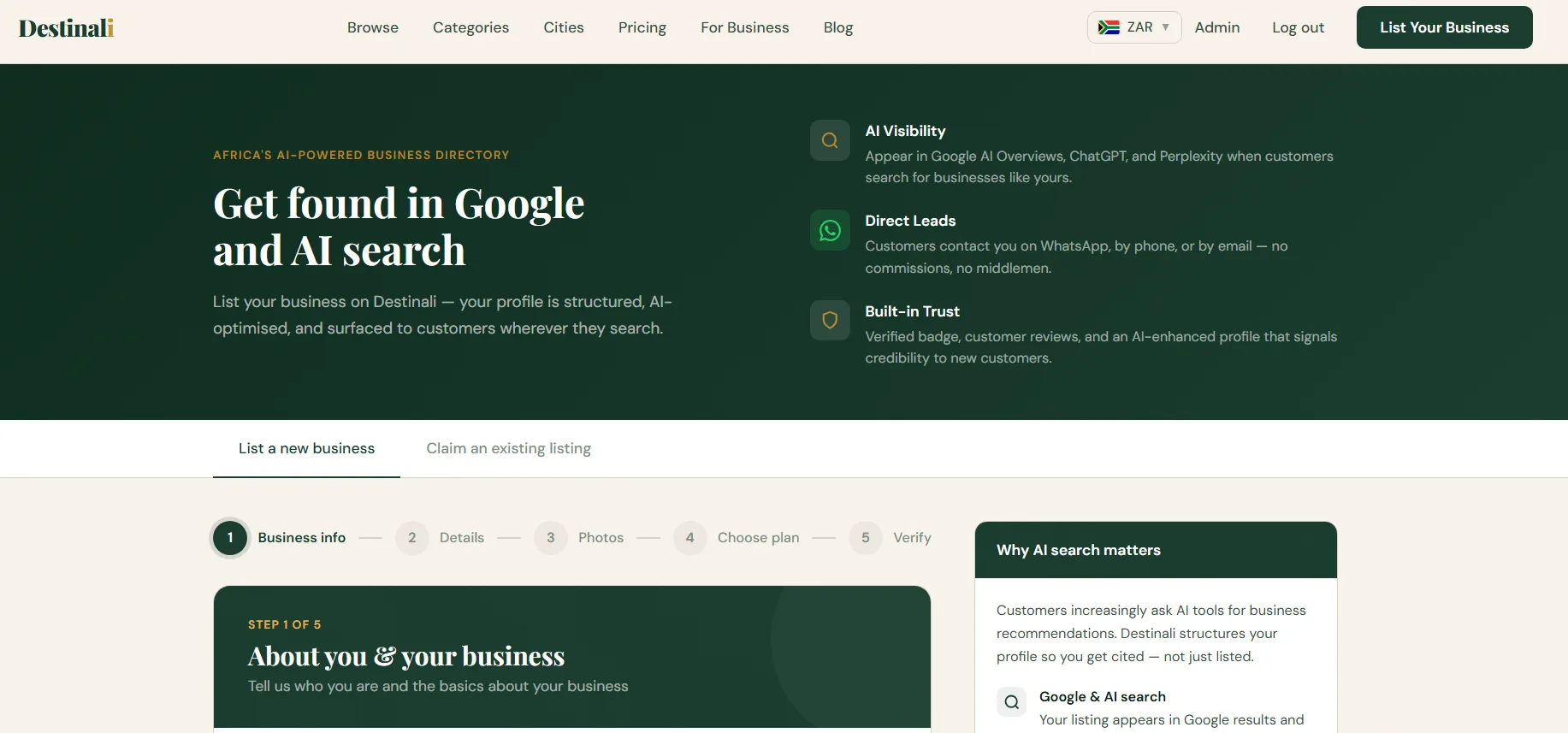
Destinali lists over one million verified businesses across 54 African countries and 80+ categories. A free listing on a platform like this puts your business in front of customers who are already searching for what you offer – no ad spend required.
What to include:
- Accurate business name, address, and phone number
- Business category and subcategories
- Operating hours
- At least three quality photos
- A short, keyword-rich business description
2. Build a Review Strategy From Day One
Customer reviews are free marketing that works around the clock. A business with 40 reviews and a 4.6-star rating will consistently outperform a competitor with no reviews, regardless of ad budget. Reviews signal trust to both search engines and potential customers making decisions.
The mistake most small businesses make is waiting for reviews to appear organically. A proactive approach – asking every satisfied customer directly, by WhatsApp or in person – generates reviews at ten times the passive rate. Consistent review generation for local SEO compounds over months, producing a visible credibility signal that paid ads cannot replicate.
How to build reviews consistently:
- Ask within 24 hours of a positive experience
- Send a direct link to your review page via WhatsApp
- Respond to every review, positive or negative
- Display review counts prominently on your website and listing
3. Publish Useful Local Content
Content marketing works by answering questions your customers are already asking. A Lagos law firm that publishes "What Documents Do You Need to Register a Business in Nigeria?" attracts clients actively researching that process. A Nairobi hotel that writes "Best Weekend Getaways Near Nairobi" appears when travellers search that phrase. The content does the selling before the customer ever makes contact.
This approach builds topical authority – search engines and AI tools reward businesses that consistently publish relevant, specific, well-structured content. A single useful article, properly optimised, can generate enquiries for years. For businesses without in-house writers, AI-assisted article generation produces SEO-ready content that search engines and AI tools are more likely to cite.
Content formats that work for local businesses:
- "Best [service] in [city]" lists
- How-to guides relevant to your industry
- FAQs about your services
- Neighbourhood or area guides
4. Add Structured Data to Your Website
Structured data – specifically JSON-LD schema markup – tells search engines and AI tools exactly what your business is, where it operates, and what it offers. Businesses without schema markup rely on search engines to guess this information. Businesses with schema markup give search engines verified, machine-readable facts.
This matters increasingly because AI-powered search (Google AI Overviews, ChatGPT, Perplexity) pulls from structured data when constructing answers. A restaurant in Kigali with proper LocalBusiness schema is far more likely to appear in an AI-generated recommendation than one without it. The free schema generator from AuthorityStack.ai produces correct JSON-LD markup for any local business in minutes, with no technical skill required.
Key schema types for local businesses:
- LocalBusiness (or more specific types: Restaurant, Hotel, LegalService)
- Review and AggregateRating
- FAQPage for service pages
5. Use WhatsApp and Email to Stay Top of Mind
Retention is acquisition. A customer who returns twice is worth three times a first-time buyer who disappears. WhatsApp and email are free channels that let businesses stay connected with past customers and bring them back or turn them into referral sources.
A WhatsApp broadcast list of 200 satisfied customers costs nothing to maintain. A monthly message with a useful tip, a new service announcement, or a limited-time offer keeps the business present in customers' minds. Email follows the same logic: a consistent newsletter to a small, engaged list outperforms expensive retargeting campaigns aimed at cold audiences.
Practical setup for small businesses:
- Collect WhatsApp numbers at every customer touchpoint
- Build an email list through your website with a simple signup form
- Send value-first messages, not just promotions
- Aim for one message per week maximum to avoid unsubscribes
6. Create a Referral System
Referrals are the oldest customer acquisition method and still one of the most effective. Nextdoor's research shows that 92% of consumers trust recommendations from friends and family – a figure that no paid advertisement can match. Most African small businesses receive referrals passively. Building a deliberate referral system turns a trickle into a channel.
The mechanism is simple: give existing customers a specific reason to refer. This does not have to be a monetary reward. Exclusive access, priority service, or a genuine thank-you goes a long way, particularly in relationship-driven business cultures across Nigeria, Ghana, Kenya, and South Africa.
Simple referral programme structure:
- Define the reward (discount, free service, priority booking)
- Make referring easy – a WhatsApp message with a code works
- Thank referrers visibly and promptly
- Track which customers refer most and nurture those relationships
7. Partner With Complementary Businesses
Cross-referral partnerships between non-competing businesses serving the same customer segment cost nothing and expand reach immediately. A physiotherapy clinic and a gym share customers. A wedding photographer and a catering company share clients. A real estate agent and a property lawyer serve the same buyers.
Formalising these relationships – agreeing to recommend each other, co-creating content, or cross-posting on social media – gives both businesses access to a warm, pre-qualified audience. In African markets where community trust drives purchasing decisions, a recommendation from a known local business carries significant weight.
How to structure a local partnership:
- Identify three to five businesses that serve your customer but do not compete with you
- Propose a mutual referral arrangement with no financial obligation
- Co-create one piece of content (a guide, a social post, a joint event)
- Review quarterly and formalise what works
8. Be Active Where Your Customers Already Are
Social media and online community presence costs nothing but time. Facebook groups, LinkedIn, industry forums, and neighbourhood apps contain thousands of potential customers asking questions, seeking recommendations, and researching options. A business that consistently shows up in these spaces – answering questions helpfully, not selling – builds familiarity and trust before any transaction occurs.
The key distinction is participation, not broadcasting. Dropping a promotional post in a community group rarely converts. Answering a question thoroughly and being identifiably associated with your business category does. Over time, members associate your name with expertise and recommend you without being asked.
Where African business owners find high-quality engagement:
- Facebook groups for local communities and industries
- LinkedIn for B2B service businesses
- WhatsApp community groups in your city or sector
- Nextdoor and local neighbourhood platforms
9. List Your Business on Free Directories and Maps
Beyond your primary listing, every additional directory or map listing creates a citation – a mention of your business name, address, and phone number that reinforces your existence to search engines. Consistent citation data across multiple platforms is a confirmed local SEO ranking factor. Inconsistent data (different phone numbers, misspelled addresses) actively harms visibility.
Google Business Profile, Apple Maps, Bing Places, and sector-specific directories are all free to list on. Each one represents a separate discovery surface where customers may find your business. A hotel in Kampala that appears across five platforms is five times more likely to be found than one appearing on only one. Consistent local business citation data helps search engines match and rank a business across platforms with confidence.
Free platforms to list on:
- Google Business Profile
- Apple Maps Connect
- Bing Places for Business
- Destinali (Africa-focused, free listing available)
- Industry-specific directories relevant to your sector
10. Speak, Teach, and Demonstrate Expertise in Public
Positioning yourself as the knowledgeable local expert is a free acquisition method with a long tail. Speaking at local events, running a free workshop, appearing on a podcast, or contributing to a local publication puts your name and business in front of audiences who already have a reason to trust you.
For service businesses – lawyers, consultants, clinics, financial advisers – this is especially powerful. A single free webinar on "How to Choose a Reliable Contractor in Johannesburg" attended by 80 people may convert five to ten of them into enquiries. The cost is an hour of preparation. The return can be months of new business.
Ways to build public expertise for free:
- Offer to speak at local business associations or chambers of commerce
- Host a free online workshop via WhatsApp, Zoom, or Google Meet
- Contribute articles to local newspapers or industry publications
- Appear on local podcasts or YouTube channels in your industry
FAQ
What Is the Most Effective Free Customer Acquisition Method for Small Businesses?
Optimising a business listing for local search consistently delivers the highest return for small businesses with no marketing budget. When customers search for a service by location – "plumber in Durban" or "accountant in Accra" – search engines rank complete, accurate, and reviewed listings above incomplete ones. This approach works continuously without ongoing effort once the listing is set up correctly.
How Long Does It Take for Free Customer Acquisition Methods to Produce Results?
The timeline varies by method. A well-optimised business listing can generate enquiries within days. Review-building and content marketing typically take two to four months to produce measurable results because they rely on accumulation. Referral programmes and partnerships can produce results immediately, depending on the existing customer base. Free methods generally require more patience than paid advertising but produce more durable results.
Do Reviews Really Affect How Many Customers Find a Local Business?
Yes. Search engines use review count, average rating, and recency as ranking signals for local search results. A business with 50 reviews and a 4.5-star rating will consistently outrank a competitor with no reviews, even if the competitor's listing is otherwise complete. Reviews also influence conversion: most customers read reviews before contacting a business, regardless of how they found it.
Is Content Marketing Worth the Effort for African Small Businesses?
Content marketing is worth the effort for any business operating in a category where customers research before buying. This includes legal services, real estate, healthcare, hospitality, financial services, and professional consulting. A single well-written article on a relevant local topic can generate qualified enquiries for years at zero ongoing cost. The upfront effort is the investment.
What Is Customer Acquisition Cost and Does It Apply to Free Methods?
Customer acquisition cost (CAC) is the total cost divided by the number of customers gained through a given method. Free methods have a CAC of zero in direct spend but carry a time cost. Tracking which free methods produce the most customers per hour spent helps businesses allocate their time as efficiently as paid advertisers allocate budget. Even without ad spend, measuring CAC in time terms is a useful discipline.
Can a Small Business Compete With Larger Competitors Using Only Free Methods?
Yes, particularly in local markets. Large competitors often focus on broad, national-level marketing and underinvest in local search optimisation, community engagement, and personalised relationship-building. A small business that builds a strong local reputation, consistent citations, and a genuine review base can dominate local search results for its category, even against much larger brands.
The Bottom Line
Free customer acquisition is not about doing everything at once. The businesses that grow without ad spend pick two or three methods, execute them consistently, and measure what works before adding more. For most African small businesses, the highest-leverage starting point is the same: get your business listed accurately, collect reviews deliberately, and be present where your customers search.
African businesses ready to be found online can create a free listing on Destinali and start appearing where customers are already looking.

Destinali helps local businesses improve online visibility, discoverability, and customer acquisition across search engines, AI systems, maps, and local search platforms.
List your business →