What Are Business Citations and How Do They Work?
A business citation is any online mention of your business's core contact details – typically your name, address, and phone number. When a customer searches for a clinic in Nairobi, a hotel in Accra, or a lawyer in Lagos, search engines scan the web for consistent references to that business across directories, map platforms, and websites. The more consistent and widespread those references are, the more confident a search engine becomes that the business is real, operating, and worth showing in results.
For African businesses trying to get discovered online, citations are one of the most direct and controllable ways to build that confidence.
A business citation is any online reference that includes a business's name, address, and phone number (NAP) – the three core data points search engines use to verify a business's identity and location.
What NAP Means and Why It Is the Foundation of Every Citation
NAP stands for Name, Address, and Phone Number. These three details are the minimum data points required to form a valid business citation. Without all three, the reference is incomplete and provides weaker signals to search engines.
Think of NAP as your business's digital identity card. Every time your business is listed somewhere online – on a directory, a review platform, a social media profile, or a news article – the consistency of that identity card matters. If your business name is listed as "Kemi's Beauty Studio" on one platform and "Kemi Beauty and Wellness" on another, search engines have to decide whether those are the same business. Inconsistency creates doubt. Consistency builds trust.
A strong citation includes the full business name, a complete physical address, and a working phone number. Many platforms also support additional data such as website URL, business hours, photos, and category tags – all of which strengthen the citation further. Destinali, which lists over one million verified businesses across 54 African countries, uses structured NAP data as a core signal to surface businesses in local and AI-powered search results.
Structured Vs. Unstructured Citations
Not all citations look the same. There are two main categories, and both contribute to your visibility in different ways.
Structured Citations
A structured citation appears on a platform specifically designed to display business information in a standard format. Business directories, map platforms, review sites, and social media profiles all produce structured citations.
Examples of platforms that generate structured citations include Google Business Profile, business directories, industry-specific listing sites, and platforms like Destinali's free business listing. The business's NAP details are presented in a consistent, organized layout that both users and search engines can read clearly.
Structured citations are generally more valuable for driving commercial traffic because they place a business directly in front of customers who are actively searching for a product or service.
Unstructured Citations
An unstructured citation is an informal reference to your business on a platform not built for directory-style listings. A blog post that mentions your restaurant by name and location, a news article that references your clinic's address, or a community forum where someone recommends your salon – these all count as unstructured citations.
Unstructured citations are harder to control and track, but they carry real value. They signal to search engines that real people and real publications know your business exists. What are local citations becomes clearer when you see both types working together: structured citations establish your data, and unstructured citations confirm your reputation.
How Citations Differ From Backlinks
Citations and backlinks are related but distinct concepts. Understanding the difference helps you build a more effective visibility strategy.
A backlink is a clickable link from one website to another. Search engines treat backlinks as votes of confidence – a signal that one site endorses another. Backlinks primarily improve a website's authority and ranking across general search results.
A citation, by contrast, is a reference to your NAP data. It does not need to include a clickable link to count. A directory that lists your business name, address, and phone number without linking to your website is still a valid citation. It still tells search engines where your business is located and confirms that the information appears consistently across the web.
| Factor | Citation | Backlink |
|---|---|---|
| Requires a clickable link | No | Yes |
| Must include NAP data | Yes | No |
| Primary SEO benefit | Local rankings and trust | Domain authority and general rankings |
| Found on | Directories, maps, review sites | Any website |
| Can be unstructured | Yes | No |
When a citation does include a link to your website, it functions as both a citation and a backlink – making it more valuable than either alone.
How Citations Build Search Engine Confidence
Search engines face a practical problem: they cannot visit your premises to confirm your business is real. Citations are how they solve this. When Google finds your business listed with the same name, address, and phone number across multiple credible platforms, it treats that consistency as evidence that the business genuinely exists at that location.
Google's local search ranking framework identifies three key factors: relevance, distance, and prominence. Citations directly build prominence – the third factor. According to Whitespark's 2023 Local Search Ranking Factors study, citations are the sixth most important signal for local pack rankings and joint fifth for local organic results.
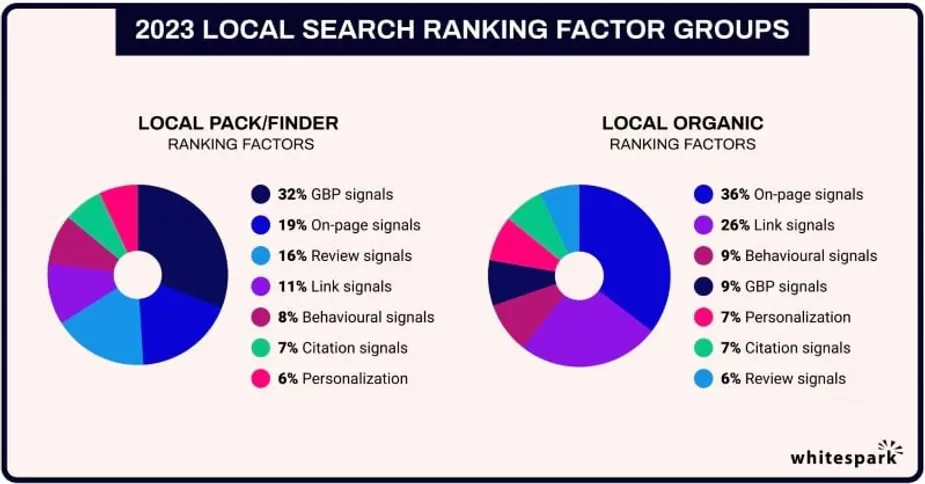
For a restaurant in Kigali or a real estate agency in Sandton, this means that building citations across the right platforms is one of the most direct actions available to improve local search placement.
Two factors determine citation authority: volume and consistency.
Volume refers to how many credible platforms reference your business. More citations from reputable sources signal greater prominence. A single listing on one directory provides minimal signal. Listings across ten or twenty credible platforms create a pattern that search engines recognize and trust.
Consistency means every citation uses exactly the same NAP data. A phone number formatted differently across platforms, a slightly different business name, or an old address that was never updated can each reduce the strength of your citation signal. Inconsistency forces search engines to reconcile conflicting data, and when they cannot do so confidently, they may show a competitor instead.
Where Business Citations Come From
Citations accumulate from several sources, some of which you control and some of which are generated automatically.
The most important citations to establish first are on major general platforms: Google Business Profile, Bing Places, and prominent national or regional directories. These high-authority platforms carry the most weight with search engines and tend to appear at the top of search results themselves.
After the major platforms, industry-specific directories add relevance. A medical clinic gains more from being listed on a healthcare directory than on a general business listing site. A hotel benefits from travel and accommodation platforms. A law firm gains visibility on legal directories. The most effective online directories for African businesses to build local citations vary by country and sector, which is why category and geographic relevance matter.
Finally, unstructured citations accumulate over time through editorial coverage, blog mentions, and community references. These are earned rather than submitted, and they carry credibility precisely because they are not self-generated.
What Happens When Citations Are Inconsistent
Citation inconsistency is one of the most common and damaging visibility problems for small businesses and one of the least visible. A business owner rarely sees the conflicting data spread across dozens of platforms. But search engines do.
Common causes of inconsistency include: changing a phone number without updating all listings, moving premises and only updating some platforms, using abbreviations in some places ("St." vs "Street"), and operating under a trading name on some platforms and a registered name on others.
The result is that search engines lose confidence in which version of the data is correct. That lost confidence translates directly into lower local rankings and reduced discovery by customers.
Tools such as local citation scanning identify where a business's data is missing, duplicated, or inconsistent across the web – giving businesses a clear starting point for correcting problems that are otherwise invisible.
Where Business Citations Are Heading
The role of citations is expanding beyond traditional search engines. AI-powered search tools – including Google's AI Overviews, ChatGPT, Perplexity, and similar platforms – use structured business data to answer location-based queries. When someone asks an AI system to recommend a reliable salon in Accra or a business hotel in Nairobi, the AI pulls from the same structured citation data that powers local search rankings.
Businesses with consistent, well-structured citations across credible platforms are better positioned to appear in AI-generated recommendations – not just in Google's traditional results. Consistent NAP data functions as a trust signal for both search algorithms and AI retrieval systems.
Schema markup is emerging as an additional layer in this process. Adding structured data to a business website in JSON-LD format helps AI systems understand and categorize business information more precisely. Tools such as the free schema generator from AuthorityStack.ai allow businesses to generate this structured data without technical skills.
FAQ
What Is a Business Citation in Simple Terms?
A business citation is any online mention of your business that includes your name, address, and phone number. It can appear on a directory, a review site, a social media profile, or a blog post. Search engines collect these references across the web to verify that your business is real and operating at a specific location.
What Does NAP Stand For?
NAP stands for Name, Address, and Phone Number. These are the three core details that form a valid business citation. Search engines use NAP data to match references across different platforms and confirm a business's identity. For citations to work effectively, NAP must be identical across every platform where the business appears.
Are Citations the Same as Backlinks?
No. A citation is a reference to your NAP data and does not require a clickable link. A backlink is a clickable link from one website to another and does not need to include NAP data. Citations primarily strengthen local search rankings. Backlinks primarily strengthen overall domain authority. When a citation includes a link, it provides both benefits simultaneously.
How Many Citations Does a Business Need?
There is no fixed number. What matters most is the quality and consistency of citations rather than sheer volume. A business with twenty accurate, consistent citations on credible and relevant platforms will typically outperform one with one hundred citations spread across unreliable or irrelevant directories. Building citations on high-authority and industry-relevant platforms first is the most effective approach.
Do Citations Still Work for Local SEO in 2025?
Yes. According to Whitespark's 2023 Local Search Ranking Factors study, citations remain the sixth most important signal for local pack rankings. Their influence extends into AI-powered search tools as well, where structured business data is used to generate location-based recommendations. Consistent and accurate citations continue to be one of the most direct ways to improve local search visibility.
What Is the Difference Between a Structured and an Unstructured Citation?
A structured citation appears on a platform designed to display business listings – such as a directory or map platform – in a standard format. An unstructured citation is an informal reference in a blog post, news article, or forum that happens to mention a business's name and location. Both types contribute to local visibility, though structured citations tend to drive more direct commercial traffic.
What Happens If My Business Information Is Inconsistent Across Citations?
Inconsistent citation data – such as a different phone number on one platform or a shortened address on another – reduces search engine confidence in your business's details. This can lead to lower local search rankings and reduced discoverability. Regularly auditing and correcting NAP data across all platforms where your business appears is essential for maintaining strong citation signals.
Key Takeaways
- A business citation is any online reference that includes your business's name, address, and phone number (NAP) – the core data search engines use to verify a business's identity.
- Citations come in two forms: structured (directory listings, map profiles) and unstructured (blog posts, news articles, forum mentions).
- Citations differ from backlinks: a citation does not require a clickable link; a backlink does not require NAP data. When a citation includes a link, it provides both benefits.
- Search engines use citation volume and consistency together to determine how prominently a business appears in local results.
- Inconsistent NAP data across platforms weakens citation signals and can directly reduce local search visibility.
- Quality matters more than quantity: citations from credible, relevant platforms carry significantly more weight than listings on low-authority directories.
- As AI-powered search tools grow, consistent and structured business data becomes relevant beyond traditional search – positioning citations as a foundational asset for modern business discovery.
African businesses ready to strengthen their online presence can create a free listing on Destinali and start building the citation foundation that search engines and AI platforms rely on to surface local businesses to customers.

Destinali helps local businesses improve online visibility, discoverability, and customer acquisition across search engines, AI systems, maps, and local search platforms.
List your business →