NAP Management for Local Businesses
NAP – Name, Address, and Phone number – is the foundational identity data that search engines and AI systems use to verify that your business is real, located where you say it is, and worth recommending to customers. When this information is accurate and consistent across every platform where your business appears, search engines trust you more, rank you higher in local results, and serve your details confidently to nearby customers. When it conflicts, they hedge and your competitors benefit.
For businesses across Africa, where customer discovery increasingly happens through Google Search, Google Maps, WhatsApp referrals, and AI-powered tools, NAP management is not a technical afterthought. It is the infrastructure that makes everything else – your Google Business Profile, your directory listings, your local SEO efforts – actually work.
NAP Management is the ongoing practice of creating, auditing, correcting, and maintaining consistent Name, Address, and Phone number data across all online platforms where a business appears, including search engines, maps, directories, and social profiles.
This guide covers everything a local business needs to know: what NAP is, why inconsistency is costly, how to audit your current data, how to fix problems, and how to maintain accuracy going forward – including what it means for AI-powered search discovery.
What Is NAP and Why Does It Matter for Local Businesses?
NAP stands for Name, Address, and Phone number. When a website URL is included alongside these three fields, the combination is referred to as NAP+W. These details appear across your website, Google Business Profile, social media pages, business directories, and data aggregators – often in dozens of places simultaneously, many of which you did not personally create.
Search engines treat consistent NAP data as a trust signal. When Google finds your business name, address, and phone number listed identically across multiple authoritative sources, it becomes more confident that your business is legitimate, operational, and located exactly where you say it is. That confidence translates directly into higher placement in local search results and the local map pack.
According to Whitespark's local SEO research, NAP consistency contributes to approximately 7–11% of local SEO ranking factors – influencing both the Google Maps local pack and organic local results. For small and medium businesses competing in city-level searches across Lagos, Nairobi, Accra, Johannesburg, or Cairo, that margin matters enormously.
Beyond rankings, accurate NAP data shapes the customer experience. A customer who finds your phone number on a directory, calls it, and reaches you has a frictionless interaction. A customer who finds an old number or a previous address loses trust immediately. Research from Moz found that 52% of consumers will leave a negative review after finding false or incorrect information on a business listing – a damage that extends well beyond the single missed contact.
How Search Engines Use NAP Data
Search engines do not simply read your Google Business Profile and move on. They cross-reference your business information across dozens of sources – directories, aggregators, social profiles, your website, and third-party mentions and build a composite picture of your business. When the data points align, confidence is high. When they conflict, the algorithm hedges.
This cross-referencing process is why a single incorrect listing can suppress your visibility even if your Google Business Profile is perfectly maintained. The algorithm weighs the totality of signals, not just the most authoritative single source.
How AI Search Engines Use NAP Data
The same logic applies and intensifies – for AI-powered search tools. Platforms like Google AI Overviews, ChatGPT, Perplexity, and Gemini build their understanding of local businesses by pulling from multiple data sources simultaneously. When your NAP details are consistent across the web, these systems cite your business with confidence. When details conflict, they either hedge, paraphrase, or recommend a competitor whose data is cleaner.
Consistent NAP data across directories helps AI search engines match your business to a specific location, category, and audience – which directly affects whether your business appears in AI-generated recommendations for queries like "best dermatology clinic in Nairobi" or "affordable hotels in Kigali."
Data Aggregators and the Spread of NAP Errors
Much of the NAP data that appears across the web was never entered by the business owner. Data aggregators – platforms that compile and distribute business information to hundreds of directories – are responsible for a large share of listings. When an aggregator holds incorrect data, that error propagates across every directory it feeds.
This is a structural challenge for African businesses in particular. Many business listings are created by third parties, scraped from older sources, or generated from incomplete data. The result is an ecosystem of partially accurate listings that the business owner may not even know exists.
The Real Cost of NAP Inconsistency
Inconsistent NAP is not a minor formatting issue. The consequences are measurable, direct, and compounding.
Lost Rankings in Local Search
When search engines encounter conflicting business information, they reduce confidence in any single listing. This can cause your business to drop out of the local pack entirely. A well-documented case from a national dental franchise illustrates the scale of this risk: after updating their address format from "Suite" to "Ste." on Google Business Profiles without making the same change across 40+ directories, 89% of their 347 locations disappeared from Google's local pack within six weeks. The result was a 67% drop in phone calls and a revenue loss of $2.3 million over four months. Once NAP consistency was restored to 99.7% accuracy, 94% of rankings recovered.
Damaged Customer Trust
When a customer finds two different phone numbers for your business, or an address that does not match Google Maps, they do not call to clarify – they move to the next result. Research cited by Moz found that 73% of consumers lose trust in businesses with inaccurate online information. For service businesses where trust is central – clinics, law firms, financial advisors, real estate agencies – the cost of that mistrust is a lost client relationship before it ever begins.
Slow Recovery After Errors
NAP problems do not resolve quickly. Correcting inconsistencies across directories and waiting for search engines to re-index updated information typically takes 30 to 120 days. That is two to four months of suppressed visibility during which customers are finding your competitors instead. Prevention is significantly more efficient than repair.
Common Causes of NAP Inconsistency
Understanding why inconsistencies occur is the first step to preventing them. Most NAP errors fall into one of five categories.
Business Changes Without Full Updates
When a business moves locations, changes its phone number, or rebrands, the change is rarely applied to every listing simultaneously. A new Google Business Profile address does not automatically update Yelp, Facebook, or the dozens of directories that hold older information. Old data persists long after the business has moved on.
Format Variations Across Platforms
The same address can be written in multiple technically correct ways. "10 Adeola Odeku Street" and "10 A. Odeku St" and "10 Adeola Odeku St., Victoria Island" may all refer to the same location, but they do not match character for character. Similarly, phone numbers can appear with or without country codes, with spaces or hyphens, with or without area code brackets. These variations confuse automated matching systems.
Third-Party Data Entry
Directories scrape data from other platforms. Aggregators distribute information without the business owner's involvement. Customers sometimes submit or edit listings themselves. Business information you never personally entered may be wrong from the start and you may not discover it without actively looking.
Multiple Staff or Agencies Managing Listings
When different team members, marketing agencies, or vendors create listings independently, small inconsistencies accumulate. One person lists the business as "Kemi's Catering & Events Ltd." Another creates a profile as "Kemis Catering" and a third as "Kemi Catering and Events." All three are discoverable, and none of them match each other.
Historical Accumulation
Businesses that have been operating for several years accumulate citations over time. Each listing created without a master NAP standard adds to a growing body of inconsistent data. The longer this goes unaddressed, the more effort an audit and correction process requires.
How to Create Your Master NAP Record
Before auditing or correcting any listings, define your canonical business information. The master NAP is the exact, authoritative version of your business details that every listing should match – character for character.
Step 1: Define Each Field Precisely
Business name: Use your exact registered or trading name. Decide whether to include a legal suffix ("Ltd", "Pty", "Co.") and apply that decision consistently. A salon operating as "Zuri Beauty Studio" should not appear anywhere as "Zuri Salon" or "Zuri's Beauty."
Address: Choose one format and apply it everywhere. Decide whether to spell out "Street" or abbreviate to "St." – then use that choice on every platform. Include or exclude floor/suite information consistently. If your building is commonly known by a local name, use the official postal address as the NAP standard, not the colloquial name.
Phone number: Select one primary number – ideally a local number, not a toll-free line and format it identically everywhere. Decide whether to include the country code (+234, +254, +233, etc.) and whether to use spaces or hyphens. That format becomes the standard for all listings.
Step 2: Document the Master NAP
Record your master NAP in a simple shared document or spreadsheet. Include the exact text for each field, the formatting rules you have chosen, and a note of any variants that have previously appeared online. This document becomes the reference for everyone who touches your listings – internal team members, agencies, and any partners who might create listings on your behalf.
Step 3: Publish the Master NAP on Your Website
Your website is the most authoritative source of NAP data available to search engines. Display your master NAP in text format – not embedded in an image – in at least three places: the footer (which appears on every page), the contact page, and any location-specific pages. Avoid images for address or phone display, as search engines cannot read text stored in image files.
Once your master NAP is on your website, implement LocalBusiness schema markup with the same details. Structured data gives search engines a machine-readable declaration of your business information, which reduces reliance on text extraction and cross-referencing. The free schema generator from AuthorityStack.ai generates LocalBusiness JSON-LD without requiring any technical skill – a practical tool for any business owner setting this up for the first time.
How to Audit Your NAP Data
An audit identifies every place your business is listed online, checks each listing against your master NAP, and documents what needs to be corrected. Most businesses discover more listings than they expected and more inconsistencies than they anticipated.
Step 1: Find All Your Listings
Search for your business using the following approaches:
- Search your business name in quotation marks on Google ("Kemi's Catering Lagos")
- Search your phone number directly in Google to find directory pages that hold it
- Search your address to find any listings tied to your location
- Search name variations you know have appeared previously
Record every result. Create a spreadsheet with columns for: platform name, listing URL, business name as listed, address as listed, phone as listed, and correction status.
Step 2: Check Major Platforms First
Priority platforms for African businesses include: Google Business Profile, Facebook Business Page, Bing Places, Apple Maps, Foursquare, and any industry-specific directories relevant to your sector. For hotels and hospitality businesses, platforms like TripAdvisor and Booking.com hold significant weight. For restaurants, Jumia Food, Google Maps, and local food discovery apps carry real discovery traffic.
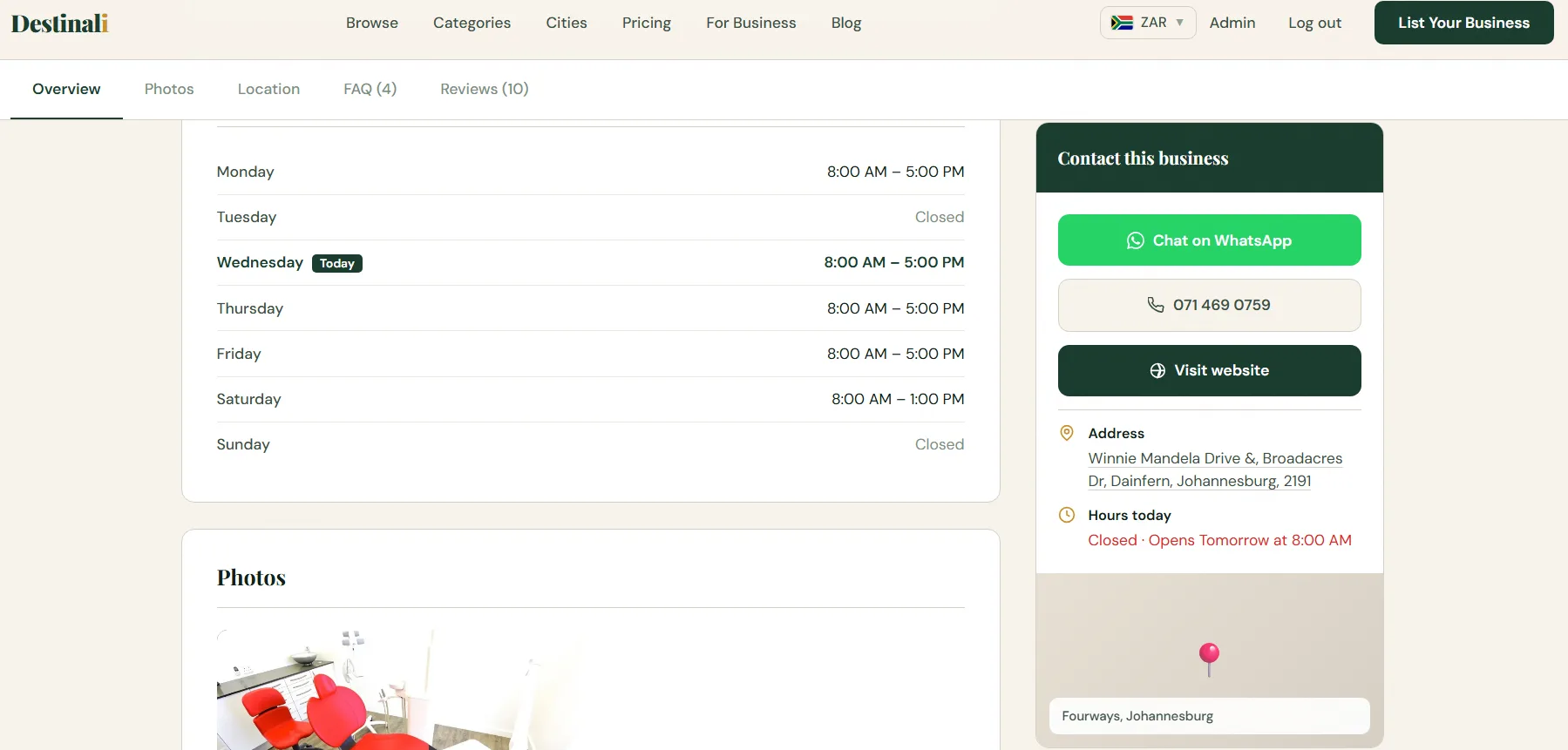
Destinali indexes over one million verified businesses across 54 African countries and 95+ categories – making it one of the most comprehensive sources of structured business data for African SMBs. Ensuring your listing is accurate on a platform with that breadth of coverage strengthens the consistency signal that search engines read.
Step 3: Categorise Inconsistencies
Once you have identified all listings, sort inconsistencies into types: wrong address, outdated phone number, name variation, format difference, and duplicate listings. Understanding the pattern helps you prioritise – a wrong address on a high-authority platform is more urgent than a formatting difference on a low-traffic directory.
Step 4: Use Tools Where Available
Manual searches find a large share of listings but rarely all of them. Citation scanning tools systematically check your business information across hundreds of directories and flag mismatches. Destinali's Local Citation Scanning tool scans your online presence to identify missing, duplicate, outdated, or inconsistent listings – providing a structured picture of citation problems that may be limiting local search performance.
How to Fix NAP Inconsistencies
Correction is methodical work. The process differs depending on the type of listing and the platform involved.
Claim and Correct Listings You Control
For platforms that allow business owners to claim and manage their profiles, go through the verification process to gain control. Once claimed, update every field to match your master NAP exactly. While you have access, complete any additional profile fields – categories, business description, hours, photos – as a complete profile performs better than a minimal one.
Contact Platforms That Do Not Allow Self-Correction
Some directories do not offer a self-service editing option. Contact the platform operator directly and request a correction. Provide documentation – your official business registration, a screenshot of your verified Google Business Profile, or another authoritative reference. Be persistent. Some directories are slow to respond, and a follow-up after two weeks is often necessary.
Handle Duplicate Listings
Duplicate listings on the same platform compete against each other and confuse both search engines and customers. Google Business Profile has a specific process for reporting and merging duplicates. For other platforms, contact support with evidence that both listings refer to the same business and request that the incorrect or older one be removed or merged.
Accept Some Exceptions
Not every listing can be corrected. Abandoned directories, locked listings, or unresponsive operators will occasionally leave an inconsistency in place. Document these exceptions in your spreadsheet and move on. As you build a larger body of accurate, high-authority citations, a small number of unresolvable inconsistencies matter progressively less.
Maintaining NAP Accuracy Over Time
A one-time audit and correction is not enough. Business information changes, new listings appear without your involvement, and directories update their data from aggregators on unpredictable schedules. NAP management is an ongoing practice, not a one-time project.
Audit on a Regular Schedule
For most businesses, a full NAP audit once a year is sufficient – supplemented by a targeted check any time the business moves, changes its phone number, or updates its trading name. Businesses operating multiple locations, or in sectors where directories are particularly active (hospitality, healthcare, legal), benefit from a twice-yearly review.
Update Your Master NAP Before Changing Listings
When a business change is imminent – a new address, a new phone number, a rebrand – update the master NAP document first, then systematically apply changes across platforms. Starting with your website and Google Business Profile, then working through major directories, ensures the most authoritative sources are updated before the change propagates through aggregators.
Control Who Creates Listings
Define clearly within your organisation who has the authority to create or modify online listings. Provide anyone in that role with a copy of the master NAP and examples of the correct format. When working with marketing agencies or vendors, brief them explicitly and verify their work before accepting it.
Monitor for New Listings
New listings can appear without your involvement – scraped from other platforms, created by customers, or generated by aggregators. Periodic manual searches for your business name and phone number will surface new listings before they accumulate errors.
Common mistakes that stop businesses from ranking in local search often trace back to exactly this problem: listings created once and never revisited, with outdated information sitting undetected across directories for months or years.
NAP Management for Multi-Location Businesses
Businesses operating more than one location face a more complex NAP challenge. Each location must be treated as a distinct entity with its own verified data – not a variation of a central listing.
Each location needs its own dedicated Google Business Profile with a unique, location-specific phone number. A single central number listed across all branches prevents Google from verifying each location as a distinct place. This distinction matters not just for Google but for every directory and aggregator that holds your data.
Format consistency must apply across all locations simultaneously. If one branch lists its address as "3rd Floor, Westlands Road" and another lists "Westlands Rd, Floor 3," that inconsistency degrades the authority of both. The master NAP document for a multi-location business should include a separate record for each location, with its own verified address, phone number, and any location-specific identifiers.
Website structure also matters. Each location should have its own dedicated page with its unique NAP data displayed in text format and marked up with LocalBusiness schema. A single contact page listing all locations without dedicated pages reduces search engines' ability to associate each location with its specific geographic area.
NAP and AI-Powered Search Discovery
AI search engines are increasingly central to how customers find local businesses. When someone asks an AI tool to recommend a hotel in Kampala, a law firm in Abuja, or a dental clinic in Cape Town, the AI draws on structured business data from multiple web sources to generate its answer. The businesses it cites with confidence are the ones whose data is clean and consistent.
How AI search engines decide which local businesses to cite comes down largely to data trustworthiness. When the same name, address, and phone number appear consistently across authoritative sources, AI systems treat that business as a reliable, verified entity. When data conflicts, these systems either skip the business or caveat their recommendation – neither outcome serves the business well.
NAP consistency is therefore a foundational requirement for AI search visibility, not just traditional SEO. As AI-generated recommendations become a growing share of how customers discover local services, the businesses that maintain clean, structured, consistent data will have a structural advantage over those that do not.
Where NAP Management Is Heading
NAP management as a discipline is evolving alongside changes in search, AI, and customer discovery behaviour. Several trends are shaping what this practice will look like over the next two to five years.
Structured data will carry more weight. As AI systems become more sophisticated in how they ingest and cross-reference business information, schema markup – the machine-readable version of your NAP and business details – will become an increasingly important signal alongside plain-text citations. Businesses that implement LocalBusiness schema now are building a foundation that will compound in value.
AI discovery will expand beyond traditional directories. The sources AI systems draw from are broader than the traditional directory ecosystem. Authoritative content on industry platforms, local news mentions, and structured business profiles on specialised platforms all contribute to the entity picture an AI builds for your business. NAP management will increasingly include ensuring consistent information across these non-traditional sources.
Automation will become essential at scale. Managing NAP across dozens of directories manually is already time-intensive for a single location. As the number of platforms that hold business data grows, centralised NAP management tools – those that push updates from a single master record to connected platforms simultaneously – will become standard practice rather than an enterprise option.
Accuracy will outweigh volume. The SEO value of having listings on hundreds of low-quality directories is declining. Search engines and AI systems are placing greater weight on the quality and authority of the sources that cite your business information. A smaller number of accurate, high-authority citations is more valuable than a large volume of inconsistent ones.
FAQ
What Does NAP Stand for in Local SEO?
NAP stands for Name, Address, and Phone number. These three pieces of information are the core identifying data that search engines use to verify a local business and match it to customer searches. When a website URL is also included, the combination is called NAP+W. Consistent NAP data across directories, maps, and social platforms is one of the foundational requirements for strong local search visibility.
How Does NAP Inconsistency Affect Search Rankings?
Inconsistent NAP data reduces the confidence that search engines have in your business information. When different platforms show different addresses, phone numbers, or business name variations, search engines treat each version as potentially referring to a different entity. This dilutes your ranking authority and can cause your business to drop out of the local map pack. Research indicates that NAP consistency contributes to 7–11% of local SEO ranking factors, and significant inconsistencies can cause a drop of two to three ranking positions.
How Do I Find All the Places My Business Is Listed Online?
Search your business name in quotation marks on Google, then search your phone number and address separately. Each search will surface directory pages and third-party listings holding your information. A citation scanning tool automates this process by checking your business information across hundreds of directories simultaneously and flagging mismatches, duplicates, and missing entries.
Does NAP Consistency Matter for AI Search Tools Like ChatGPT and Perplexity?
Yes, and the impact may be greater than for traditional SEO. AI search tools build their understanding of a business by cross-referencing multiple sources simultaneously. When NAP data is consistent across those sources, AI systems cite the business with confidence. When the data conflicts, they either omit the business or qualify their recommendation. Consistent NAP is now a foundational requirement for AI-powered local discovery, not just Google rankings.
How Often Should I Audit My NAP Data?
For most single-location businesses, an annual full audit is sufficient, supplemented by a targeted check whenever the business changes its address, phone number, or trading name. Businesses with multiple locations, or those operating in sectors with active directory ecosystems such as healthcare, hospitality, or legal services, benefit from auditing every six months. Errors accumulate silently, and the cost of correcting them grows the longer they sit unaddressed.
What Is the Difference Between NAP Consistency and NAP Accuracy?
NAP accuracy means the information is correct – the address exists, the phone connects, the name matches what the business actually trades under. NAP consistency means the information appears in the same format across all platforms. Both matter, but accuracy is the higher priority. A consistently formatted wrong address is worse than a slightly inconsistently formatted correct one. The practical goal is information that is both accurate and consistent.
How Long Does It Take for NAP Corrections to Improve Search Rankings?
Search engines re-index directory data on different schedules, and corrections do not produce instant results. Most businesses see ranking improvements within 30 to 90 days of completing a thorough NAP correction across major platforms. Complex situations – such as widespread format errors, duplicate listings, or previous address information that has spread through aggregators – can take up to 120 days to fully resolve. Starting with your Google Business Profile, website, and highest-authority directories produces the fastest improvement.
Do I Need a Different Phone Number for Each Business Location?
Yes, for multi-location businesses. Each Google Business Profile must have a unique, location-specific phone number to be treated as a distinct location by Google's verification system. Using the same central or toll-free number across all locations causes Google to question whether each profile represents a genuinely separate place, which can lead to profile suppression or lower confidence in location data. A local direct-dial number per location – even if it forwards to a central team – is the correct approach.
What Should a Master NAP Record Include?
A master NAP record is a single authoritative document containing the exact, canonical version of your business name, address, and phone number – including the precise format, abbreviations, punctuation, and country code conventions you will use on every platform. For multi-location businesses, it includes a separate entry for each location. The document should also note any known name variations or old information that has appeared online, so they can be identified and corrected during audits.
Key Takeaways
- NAP – Name, Address, and Phone number – is the core identity data that determines whether search engines and AI tools trust, rank, and recommend your business to nearby customers.
- Inconsistent NAP data confuses search engines, dilutes local ranking authority, reduces customer trust, and can cost significant revenue. Corrections take 30–120 days to take effect, making prevention far more efficient than repair.
- The most common causes of NAP inconsistency are business changes applied inconsistently, address format variations, third-party data entry errors, multiple people managing listings without a shared standard, and historical accumulation of unmanaged citations.
- Creating a master NAP record – the exact, canonical version of your business details – is the essential first step before auditing or correcting any listings.
- A NAP audit involves finding every listing online, checking each against the master NAP, categorising inconsistencies, and correcting them by priority, starting with Google Business Profile and high-authority directories.
- Implementing LocalBusiness schema markup on your website gives search engines a machine-readable declaration of your NAP and reduces dependence on text extraction across third-party sources.
- NAP consistency is now a requirement for AI search visibility, not just traditional SEO. AI systems cite businesses whose data is clean and consistent; they avoid or caveat businesses whose data conflicts.
- Multi-location businesses must treat each location as a distinct entity with its own verified address, dedicated phone number, and location-specific directory listings.
- NAP management is an ongoing practice. Regular audits, a controlled update process for business changes, and clear internal ownership of listing management are what keep accuracy from deteriorating over time.
African businesses can create a free listing on Destinali to establish a verified, accurate business profile that contributes to consistent NAP data across one of Africa's largest structured business directories.

Destinali helps local businesses improve online visibility, discoverability, and customer acquisition across search engines, AI systems, maps, and local search platforms.
List your business →