What Is Local Rank Tracking and Why Does It Matter for Your Business
Local rank tracking is the practice of monitoring where your business appears in search results for specific locations – a city, a neighborhood, or a service area. Unlike standard SEO tracking, which measures rankings across a broad audience, local rank tracking tells you exactly what a potential customer sees when they search for your type of business from a specific place. For small businesses that depend on nearby customers, this distinction is everything.
Why Local Search Is Different From General Search
When someone searches for "plumber near me" or "best restaurant in Lagos," Google does not return the same results for everyone. Search engines personalize results based on the searcher's physical location, often down to the street level. A salon in Nairobi's Westlands neighborhood may rank first for customers in that area but be entirely invisible to someone searching from a different part of the city.
This location-based personalization is what makes local rank tracking a separate discipline from general SEO. A traditional SEO tool might show your website ranking on page one but that figure could reflect an average across thousands of locations. Local rank tracking removes that ambiguity. It shows your actual position as experienced by real people in the specific places where you want to win customers.
For businesses in competitive urban markets – Accra, Lagos, Nairobi, Cape Town, London, Manila, or Toronto – rankings can shift dramatically across short distances. Knowing your position at that level of detail is the starting point for any meaningful local SEO strategy.
What the Google Local Pack Is
The Google Local Pack is the group of three business listings that appear near the top of Google's search results, usually accompanied by a map. When someone searches for "dentist in Lekki" or "hotel near Victoria Island," the Local Pack is often the first thing they see – appearing above the standard website results.
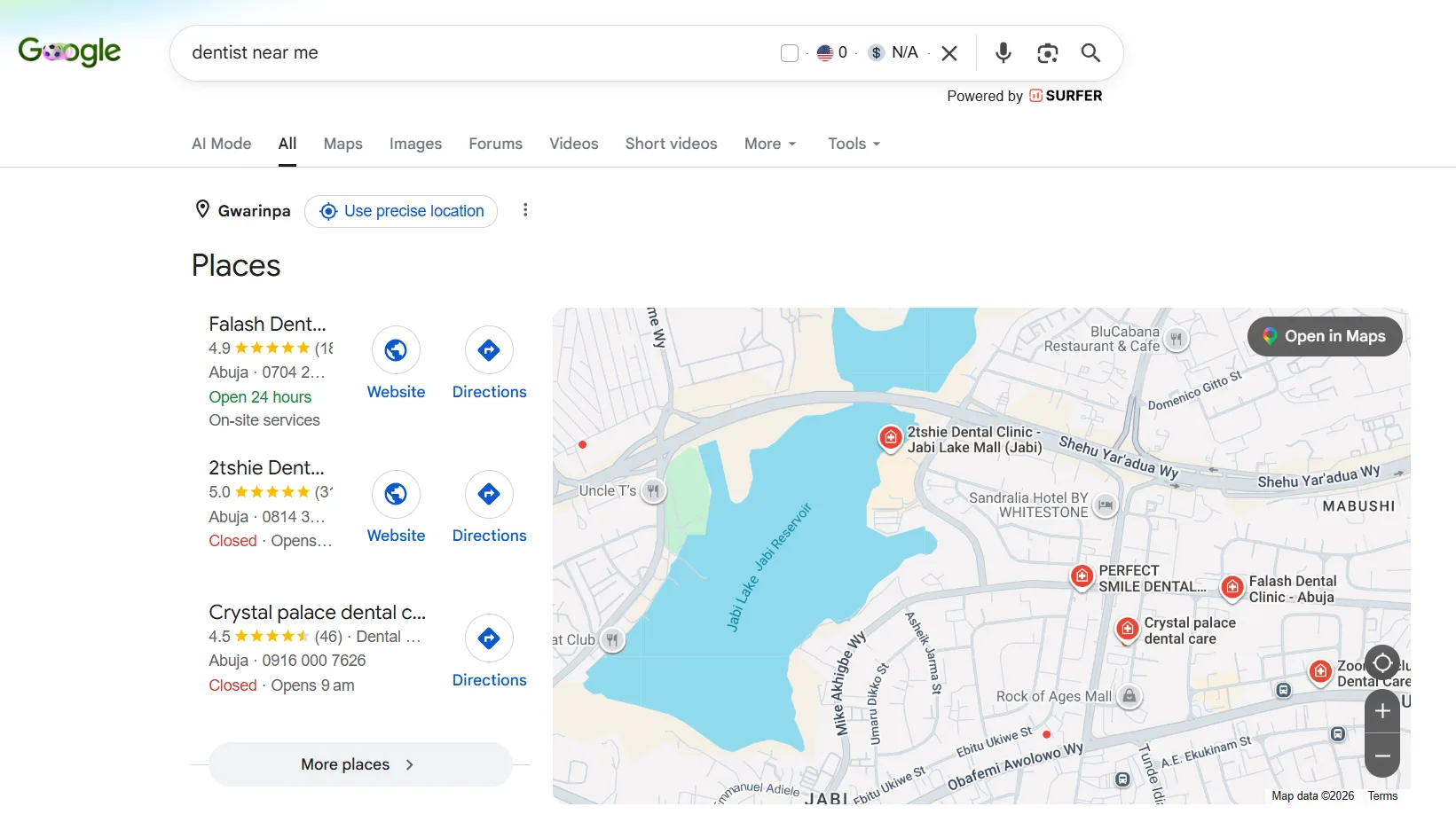
The Google Local Pack is a prominent search result feature that displays up to three local businesses alongside a map, triggered when Google determines that a search has local intent. Businesses that appear in the Local Pack receive significantly more clicks and calls than those listed below it in standard organic results.
Appearing in the Local Pack is one of the most valuable outcomes of local SEO. Studies consistently show that Local Pack listings attract far more attention than organic results further down the page. Local rank tracking tells you whether your business is appearing in the Local Pack for your target keywords and if not, how far you are from that threshold.
How Local Rank Tracking Works
Local rank tracking tools simulate searches from specific geographic locations and record where your business appears in those results. Instead of checking "how do I rank globally for this keyword," you ask "how do I rank for this keyword when someone searches from a particular neighborhood, city, or postal code."
The process typically works like this:
- You select the keywords your customers use to find businesses like yours (e.g., "accountant in Abuja" or "hair salon near Ikeja").
- You specify the locations where you want to measure performance – cities, districts, or even specific coordinates.
- The tracking tool runs simulated searches from those locations and captures your ranking position.
- Results are compiled into reports you can review regularly, track over time, and compare against competitors.
Local rank tracking on Destinali, for example, is built to monitor keyword rankings across cities, neighborhoods, and service areas – giving businesses the location-specific data needed to understand where they are visible and where they are not.
Tracking should be done on a recurring basis – weekly or monthly – because local rankings shift. A competitor improves their listing, a new business opens nearby, Google updates its algorithm, and your position changes. Monitoring over time catches these shifts early.
Why Rankings Vary by Location and Device
One of the most important things to understand about local search is that your ranking is not a single fixed number. Search results vary based on:
Where the searcher is located. A customer two blocks from your business may see you ranked first. Someone in a neighboring district may not see you in the top ten. The same keyword produces different results at different GPS coordinates.
The device being used. Mobile searches and desktop searches often return different results. Mobile users searching "near me" while out in a city tend to see highly location-specific results. Desktop users at home may get slightly different rankings. Mobile optimization matters significantly here, since a large share of local searches happen on smartphones.
The time of search. For some categories – restaurants, pharmacies, emergency services – Google weights business hours and real-time availability in how it ranks results.
This means a business can have very different visibility profiles depending on who is searching and from where. Local rank tracking accounts for these variables by letting you test rankings across multiple locations and device types, giving you an accurate map of your actual visibility rather than a misleading average.
The Business Case for Local Rank Tracking
Understanding your local rankings has direct commercial value. Here is why it matters for day-to-day business decisions.
You Find Out Where You Are Actually Losing Customers
Without location-specific data, you cannot know which areas of your city are generating business and which are not. A restaurant in Accra may be well-known in one district but invisible to customers searching from a nearby area. Local rank tracking identifies these gaps precisely, so resources go toward fixing the right problems.
You Can Respond to Competitor Moves
Competitors work on their local SEO too. A new business listing, a surge in positive reviews, or an updated Google Business Profile can shift rankings quickly. Consistent local rank monitoring helps you detect when a competitor has climbed past you and gives you the data to respond before the change affects your revenue.
You Measure Whether Your Efforts Are Working
Local SEO takes time. Updating your business profile, building citations, and gathering reviews do not produce instant results. Local rank tracking provides the feedback loop that tells you whether those efforts are moving the needle. Without it, you are investing time and money with no clear signal of whether it is paying off.
You Make Smarter Decisions With Limited Resources
Most small businesses do not have large marketing budgets. Local rank tracking shows exactly which keywords and locations deserve attention so effort is concentrated where it produces the most return. There is no need to guess which part of the city to target or which keywords to prioritize when the data makes it clear.
Local Rank Tracking Vs. Traditional Rank Tracking
These two approaches serve different purposes. The table below explains the key differences.
| Factor | Traditional Rank Tracking | Local Rank Tracking |
|---|---|---|
| What it measures | Rankings across a broad or national audience | Rankings from specific cities or neighborhoods |
| Useful for | E-commerce, national brands, online services | Brick-and-mortar businesses, service areas, local brands |
| Result type | Average position across many locations | Position as seen from a specific location |
| Local Pack visibility | Not tracked | Tracked directly |
| Device variation | Often limited | Captures mobile and desktop separately |
| Granularity | Low (country or region level) | High (city, district, or GPS coordinate) |
A business that relies on local customers – a clinic, a hotel, a law firm, a salon, a real estate agency – needs local rank tracking specifically. Traditional tracking gives a picture that is too broad to be useful for competing in a specific city.
What Affects Your Local Ranking
Local search rankings are shaped by three core factors that Google uses to decide which businesses to show and in what order.
Relevance
How closely does your business match what the searcher is looking for? This depends on the accuracy and completeness of your business listing, the categories you are listed under, and the content on your website. A business that has not clearly described what it does will rank lower than one that has.
Distance
How far is your business from the searcher? Google estimates the searcher's location and favors nearby businesses for local queries. This is why ranking higher on Google Maps in your specific city requires a strategy that goes beyond just having a website – your location signals, business address data, and map listing all feed into this calculation.
Prominence
How well-known and trusted is your business online? Google looks at reviews, the number and quality of citations across the web, backlinks, and overall online reputation. A business with 200 positive reviews and consistent listings across directories will generally outrank one with minimal online presence, even if the latter is closer to the searcher.
Understanding these three factors helps you interpret your local rank tracking data and identify which lever to pull first.
Where Local Search Is Heading
Local search is not static. Two shifts are worth tracking closely.
AI-powered search is changing how results are surfaced. Tools like ChatGPT, Google's AI Overviews, and Perplexity increasingly answer local business queries directly, without the user clicking a link. When someone asks an AI assistant "which accountant should I call in Nairobi," the response is generated from structured business data across the web – not just Google rankings. Businesses that maintain accurate, consistent information across directories and listings are better positioned to appear in these AI-generated answers. Business visibility across AI search tools is becoming as important as traditional map rankings.
Hyper-local targeting is becoming more precise. Search platforms are getting better at serving results at the neighborhood level rather than the city level. A business that tracks only at the city level may miss important visibility gaps within districts or service zones. Tracking at finer geographic granularity will become standard practice for competitive local markets.
FAQ
What Is Local Rank Tracking?
Local rank tracking is the process of monitoring where your business appears in search results when someone searches from a specific location. It measures your ranking position for target keywords – such as "hotel in Abuja" or "electrician near me" – as experienced by searchers in particular cities, neighborhoods, or areas, rather than showing a generic average position.
How Is Local Rank Tracking Different From Regular SEO Tracking?
Regular SEO tracking measures how a website ranks for keywords across a broad or national audience. Local rank tracking measures how a business ranks from specific geographic locations – a city, a district, or a set of GPS coordinates. Local tracking also captures Local Pack rankings, which appear above standard organic results and are not visible in traditional SEO reports.
Why Do My Rankings Differ Depending on Location?
Google personalizes search results based on the searcher's physical location. A customer standing outside your business and one searching from across the city will often see different results for the same keyword. Rankings vary because Google weights proximity differently depending on where the search originates – which is why tracking from multiple locations gives a more accurate picture of your real visibility.
What Is the Google Local Pack and Why Does It Matter?
The Google Local Pack is the group of three business listings with a map that appears near the top of search results for local queries. It is the most visible position on the search results page for local searches. Businesses in the Local Pack receive substantially more clicks, calls, and direction requests than those listed below it in standard organic results.
Do I Need Local Rank Tracking If I Already Have a Google Business Profile?
Yes. A Google Business Profile (GBP) is essential, but it does not tell you how you rank relative to competitors, or how your visibility varies across different parts of your city. Local rank tracking answers those questions. GBP shows that your listing exists; local rank tracking shows where it appears when customers search.
How Often Should I Check My Local Rankings?
Weekly or monthly tracking is appropriate for most small businesses. Rankings shift due to competitor activity, algorithm updates, and changes in your own listing or reviews. Monthly tracking captures meaningful trends without requiring daily attention. Businesses in highly competitive local markets may benefit from more frequent monitoring.
Can a Business Rank Locally in a City Where It Has No Physical Address?
It is possible but more difficult. Google generally favors businesses with a verified address in the area where they want to rank. Service-area businesses – those that travel to customers rather than receiving them at a fixed location – can indicate their service areas in Google Business Profile, which helps with local visibility. However, the absence of a physical address in a target city typically reduces ranking strength compared to businesses located there.
Key Takeaways
- Local rank tracking measures where your business appears in search results from specific locations – a city, neighborhood, or service area.
- Search results are personalized by location, meaning your ranking varies for different customers even searching the same keyword.
- The Google Local Pack – the map and top three listings – is the most valuable position in local search. Local rank tracking shows whether and where you appear in it.
- Rankings are shaped by three factors: relevance (how well your listing describes your business), distance (how close you are to the searcher), and prominence (your reviews, citations, and online reputation).
- Local rank tracking is distinct from traditional SEO tracking, which measures broad or national rankings and does not capture Local Pack performance.
- Regular tracking creates a feedback loop – it shows whether your local SEO efforts are working and alerts you when a competitor's position improves.
- AI-powered search is an emerging factor: businesses with consistent, structured data across the web are better positioned to appear in AI-generated local recommendations.
Businesses serious about growing their local visibility can track their local rankings with Destinali's local rank tracking tool, which monitors keyword positions across cities, neighborhoods, and service areas in one place.
Destinali helps local businesses improve online visibility, discoverability, and customer acquisition across search engines, AI systems, maps, and local search platforms.
List your business →