What Is Local Pack and Why Does It Matter for Your Business?
When someone searches "dentist near me" or "best salon in Lagos," Google often responds not with a list of blue links but with a map and three business listings displayed prominently at the top of the page. That block is the Local Pack and for local businesses, appearing there is one of the highest-value positions available in search. Businesses that earn Local Pack visibility receive 126% more traffic and 93% more user actions – calls, clicks, and direction requests – than those ranked below the top three.
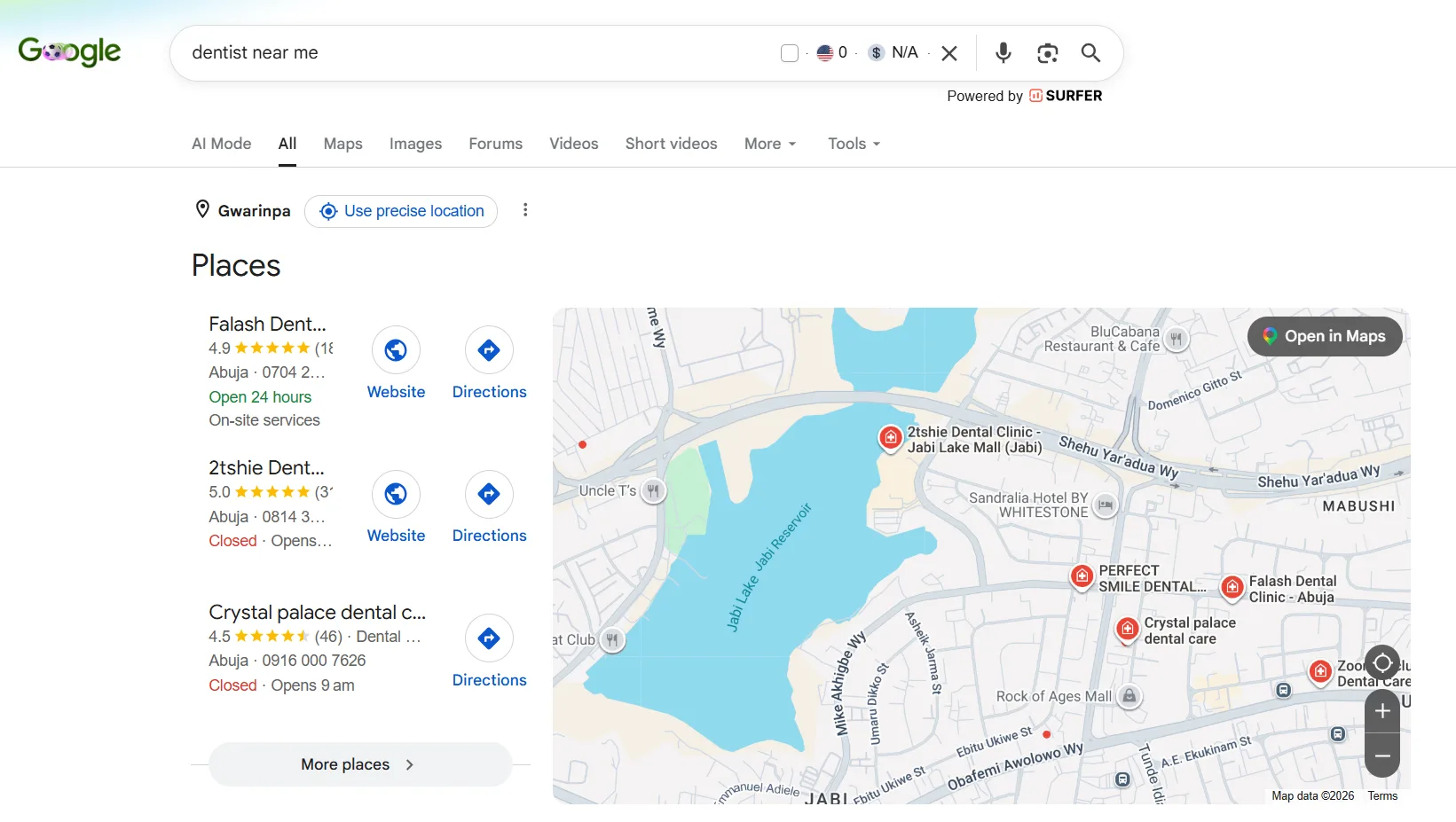
This guide explains how the Local Pack works, what determines who appears in it, and exactly what you need to do to earn your place there.
What the Local Pack Is
The Local Pack is a map-based block that appears near the top of Google's search results when a query has local intent. It shows three business listings alongside a map, each displaying the business name, star rating, address, phone number, hours, and sometimes photos or review excerpts.
The Local Pack goes by several names – the "map pack," the "3-pack," and the "local 3-pack" are all common. Before 2015, Google showed seven business listings in this section. The shift to three was driven by mobile usability: fewer results, faster decisions, better experience for users on small screens.
The Local Pack sits above organic search results. That placement gives it priority attention. A user who searches for a plumber, a restaurant, or a clinic will see the Local Pack before any traditional website listings. For businesses that depend on local customers, this is where the first impression happens.
How the Local Pack Differs From Organic Results
The Local Pack and organic search results look different, behave differently, and are driven by different signals entirely.
Organic results are ranked based on website content, backlinks, page authority, and technical performance. The Local Pack draws its information primarily from Google Business Profiles – not from website content alone. A business can rank in the Local Pack without appearing on the first page of organic results, and a business with a strong website can rank organically while being completely absent from the Local Pack.
The user behavior is also different. Organic results require a click to a website. The Local Pack gives the user what they need immediately: contact details, directions, reviews, and hours. Many users call or navigate directly from the pack without ever visiting a website. This makes Local Pack visibility especially valuable for service businesses, clinics, restaurants, and retail shops where the customer's decision is made quickly.
What Triggers a Local Pack
Google displays a Local Pack when it detects local intent in a search query. Three types of queries trigger it:
- Explicit location queries – searches that include a place name, neighbourhood, or city. "Accountant in Nairobi" or "hotel in Cape Town CBD" are clear examples.
- Near-me queries – searches using "near me" or "nearby." Google uses the searcher's device location to determine which results to show.
- Implied local queries – searches without a location that Google interprets as locally motivated. A user in Accra searching "barber" without specifying a city will likely see a Local Pack based on their detected location.
Google shows a Local Pack for approximately 93% of local searches. Understanding which queries trigger one for your industry and service area is a foundational step in any local visibility strategy.
How Google Decides Which Businesses Appear
Google uses three core factors to determine which businesses appear in the Local Pack: relevance, distance, and prominence. Each plays a distinct role.
Relevance
Relevance measures how well a business profile matches the searcher's query. Google evaluates the business category, name, description, services listed, and the overall completeness of the Google Business Profile. A clinic that lists "paediatric care" as a service and includes detailed descriptions will be more relevant to a search for "paediatric clinic near me" than a clinic with a generic "medical practice" label and no service detail.
Distance
Distance is the proximity of the business to the searcher's location or the place named in the query. This is the one factor a business cannot directly control. A competitor located two streets away from the searcher will have a proximity advantage regardless of how well-optimized your profile is. For businesses with multiple locations, each location competes independently – a restaurant group with eight branches is competing for eight separate Local Pack positions across different areas.
Prominence
Prominence is Google's measure of how well-known and trusted a business is. It draws on review volume and quality, consistency of business information across the web, backlinks, and overall online presence. A salon with 200 Google reviews averaging 4.6 stars and consistent listings across 30+ directories will outperform a newer salon with five reviews and incomplete directory data – even when both are equally close to the searcher.
Step-by-Step: How to Get Your Business Into the Local Pack
Step 1: Claim and Verify Your Google Business Profile
Your Google Business Profile (GBP) is the foundation of Local Pack visibility. Without a verified profile, your business cannot appear in the pack at all.
Go to Google Business Profile, search for your business name, and claim it if it already exists, or create a new listing. Complete the verification process – Google typically verifies by video, phone, or postcard. A verified profile is the entry requirement for everything that follows.
Many businesses in markets across Africa, the Philippines, and other high-growth regions have unclaimed profiles sitting idle. Claiming yours is the single fastest action you can take.
Step 2: Complete Every Section of Your Profile
A half-finished profile is less competitive than a complete one. Google rewards completeness. Fill in every available field:
- Business name (exactly as it appears on your shopfront or official registration)
- Address and service area
- Phone number
- Website URL
- Business hours, including holiday hours
- Business category – primary and secondary categories
- Services and products with descriptions
- Business description (use natural language that reflects what customers search for)
Businesses with fully completed profiles are significantly more likely to appear in Local Pack results than those with partial information.
Step 3: Add High-Quality Photos
Photos increase profile engagement. Google Business Profiles with photos receive more direction requests and website clicks than those without. Upload images that accurately represent your business: the exterior, interior, team, products, or services.
Update photos regularly. An active profile signals to Google that the business is operating and engaged. Detailed guidance on optimising Business Profile photos can further strengthen this signal.
Step 4: Choose the Right Business Categories
Your primary category is one of the strongest relevance signals Google uses to match your business to queries. Choose the most specific category available – not a broad parent category.
A physiotherapy clinic should select "Physical Therapist," not "Health." A Nigerian restaurant should select "Nigerian Restaurant," not "Restaurant." Secondary categories allow you to capture additional search intent: a hotel that also serves food can add "Restaurant" as a secondary category.
Step 5: Build Consistent NAP Data Across the Web
NAP stands for Name, Address, and Phone number. Google cross-references your business information across directories, listing platforms, and your own website. When the data matches, Google's confidence in your business details increases, which supports Local Pack ranking.
Inconsistencies – a different phone number on one directory, an old address on another – dilute that trust signal. Audit your listings across major platforms and correct any discrepancies. Destinali's NAP management tool maintains accurate business details across search engines, maps, directories, and business listings to keep this data consistent at scale.
Step 6: Build Local Citations
A local citation is any online mention of your business name, address, and phone number – whether on a directory, a news site, or an industry platform. Citation volume and accuracy are prominence signals that influence Local Pack rankings.
Start with the major general directories: Google, Bing Places, Apple Maps, Yelp, and any regional equivalents relevant to your market. Then move to industry-specific directories: TripAdvisor for hospitality, Zocdoc or similar for healthcare, legal directories for law firms. Consistent local citation data helps search engines match your business accurately across platforms.
Step 7: Generate and Respond to Google Reviews
Reviews are a direct ranking factor in Local Pack placement. Google considers the number of reviews, the average rating, and the recency of reviews when evaluating prominence.
Ask satisfied customers to leave a review. Make it easy: send a direct link to your Google review page via WhatsApp message, email, or a printed card at the point of service. Respond to every review – positive and negative. Responses signal active management and build trust with both customers and Google.
Businesses that consistently generate new reviews maintain a stronger Local Pack position than those with a static review count. More Google reviews also improve click-through rates: users scan star ratings before deciding which listing to tap.
Step 8: Align Your Website With Local Search Intent
Your website supports your Local Pack ranking through relevance and prominence signals. Include location-specific content: service pages that name the cities or neighbourhoods you serve, a clear contact page with your full address, and schema markup that tells search engines exactly what your business is and where it operates.
Use the free schema generator from AuthorityStack.ai to create LocalBusiness JSON-LD markup without any technical knowledge. Structured data gives Google a machine-readable description of your business, which supports both Local Pack inclusion and AI search visibility.
Why the Local Pack Matters More Than Most Businesses Realise
The Local Pack captures a disproportionate share of clicks for local queries. The top position in the pack receives roughly 24% of all clicks. Positions four and below – requiring an extra click on "More places" – see dramatically lower engagement. For practical purposes, local search visibility means the top three or it means very little.
The intent behind local searches is also unusually high. Research shows that 76% of people who search for something nearby on their smartphone visit a business within a day, and 28% of those searches result in a purchase. The Local Pack is the primary interface for this behaviour. A restaurant, clinic, law firm, or hotel that does not appear in the Local Pack for its core queries is invisible to the highest-intent customers in its area – people who are ready to act.
For businesses in African markets and other high-growth regions where mobile search dominates, this matters even more. The Local Pack is often the first and only result a mobile user engages with. Being absent from it is not a minor visibility gap; it is a customer acquisition problem.
What the Local Pack Does Not Include
Two things are commonly confused with the Local Pack: Google Ads and Local Services Ads.
Paid search ads appear above the Local Pack but are clearly labeled as "Sponsored." They require ongoing budget and do not influence organic Local Pack placement. Paying for Google Ads does not improve your Local Pack ranking.
Local Services Ads (labeled "Google Verified") appear as a separate block for certain service categories – plumbers, electricians, and similar trades in markets where the programme operates. These are a paid placement distinct from the organic Local Pack and operate under a separate system.
The three listings in the organic Local Pack are earned, not bought. They are the result of profile optimisation, citation consistency, review management, and website relevance signals applied over time.
FAQ
What Is a Local Pack in Simple Terms?
The Local Pack is a block that appears near the top of Google search results for location-based queries. It shows a map and three business listings, each with a name, address, phone number, star rating, and hours. Users can call, get directions, or visit a website directly from the pack without clicking through to a search results page.
Why Does My Business Not Appear in the Local Pack?
The most common reasons are an unclaimed or incomplete Google Business Profile, inconsistent business information across directories, too few customer reviews, and missing or inaccurate business categories. A business that has not verified its profile with Google will not appear in the Local Pack at all.
Does Paying for Google Ads Guarantee a Local Pack Position?
No. The organic Local Pack is separate from paid advertising. Google Ads can place a sponsored listing above the Local Pack, but paying for ads does not improve a business's position in the organic three-pack. Local Pack rankings are earned through profile optimisation, review signals, citation consistency, and proximity.
How Long Does It Take to Rank in the Local Pack?
There is no fixed timeline. A newly verified, fully optimised profile can begin appearing for lower-competition queries within a few weeks. More competitive markets and queries – such as "hotel in Nairobi" or "lawyer in Lagos" – take longer and require stronger review volume and citation authority. Consistency over months matters more than any single optimisation action.
Can a Business Appear in the Local Pack for Multiple Cities?
A physical business location competes for the Local Pack in the area surrounding that location. A business with multiple locations can appear in the Local Pack for each location's area, with each competing independently in its local market. Service-area businesses without a physical shopfront can specify a service area in their Google Business Profile, which allows them to appear for queries across that area.
Do Reviews Affect Local Pack Rankings?
Yes. Review volume, average rating, and recency are all prominence signals that Google uses to rank businesses in the Local Pack. A business with more recent, high-quality reviews consistently outperforms one with fewer or older reviews – even when other factors are similar.
Is the Local Pack Different From Regular Google Search Results?
Yes. Regular organic search results are ranked based on website content, backlinks, and technical SEO factors. The Local Pack ranks based on Google Business Profile data, review signals, citation consistency, and proximity to the searcher. A business can rank well in one and not appear in the other – they are separate systems with different optimisation requirements.
How Does the Local Pack Affect AI Search Results?
AI-powered search tools like Google AI Overviews increasingly reference local business data when answering location-based queries. Businesses with well-structured profiles, consistent citations, and strong review signals are more likely to be referenced by AI search tools, extending Local Pack-style visibility into AI-generated answers. Structured data – particularly LocalBusiness schema on your website – strengthens this AI discoverability.
What to Do Now
- Claim and verify your Google Business Profile if you have not done so already.
- Complete every section of your profile: categories, services, hours, photos, and description.
- Audit your business name, address, and phone number across directories and correct any inconsistencies.
- Start a systematic process for requesting and responding to Google reviews.
- Add LocalBusiness schema markup to your website using the free schema generator.
- Monitor your Local Pack rankings over time so you can see what is working and where gaps remain.
Local Pack visibility compounds. Each improvement – a more complete profile, stronger review signals, consistent citations – adds to a cumulative signal that Google uses to rank your business. Businesses that take a disciplined, ongoing approach to these fundamentals consistently outperform competitors who treat it as a one-time task.
Businesses looking to close visibility gaps faster can create a free listing on Destinali and get their business found across search engines, maps, and AI-powered discovery platforms.
Destinali helps local businesses improve online visibility, discoverability, and customer acquisition across search engines, AI systems, maps, and local search platforms.
List your business →