How to Create a Lead Generation Funnel for Your Business
A lead generation funnel is the structured path that turns a complete stranger into a paying customer. It moves prospects through five stages – awareness, interest, desire, action, and conversion – with specific content and touchpoints at each step. For African businesses, from Nairobi restaurants to Lagos law firms, building this funnel is how you stop relying on word of mouth and start generating consistent, qualified leads online.
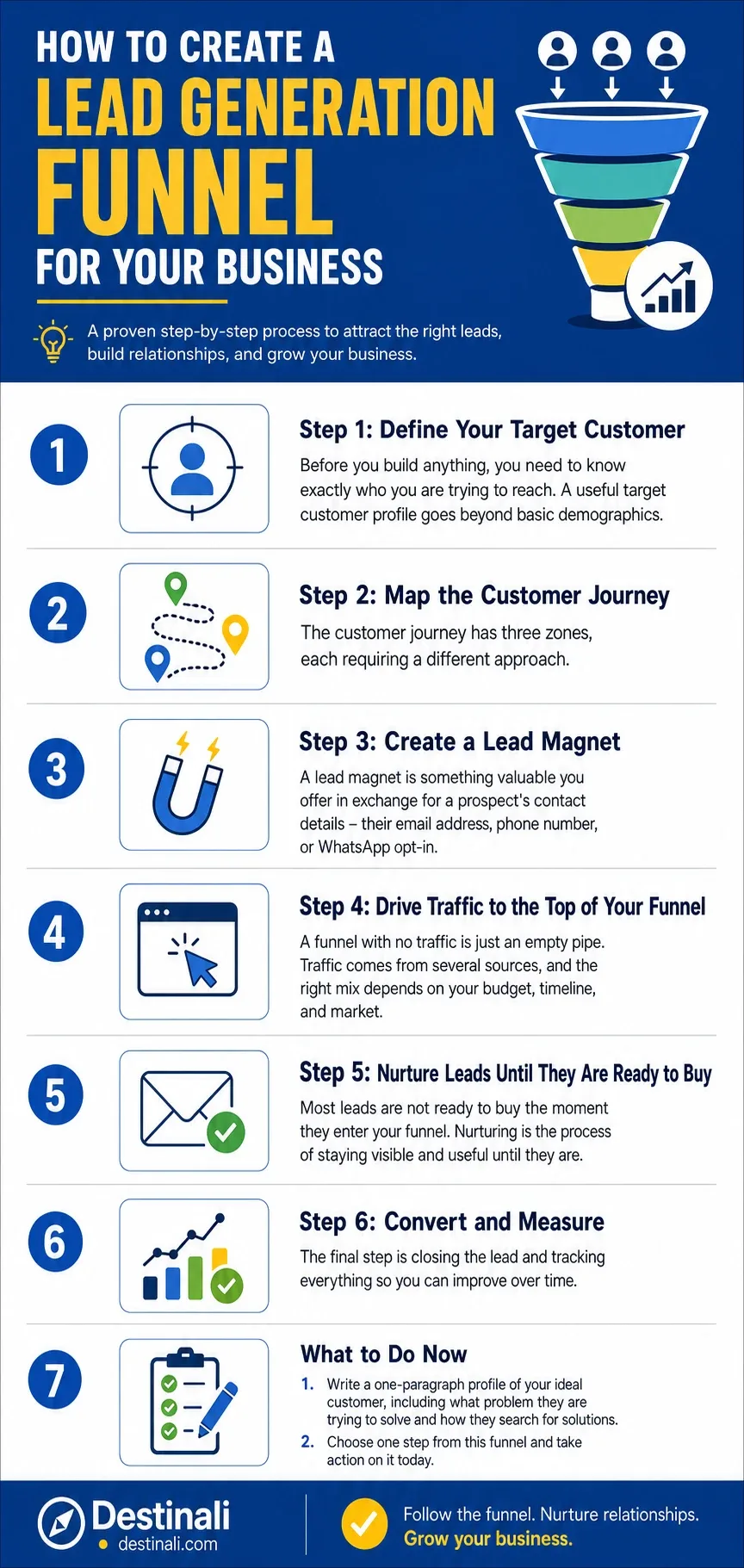
Step 1: Define Your Target Customer
Before you build anything, you need to know exactly who you are trying to reach.
A useful target customer profile goes beyond basic demographics. It captures the specific problem your customer is trying to solve, what they search for online, and what would make them trust you over a competitor. A Nairobi clinic, for example, is not targeting "anyone who gets sick" – it is targeting working professionals who search for specialist services online and book appointments through their phones.
Document your ideal customer's industry, location, common pain points, and how they discover businesses like yours. This profile shapes every decision you make in the funnel, from the content you create to the platforms you prioritise.
Destinali helps African businesses across 54 countries build their online presence in a way that aligns with how real customers search – whether through Google, AI tools, or local discovery platforms. Knowing your customer first makes that presence work harder.
Step 2: Map the Customer Journey
The customer journey has three zones, each requiring a different approach.
Top of Funnel: Awareness
At this stage, the prospect does not know your business exists. They have a problem and are searching for answers. Your job is to appear where they are looking – search engines, social media, local directories, and AI-powered discovery platforms.
Content that works at this stage includes blog posts answering common questions, social media content that surfaces a problem and hints at a solution, and business listings that appear when someone searches "best physiotherapist in Accra" or "hotel near Victoria Island Lagos."
Middle of Funnel: Consideration
The prospect now knows your business exists and is comparing options. They want to know why you are the right choice. This is where your credibility matters most: verified reviews, clear descriptions of your services, comparison content, and specific proof of results.
A business profile with complete information, strong reviews, and accurate contact details is far more persuasive at this stage than a generic social media post.
Bottom of Funnel: Conversion
The prospect is ready to act. The barrier here is friction. A missed call, a slow-loading website, or an unclear price list will send them to a competitor. Remove every obstacle between decision and contact. Make it easy to call, message on WhatsApp, book online, or get directions.
Step 3: Create a Lead Magnet
A lead magnet is something valuable you offer in exchange for a prospect's contact details – their email address, phone number, or WhatsApp opt-in.
The best lead magnets solve a specific problem the prospect already knows they have. They do not need to be long or expensive. What matters is relevance.
Effective lead magnets for African SMBs include:
- Free consultation: Common for lawyers, clinics, financial advisors
- Price guide or package list: Useful for agencies, hotels, contractors
- Checklist or resource: Works for any service business explaining a process
- Exclusive offer or discount: Effective for restaurants, retail, hospitality
A real estate agency in Nairobi, for example, could offer a free PDF guide titled "What to Check Before Signing a Lease in Kenya." Anyone who downloads it has signalled genuine interest in property. That contact now enters the funnel.
Host your lead magnet on a dedicated landing page with a short form. Keep the form to three fields maximum: name, phone or email, and one qualifying question. The more fields you add, the fewer leads you collect.
Step 4: Drive Traffic to the Top of Your Funnel
A funnel with no traffic is just an empty pipe. Traffic comes from several sources, and the right mix depends on your budget, timeline, and market.
Organic Search and Local SEO
Businesses that appear in local search results and AI-generated recommendations receive consistent traffic without paying for each click. This requires a complete, optimised business profile across major discovery platforms, structured data that search engines and AI tools can read, and content that answers the questions your customers are actually typing.
Local lead generation for real estate and services businesses in Africa relies heavily on this channel, since most discovery now starts with a search rather than a referral.
Social Media
Facebook, Instagram, LinkedIn, and TikTok all work for lead generation but the platform should match your audience. A B2B consultancy in Johannesburg will find more traction on LinkedIn. A Ghanaian restaurant chain will perform better on Instagram and Facebook. Choose one or two platforms and focus on them rather than spreading effort across all of them.
Paid Advertising
Paid ads – Google Search, Meta, or programmatic display – accelerate the top of your funnel when budget allows. They are particularly effective during product launches, seasonal promotions, or when entering a new market. The risk is cost: once you stop paying, the traffic stops.
Referrals and Partnerships
Do not underestimate offline and digital referral networks. A hotel in Kigali might partner with a local tour operator. A Cape Town accounting firm might build a referral relationship with a business law firm. These partnerships cost nothing and often produce high-intent leads.
Step 5: Nurture Leads Until They Are Ready to Buy
Most leads are not ready to buy the moment they enter your funnel. Nurturing is the process of staying visible and useful until they are.
Email Sequences
Once a prospect shares their contact details, send a short welcome message confirming what they will receive. Follow it with two or three emails spaced over one to two weeks. Each email should provide genuine value – a useful tip, a relevant case study, or an answer to a question you know they have.
Segment your list from the beginning. A lead who downloaded a price guide has different intentions than one who came through a blog post. The emails they receive should reflect that difference.
WhatsApp Follow-Up
WhatsApp is the dominant messaging channel for business communication across most of Africa. A brief, personalised WhatsApp message after a prospect fills in a form can dramatically improve conversion rates. Keep it professional, reference their specific enquiry, and make it easy for them to respond.
Retargeting Ads
For businesses running paid campaigns, retargeting – showing ads specifically to people who visited your website or landing page but did not convert – brings warm prospects back into the funnel. Conversion rates from retargeting are typically two to five times higher than cold traffic campaigns.
Reviews and Social Proof
Mid-funnel prospects compare businesses based on trust signals. Actively collecting and displaying customer reviews, both on your website and on the platforms where customers search, accelerates the decision. A restaurant with 200 positive reviews closes more table reservations than one with 20, regardless of menu quality.
Step 6: Convert and Measure
The final step is closing the lead and tracking everything so you can improve over time.
Reduce Friction at the Conversion Point
Every extra click, form field, or waiting period between decision and action costs you leads. Make it simple to call you, book a slot, send a WhatsApp message, or complete a purchase. If you use a booking system, test it yourself monthly. If you list a phone number, make sure it is answered.
Track What Is Working
You do not need sophisticated analytics to manage a lead funnel effectively. At minimum, track where each lead came from, how many contacted you, and how many converted to paying customers. A simple spreadsheet or a free CRM is enough to start. What matters is consistency: review the numbers monthly and ask where leads are dropping off.
The most common drop-off points are the landing page (poor offer clarity), the nurture sequence (irrelevant or infrequent emails), and the conversion step itself (too much friction). Identifying which stage is leaking tells you where to focus.
Optimise One Step at a Time
Improve one variable at a time rather than changing multiple things simultaneously. Test a new headline on your landing page for two weeks before changing the form layout. This approach produces clear cause-and-effect data and prevents wasted effort.
FAQ
What Is a Lead Generation Funnel?
A lead generation funnel is a structured process that moves potential customers from first discovering your business to making contact or completing a purchase. It typically has three zones – awareness, consideration, and conversion – each with specific content and actions designed to build trust and reduce friction at every step.
How Many Stages Does a Lead Funnel Have?
Most lead funnels operate across five stages: awareness, interest, desire, action, and conversion. These stages map onto three funnel zones – top (TOFU), middle (MOFU), and bottom (BOFU). The number of stages a business uses in practice depends on the complexity of its sales cycle and the length of the customer's decision process.
What Is the Best Lead Magnet for a Small Business?
The best lead magnet solves a specific problem the target customer already knows they have. For small businesses in Africa, free consultations, price guides, service checklists, and exclusive offers consistently outperform generic content. The lead magnet should be simple to deliver and immediately relevant to the customer's situation.
How Do I Drive Traffic to My Lead Funnel?
Traffic comes from four main sources: organic search and local SEO, social media content, paid advertising, and referral partnerships. Local SEO – ensuring your business appears in search results, AI-powered discovery tools, and maps – is the most cost-effective long-term channel for African SMBs because it generates consistent inbound interest without recurring ad spend.
How Do I Know If My Funnel Is Working?
Track three numbers: how many leads entered the funnel each month, how many progressed to contact or enquiry, and how many converted to paying customers. If the funnel is healthy, each step will show a predictable conversion rate. If leads drop off at a specific stage, that stage needs attention – either the offer is weak, the friction is high, or the follow-up is insufficient.
How Long Does It Take to Build a Lead Funnel?
A basic funnel – a lead magnet, a landing page, a two-email nurture sequence, and a clear conversion path – can be built in one to two weeks. A more sophisticated funnel with segmented email sequences, retargeting campaigns, and full analytics integration takes four to eight weeks to build and another two to three months to optimise based on real data.
Do African Businesses Need a Different Approach to Lead Funnels?
The funnel structure is the same, but the channels and tactics should reflect how African customers actually search and communicate. WhatsApp is more effective than email for initial follow-up in many markets. Local discovery platforms matter more than global directories. AI-powered search tools are reshaping how customers find businesses in cities like Lagos, Nairobi, Accra, and Johannesburg and funnels that account for this grow faster than those built on Western-market assumptions alone.
What to Do Now
- Write a one-paragraph profile of your ideal customer, including what problem they are trying to solve and how they search for solutions.
- Choose one lead magnet – a free consultation, a price guide, or a resource and create a simple landing page to host it.
- Set up a two-email welcome sequence that delivers the lead magnet and follows up with one useful piece of information.
- Ensure your business is listed and fully optimised on local discovery platforms where your customers search – including AI-powered tools that are increasingly shaping first contact in African markets.
- Review your conversion point: call your own number, fill in your own contact form, and identify any friction that would stop a busy customer from completing the action.
African businesses with a clear online presence generate qualified leads without paying commissions on every enquiry – create a free listing on Destinali to put your business in front of customers who are already searching.
Destinali helps local businesses improve online visibility, discoverability, and customer acquisition across search engines, AI systems, maps, and local search platforms.
List your business →