Can a Business Rank Locally in a City Where It Has No Physical Address?
Yes – a business can rank locally in a city where it has no physical address, but the path looks different depending on whether you are targeting the local Map Pack or organic search results. The Map Pack heavily favors proximity to the searcher, so businesses without a verified address in a target city face a real disadvantage there. Organic local results are more achievable and can drive meaningful traffic even without a physical presence. The businesses that succeed in non-physical local ranking do so by combining a correctly configured service-area profile, city-specific website content, consistent citation data, and location-relevant reviews.
Overview: The Two Types of Local Ranking
Local search results appear in two distinct places, and the rules are different for each.
The Map Pack – the cluster of three business pins that appears near the top of Google results – is heavily proximity-driven. Google anchors Map Pack results to a geographic center point. Without a verified address in a city, your business has no pin there, which makes Map Pack visibility in that city difficult and inconsistent.
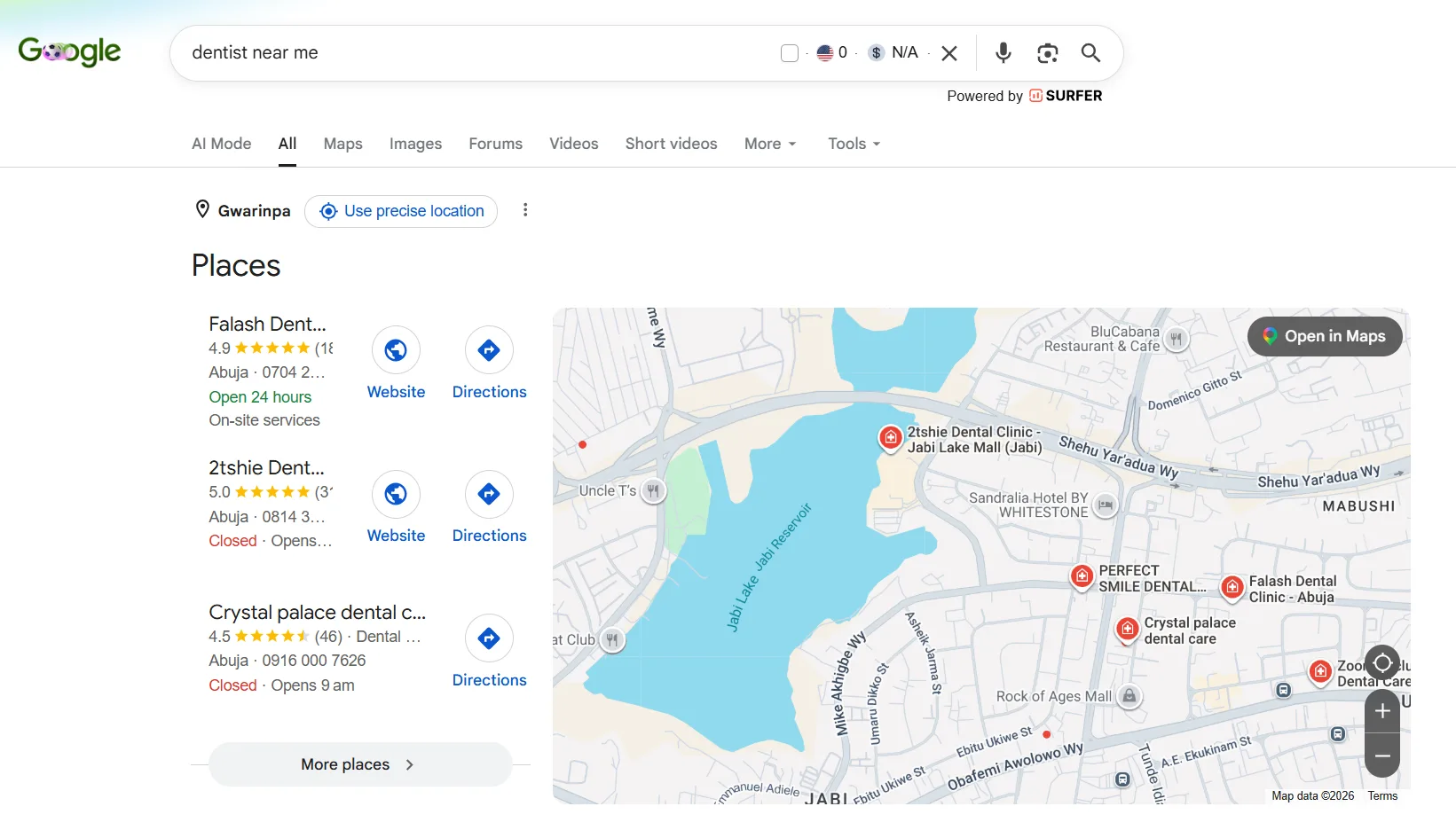
Organic local results sit just below the Map Pack and are driven by relevance signals: page content, backlinks, citations, and reviews. A business with strong content and local signals can rank in organic results for city-based searches without having any address there at all.
Understanding this distinction matters. Many businesses focus entirely on the Map Pack and give up when they cannot appear there. Organic local rankings are often more achievable and can be just as valuable for customer acquisition.
FAQ: Service-Area Business Basics
What Is a Service-Area Business?
A Service-Area Business (SAB) is a business that provides services at the customer's location rather than at a fixed storefront – such as a plumber, home cleaner, mobile therapist, electrician, or delivery service.
Google formally recognizes the service-area business model and allows these businesses to set defined service regions in their Google Business Profile without displaying a physical address publicly. Common examples include plumbers, electricians, landscapers, cleaning companies, mobile clinics, and freelance service providers. Many clinics and healthcare providers, for instance, rank in nearby towns using this same service-area framework.
Can a Service-Area Business Appear on Google Maps Without an Address?
Yes. Google Business Profile allows service-area businesses to hide their physical address and list service regions instead. Your business can appear in map-based searches within those regions. However, because there is no fixed pin on the map, your ranking area is typically smaller and less consistent than that of a business with a verified storefront address. You must compensate with stronger relevance and prominence signals – content, citations, reviews, and backlinks – to close that gap.
How Does Google Rank Businesses That Have No Physical Address in a City?
Google's local ranking algorithm applies three core factors: proximity, relevance, and prominence. For businesses without a physical address, proximity signals are weaker. Google uses the centroid – a calculated center point – of your declared service area to estimate your geographic relevance. Your visibility across a city depends on how strongly your other signals reinforce your presence in that area: consistent NAP data, city-specific content, local backlinks, and reviews that mention the target city by name.
Is It Possible to Rank in Organic Local Results Without a Physical Address?
Yes, and for many service-area businesses, organic local results are the primary opportunity. Pages targeting specific city-and-service keyword combinations – such as "accountant in Accra" or "pest control Lagos" – can rank in organic results without any physical address in those cities. This requires dedicated city-specific landing pages, local citations, and backlinks from sources in or associated with the target location.
FAQ: Google Business Profile Configuration
How Should a Service-Area Business Set up Google Business Profile Without an Address?
When creating or editing your Google Business Profile, select the option to hide your address if you do not serve customers at your location. Then add your service areas – you can specify cities, postal codes, or broader regions. Fill in every available field: business category, phone number, business hours, website URL, and service descriptions. Upload genuine photos of your work, team, or vehicles. A complete profile gives Google more signals to work with and helps your business appear in service-area searches even without a fixed pin.
How Many Service Areas Should a Business List?
List only the cities and regions you can realistically serve. Five to ten well-chosen service areas is the recommended range for most businesses. Listing more than fifteen to twenty cities can dilute your profile's relevance and reduce your ranking strength in the locations that matter most to you. A plumber based in Johannesburg who lists every major South African city will rank in none of them as strongly as one who lists six nearby districts and builds content around each. Keep your service areas accurate and update them if your coverage changes.
What Happens If a Business Uses a Fake or Virtual Office Address?
Using a fake address or listing a virtual office address as a physical business location when no staff are present – violates Google's Business Profile guidelines. Google actively detects and removes listings that use unverified or misleading addresses. A suspended listing is significantly harder to recover than one that was set up correctly from the start. If you need a registered business address for legal or administrative purposes, use a legitimate registered agent service but do not list that address in your Google Business Profile as though customers can walk in.
Can a Business Use a Virtual Office Address on its Google Business Profile?
Only if staff are genuinely present at that address during the listed business hours. Google's guidelines require that the address represent a real, staffed location. A virtual office that simply receives mail does not meet this requirement. Businesses that attempt to verify a listing at a shared or mail-only address risk profile suspension. The safer and compliant approach is to set up your profile as a service-area business with no public address displayed.
FAQ: Website Content and Local Landing Pages
Do City-Specific Landing Pages Actually Help a Business Rank Without an Address?
Yes. City-specific landing pages are the single most effective website-based tool for ranking in cities where a business has no physical location. Each page should target one city and one service category, contain genuinely useful content specific to that location, and be at least 500 to 800 words with custom sections rather than templated text. Pages that simply say "We serve Lagos" with no supporting content will not rank. Pages that address local context – neighborhoods, common local problems, client case studies from that city – signal real relevance to both search engines and readers.
How Many City Landing Pages Should a Business Create?
Create pages only for cities you actively serve and where you have a genuine prospect base. Up to ten location-specific pages is a reasonable ceiling for most small and medium businesses. Beyond that, quality tends to drop, and Google may treat thin or near-duplicate location pages as low-quality content. One well-built landing page per city will outperform ten templated ones. Each page should be interlinked with your main services pages and, where possible, with relevant blog content that adds local context.
What Content Should Go on a City Landing Page?
A strong city landing page includes: a clear description of the services offered in that city, references to local neighborhoods or landmarks where relevant, testimonials or case studies from clients in that city with the city name mentioned explicitly, any local partnerships or community involvement, and a local phone number or contact method if available. Avoid copying the same text across multiple city pages with only the city name changed. Each page needs original content to have any chance of ranking. You can also reinforce these pages by optimizing your Google Business Profile with posts and updates that reference the same target cities.
Does Schema Markup Help a Business Rank in Cities It Does Not Operate From?
Structured data markup – specifically LocalBusiness schema – helps search engines read your business details accurately. It communicates your name, service area, contact information, and business category in a format that is unambiguous to search crawlers. For service-area businesses, schema markup supports local ranking by reinforcing the geographic and categorical signals that a physical address would otherwise provide. The free schema generator from AuthorityStack.ai allows any business to produce JSON-LD schema without technical knowledge. Consistent structured data for your business name, address, and phone is one of the clearest trust signals you can send to search platforms.
FAQ: Citations, NAP Consistency, and Directory Listings
What Are Local Citations and Why Do They Matter for Businesses Without an Address?
A local citation is any online mention of a business's name, phone number, and address (or service area) on a third-party platform – including directories, review sites, social platforms, and industry listings.
Citations help search engines verify that a business is legitimate and active in the locations it claims to serve. For service-area businesses, citations build trust even when no address is publicly displayed. Submitting your business to general directories, industry-specific directories, and local Chamber of Commerce listings strengthens your geographic relevance signal. Consistent local citation data helps search platforms match your business across directories and confirm you are the same entity in every location.
What Is NAP Consistency and Why Does It Matter?
NAP stands for Name, Address, and Phone number. NAP consistency means that these three details appear in exactly the same format across every platform where your business is listed – directories, your website, your Google Business Profile, and social media pages. Inconsistent NAP data – even minor differences like "St." versus "Street" – can confuse search engines and weaken your local authority. For businesses without a physical address, consistent NAP data is especially important because it compensates for the absence of a fixed location pin. Any business wanting to identify where its listings are inconsistent or incomplete can scan its existing citations using a citation scanning tool before attempting to build new ones.
Which Directories Should a Service-Area Business Prioritise?
Start with the directories that carry the most authority in your market: Google Business Profile, Yelp (where active in your region), your industry association directories, and your local Chamber of Commerce listings. For businesses in African markets, this also means prioritising local business directories and sector-specific platforms that are indexed by regional search engines and AI discovery tools. Destinali provides structured business listings designed for discoverability across search engines, maps, and AI-powered discovery tools – a useful option for businesses building their citation footprint in African markets and beyond.
FAQ: Reviews, Backlinks, and Reputation Signals
How Do Reviews Help a Business Rank in a City It Is Not Based In?
Reviews are one of the strongest local ranking signals, and they carry geographic data. When a customer in Nairobi reviews your business and mentions the city by name, that review adds a location-relevant signal to your profile. Encourage customers to leave detailed reviews that naturally include their city and the specific service they received. Responding to reviews and including the city name in your response where appropriate – reinforces that geographic signal further. Location-rich reviews are particularly valuable for service-area businesses because they substitute for the proximity signal that a physical address would otherwise provide.
Do Local Backlinks Help a Business Rank in Cities Without an Office?
Yes. Backlinks from websites based in or associated with a target city tell search engines that your business has genuine relevance in that location. These can come from local news sites, industry associations, event sponsors, Chamber of Commerce pages, community organizations, or local bloggers. Even a small number of high-quality local backlinks can meaningfully improve your organic local rankings in a city. Paid directory links and low-quality link farms do not produce the same effect and can harm your overall domain authority.
What Role Do AI Search Platforms Play in Local Discovery Without an Address?
AI-powered search tools like ChatGPT, Perplexity, and Google AI Overviews are increasingly used for local business queries – "best accountant in Lagos", "top cleaning service in Cape Town" and they do not rely on map pins the way traditional local search does. AI systems pull from structured data, directory listings, reviews, and content. A business with well-structured listings, consistent citations, and city-specific content has a real opportunity to appear in AI-generated recommendations even without a physical address. This is one reason why structured business data and content quality are becoming central to local visibility strategy, not just traditional SEO metrics.
Quick Summary
- A business can rank locally in a city without a physical address, but organic search results are far more accessible than the Map Pack, which is heavily proximity-dependent.
- Service-area businesses should configure Google Business Profile with service areas listed and no address displayed, rather than using a fake or virtual office address.
- City-specific landing pages with genuine, original content are the most effective website tool for ranking in target cities without a local office.
- Consistent NAP data across directories, local citations, location-rich reviews, and local backlinks all compensate for the absence of a physical address.
- Structured data markup and AI-ready business listings are increasingly important as AI-powered search tools expand local discovery beyond traditional map-based results.
- List only the service areas you can realistically serve – five to ten is a practical range for most businesses.
Businesses that want to grow their local visibility across multiple cities can create a free listing on Destinali to start building a structured, discoverable presence across search engines and AI-powered local discovery platforms.

Destinali helps local businesses improve online visibility, discoverability, and customer acquisition across search engines, AI systems, maps, and local search platforms.
List your business →