How Home Service Businesses Get Found Online: The Complete Guide to Local Visibility
Home service businesses operate in one of the most competitive discovery environments in local search. When a pipe bursts or an air conditioner fails, the homeowner reaching for their phone is not comparing options over days – they are calling whoever appears first in the next thirty seconds. That moment of high intent, repeated thousands of times daily across every city and neighborhood, is where local visibility determines revenue. This guide covers every layer of that visibility: how search platforms evaluate your business, how customers discover you, and what consistent action over time produces in leads and growth.
Why Local Visibility Is the Only Marketing That Captures Ready Buyers
Most marketing reaches people before they need you. Social media builds awareness. Display ads create familiarity. Email nurtures future consideration. Local search is different: it captures people at the moment they have already decided to hire someone. They are not researching. They are choosing.
Nearly 46% of all Google searches carry local intent, meaning the person is looking for something close to home. For home service categories – plumbing, electrical, HVAC, cleaning, carpentry, pest control – that share rises even higher because most of these services cannot be delivered remotely. The customer must hire someone nearby.
88% of mobile local searches result in a call or visit within 24 hours, and 18% of local searches result in a purchase the same day. A single plumbing job can be worth hundreds to thousands of dollars. Missing local visibility consistently means that revenue flows directly to competitors who have simply managed their online presence more carefully.
The implication for home service businesses is direct: local visibility is not a marketing tactic sitting alongside paid ads and social media. It is the channel where the highest-value customers are found, and it compounds over time in ways that paid advertising does not.
How Customers Actually Find Home Service Businesses
Understanding the customer journey makes every optimization decision clearer. The path most local customers follow looks like this:
- A need arises – often suddenly and urgently.
- They open a phone and search for the service plus their location ("AC repair near me", "plumber in Lagos", "cleaning service Cape Town").
- Google returns a local map pack showing three businesses, with ratings, distance, and a call button.
- The customer scans those three options, glances at star ratings, and calls the most credible-looking option.
- Many never scroll past the map pack to organic results.
This is the moment home service businesses must win. The ways customers find businesses online have consolidated dramatically around mobile search and map-based results. A business invisible in that map pack is, for most customers in that moment, invisible entirely.
Voice search and AI-assisted search are adding a new layer to this behavior. Customers increasingly ask questions – "Who is the best electrician near me?" and receive a direct answer rather than a list of links. This shift is explored in more detail later in this guide.
The Three Factors Google Uses to Rank Local Businesses
Google evaluates local businesses using three core criteria. Every optimization decision a home service business makes should trace back to improving at least one of these.
Relevance
Relevance measures how well your business profile and website match what the customer searched for. If someone searches "licensed electrician," your Google Business Profile category, service descriptions, and website content must clearly reflect that you provide electrical services. Vague or broad descriptions – "we do all home services" – dilute your relevance signal and make it harder for Google to match your listing to specific searches.
Distance
Distance is how far your location or defined service area is from the searcher. Proximity still matters, but it no longer wins automatically. A business two miles away with a weak, neglected profile can be outranked by a competitor five miles away with strong reviews, consistent citations, and an active listing. Distance is one input, not the deciding factor.
Prominence
Prominence is the most complex of the three, and the one where most home service businesses fall short. Google measures prominence through the volume and quality of your customer reviews, the consistency of your business information across the web, inbound links to your website, and the overall depth of your online presence. A business with 200 detailed five-star reviews and citations across directories will outrank a nearby competitor with five reviews and an incomplete profile, even when that competitor has operated in the market for years.
Google Business Profile: The Foundation of Local Visibility
Google Business Profile is a free platform that allows businesses to manage how they appear in Google Search and Google Maps, including their name, address, hours, services, photos, and customer reviews.
Your Google Business Profile is where most local search decisions are made before a customer ever visits your website. Google Business Profile signals now carry roughly 32% of the total Map Pack ranking weight, making it the single strongest factor in local rankings.
Completing Every Field
A partially completed profile sends a weak signal. Fill out every available field: business name, address or service area, phone number, website, hours of operation, and a full business description. Use all 750 characters available in the description to explain your services, service area, years of experience, and any certifications or specializations that differentiate you.
Choosing the Right Categories
Category selection is a gatekeeper, not a detail. Your primary category determines which searches trigger your listing. Choose the most specific category that reflects your core service – "Emergency Plumber" is more useful than "Home Services" for a plumbing business. Add secondary categories for additional services you offer, but do not claim categories for services you do not actually provide.
Photos and Visual Content
Profiles with photos receive 42% more requests for directions and 35% more clicks to their websites than profiles without them. Upload high-quality images of your team, vehicles, completed work, and equipment. For home service businesses operating across African markets, images of local jobs and recognizable neighborhoods build additional trust with nearby customers.
Keeping the Profile Active
Google treats an actively maintained profile as a stronger signal than one that was set up and forgotten. Update your hours when they change, respond to questions, post updates when relevant, and use the posts feature to share seasonal service reminders or completed project photos. Consistent activity signals to Google that your business is operating and engaged.
NAP Consistency: Why Your Business Information Must Match Everywhere
NAP consistency refers to the practice of keeping a business's name, address, and phone number identical across every platform, directory, and online listing where the business appears.
Inconsistent business information is one of the most common and costly mistakes home service businesses make. If your Google Business Profile lists your phone number one way, your website lists it differently, and a local directory has an outdated address, Google encounters conflicting signals about which information is correct. The result is lower confidence in your listing and weaker local rankings.
NAP consistency matters because Google cross-references your business information across dozens of sources to verify that your business is real, stable, and located where you say it is. Consistent local citation data helps search engines match your business accurately across directories and map platforms, strengthening your prominence score in the process.
Common places NAP inconsistencies appear include:
- Abbreviations used in some listings but not others ("St" vs "Street", "Ave" vs "Avenue")
- Old phone numbers still appearing on directories after a number change
- A trading name used in some places and a registered company name in others
- Old addresses remaining on directories after a business moves
Audit your listings across every platform where your business appears. Correct any mismatch, then establish a process for updating all listings simultaneously whenever your business information changes.
Local Citations and Directory Listings
A local citation is any online mention of a business's name, address, and phone number, whether on a directory, a review platform, a social media profile, or a news article.
Citations build the web of references that Google uses to confirm your business's legitimacy and location. The more consistently your business appears across credible sources, the stronger your prominence signal becomes.
Where to Build Citations
Start with the platforms that carry the most weight for local search: Google Business Profile, Bing Places, Apple Maps, Facebook, and Yelp. Then move to industry-specific directories relevant to home services – platforms like Thumbtack, Angi, and Houzz in the US; local equivalents in African markets, the UK, Australia, Canada, and the Philippines. Chamber of Commerce listings and Better Business Bureau profiles carry additional authority in many markets.
For businesses serving African markets specifically, listing on local business directories that serve Lagos, Nairobi, Accra, Cape Town, or Johannesburg delivers geographic signals that global directories cannot replicate. The top online directories for African businesses vary by country and industry, and coverage across them strengthens local search performance in those markets.
Structured Vs. Unstructured Citations
Structured citations appear in formatted directory listings – the business name, address, and phone number in clearly defined fields. Unstructured citations appear when a business is mentioned in a blog post, news article, or forum without a directory format. Both types contribute to prominence, though structured citations are easier to audit and maintain.
Customer Reviews: The Trust Signal That Drives Calls
Reviews now account for approximately 20% of Map Pack ranking weight, and their influence on customer behavior is even greater than their ranking impact suggests. Over 99% of consumers read reviews before visiting or contacting a local business. For home service businesses specifically, a strong review profile is often the deciding factor when a customer is choosing between two equally close and seemingly similar options.
What Makes a Review Profile Strong
Volume matters, but it is not the only variable. Recency, detail, and response rate all influence how Google and customers evaluate your reviews. A business with 200 reviews but the most recent one from two years ago looks less active than a business with 80 reviews and three new ones this month.
Detailed reviews – those that mention a specific service, a technician's name, or a particular job – carry more weight than generic five-star ratings without text. Encourage customers to share specific details when leaving a review.
Reviews influence AI search recommendations in addition to traditional rankings. AI systems like ChatGPT, Gemini, and Perplexity increasingly surface businesses based on sentiment signals drawn from review content, making review quality a factor in both search and AI-powered discovery.
Building a Review Generation Process
The most consistent review generators in home services are businesses that make the request a standard step in their post-job process. Ask every satisfied customer for a review within 24 hours of completing a job, when the work is fresh and the positive feeling is at its peak. Send a direct link to your Google Business Profile review form via SMS or WhatsApp to reduce friction. Most customers who intend to leave a review will do so if the process is easy and the request comes quickly.
Responding to Every Review
Respond to every review, both positive and negative. Responding to positive reviews reinforces the relationship and shows prospective customers that you engage with your community. Responding to negative reviews professionally demonstrates that you take quality seriously. 73% of unhappy customers will give a local business a second chance if the owner responds professionally to a negative review.
Your Website's Role in Local Visibility
Your website is not the primary discovery point for most local searches – your Google Business Profile often handles that but it plays a critical supporting role. Google cross-references what your website says against what your profile claims. Conflicting signals between the two weaken your rankings.
Service Pages and Location Pages
Each major service you offer deserves a dedicated page. A generic "services" page performs far worse than individual pages for "kitchen plumbing repair," "burst pipe emergency service," or "HVAC installation." Each page should target a specific service term plus the city or area you serve.
If you serve multiple cities or neighborhoods, create a dedicated location page for each. These pages target geographic search terms and help Google understand exactly where you operate. Keep content unique on each location page – copying the same text with only the city name changed provides little signal value and can be counterproductive.
Schema Markup for Local Businesses
Schema markup is structured data added to your website's code that helps search engines and AI systems understand your business type, location, services, hours, and contact details. For home service businesses, LocalBusiness schema and Service schema are the most directly useful.
Adding schema is not technically complex, and tools like the free schema generator from AuthorityStack.ai allow businesses to generate JSON-LD structured data for any page without writing code. Proper schema implementation helps your business appear in rich search features and makes your information readable by both traditional search engines and AI-powered platforms.
Mobile Performance
Over 60% of local searches happen on mobile devices, and most home service searches are made urgently, on a phone, while the problem is happening. A website that loads slowly or displays poorly on mobile loses customers before they ever see your phone number. Ensure your site loads in under three seconds on mobile, displays cleanly on small screens, and makes it simple to call or message your business with a single tap.
AI Search Visibility: How Home Service Businesses Get Found in ChatGPT, Gemini, and Perplexity
AI-powered search tools are changing how a meaningful share of customers find local service providers. When someone asks ChatGPT "Who are the best electricians in Nairobi?" or asks Perplexity to recommend a reliable plumber, these systems generate answers by drawing on structured data, review content, business listings, and the quality of information available about each business online.
Being visible in AI search requires the same foundations as traditional local SEO – strong profiles, consistent citations, and genuine reviews but it adds additional requirements around how information is structured and how clearly a business's entity is defined across the web.
A business that appears consistently under the same name across Google, Yelp, Facebook, and industry directories sends a clear entity signal. AI systems can confidently identify and recommend it. A business with inconsistent information across platforms, or sparse online presence, becomes difficult for AI systems to surface reliably, even when the business has excellent service quality and years of experience.
Strategies for building visibility across search platforms, including AI-powered ones, follow the same core logic as local SEO: clarity, consistency, and completeness. Businesses that manage their information carefully across all platforms benefit across every discovery channel, traditional and AI-powered alike.
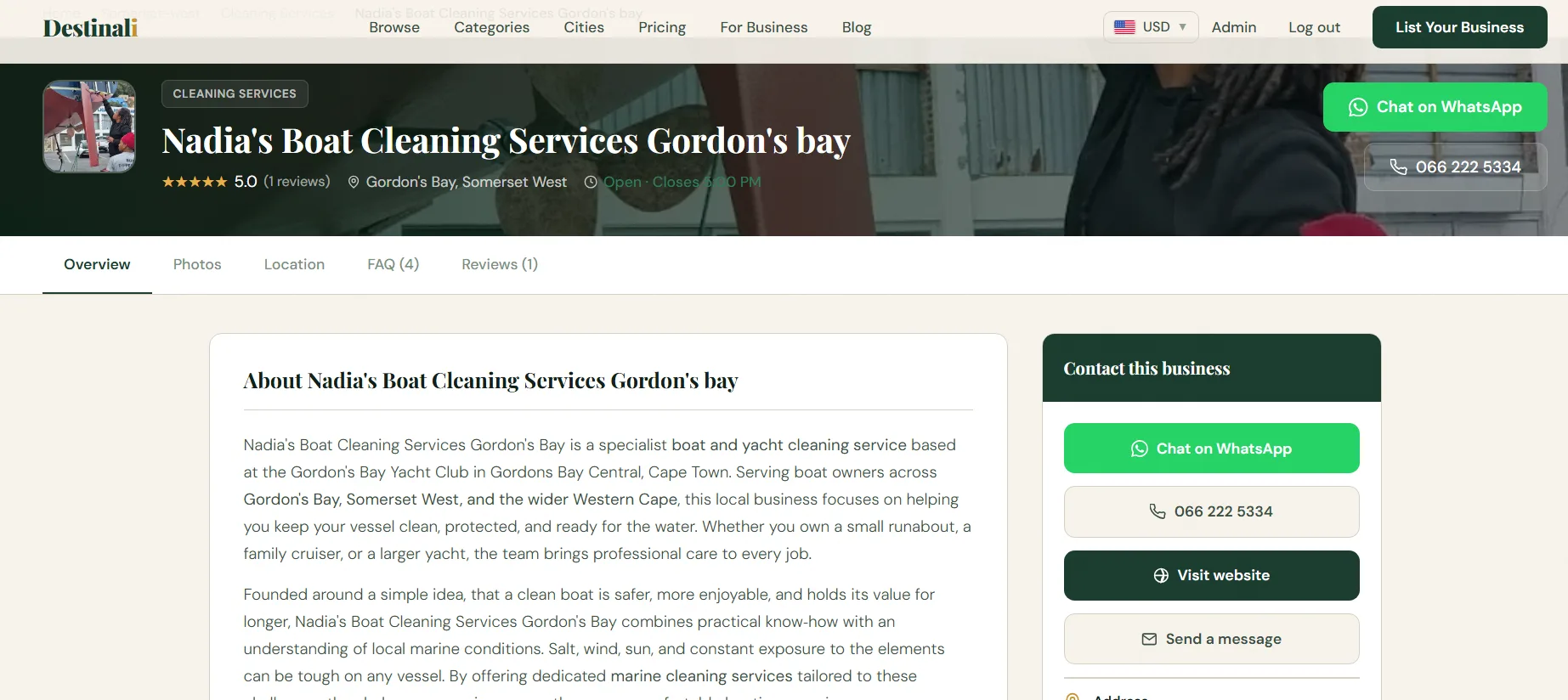
Destinali works with home service businesses, clinics, restaurants, and local brands across African markets and internationally to strengthen exactly this kind of cross-platform visibility – combining business listings, citation management, review signals, and local SEO tools in one place.
Common Mistakes That Limit Local Search Performance
Many home service businesses invest real effort into marketing without seeing results, because foundational visibility problems go unaddressed. These are the most common issues that suppress local search performance.
Claiming a Profile but Not Maintaining It
A claimed but neglected Google Business Profile is nearly as weak as no profile at all. Outdated hours, missing services, old photos, and unanswered reviews signal to Google that the business is inactive. Treat your profile as a live, maintained asset – not a form you fill out once.
Claiming Too Many Service Areas
Listing twenty cities in your service area when your website and reviews only reflect two or three creates a mismatch that Google notices. Serve areas you actually reach, and let your reviews, website content, and citations confirm those areas consistently.
No Review Generation System
Most home service businesses receive reviews sporadically – when a very happy or very unhappy customer takes the initiative. This produces a thin, stale review profile. Systematic post-job review requests, sent within 24 hours via direct link, transform review accumulation from random to reliable.
Ignoring Citations After Setup
Building citations once and never auditing them leaves outdated information compounding over time. Every time a phone number changes, an address moves, or a business name evolves, old citations need updating. Unmanaged citations erode NAP consistency and quietly suppress rankings.
Duplicate Listings
Multiple listings for the same business split authority and confuse search engines. This often happens after a business changes address or phone number and creates a new listing instead of updating the existing one. Identify and remove duplicates to consolidate all signals into a single authoritative listing.
Where Local Search Is Heading: Trends for Home Service Businesses
The local search landscape is evolving in ways that reward businesses who build strong foundations now.
AI-integrated local results. Google's AI Overviews, ChatGPT search, Gemini, and Perplexity are all integrating local business data into conversational answers. The businesses that appear in these answers are those with the clearest, most consistent information across the web. This is not a future concern – it is happening now, and home service businesses in competitive markets are already losing or winning customers through AI-powered recommendations.
Behavioral signals gaining weight. Direction requests, photo views, calls from listings, and website clicks are increasingly factored into local rankings alongside traditional signals. An actively used, fully optimized listing that generates engagement outperforms a stagnant listing with older signals. This trend rewards businesses that treat their profiles as active marketing assets.
Voice and conversational search. As voice search through phones, smart speakers, and AI assistants grows, search queries are becoming longer and more conversational. Optimizing for how people speak ("Who fixes air conditioners near me on weekends?") rather than how they type will become increasingly important. FAQ content and natural-language service descriptions position businesses for this shift.
Local content as an authority signal. Blog posts, service guides, and location-specific articles that answer real customer questions are building stronger authority signals for local businesses. A plumbing company that publishes "What to Do When a Pipe Bursts at Night in Lagos" builds both customer trust and search relevance in a way that a profile alone cannot replicate.
FAQ
What Is the Google Map Pack and Why Does It Matter for Home Service Businesses?
The Google Map Pack is the block of three local business listings that appears at the top of search results when someone searches for a local service. It includes the business name, star rating, distance, hours, and a click-to-call button. For home service businesses, the Map Pack is where most customer calls originate – the majority of searchers choose from these three results and never scroll further.
How Do I Get My Home Service Business Into the Google Map Pack?
Getting into the Map Pack requires optimizing across three factors: relevance, distance, and prominence. Relevance comes from correctly categorized profiles and service-specific content. Distance is determined by the searcher's location relative to your business or service area. Prominence is built through customer reviews, consistent citations across directories, backlinks to your website, and an active, complete Google Business Profile. All three factors must be addressed together – strong performance on one cannot fully compensate for weakness on another.
How Many Reviews Does a Home Service Business Need to Rank Well Locally?
There is no fixed threshold, and the number that matters depends on your market and competition. In less competitive markets, 30 to 50 detailed, recent reviews can be sufficient to rank in the Map Pack. In competitive urban markets, 100 or more may be necessary just to be competitive. More important than a specific number is consistency – businesses that generate reviews regularly rank better than those with a large total but no recent activity. Aim to generate at least two to four new reviews every month.
What Is NAP Consistency and Why Does It Affect Local Rankings?
NAP stands for Name, Address, and Phone Number. NAP consistency means these three pieces of information are identical across every platform, directory, and listing where your business appears. Search engines cross-reference this data to verify your business's legitimacy and location. Even small inconsistencies – different abbreviations, outdated phone numbers, or a business name formatted differently in different places – create conflicting signals that weaken your local search authority and suppress your rankings.
Do Home Service Businesses Need a Website If They Have a Google Business Profile?
Yes. A Google Business Profile handles most of the initial discovery, but your website serves two important roles. First, it provides the depth of information that converts an interested searcher into an actual customer – service details, pricing guidance, photos of completed work, and contact options. Second, Google cross-references your website against your profile to verify your services and location. A website that clearly reflects your services, service areas, and contact information strengthens your profile's authority and helps your listing rank higher.
How Does AI Search Affect Local Business Discovery?
AI-powered search tools including ChatGPT, Gemini, Perplexity, and Google AI Overviews are increasingly surfacing local business recommendations in response to conversational queries. These systems draw on structured business data, review sentiment, and the consistency of a business's information across the web. Businesses with strong, consistent profiles and genuine reviews are more likely to be recommended by AI systems. Businesses with sparse or inconsistent online presence are likely to be overlooked, regardless of actual service quality.
How Long Does It Take for Local SEO to Produce Results?
Most home service businesses begin seeing measurable improvements in local visibility within two to four months of implementing the core foundations: a fully optimized Google Business Profile, consistent citations, and an active review generation process. More competitive markets take longer, and achieving Map Pack placement in a high-competition category can take six to twelve months of consistent effort. The compounding nature of local SEO means results grow over time – a business that maintains consistent optimization for two years typically sees far stronger returns than one that optimizes in short bursts.
What Is Schema Markup and Does My Business Need It?
Schema markup is structured data code added to a website that tells search engines and AI systems precisely what your business does, where it operates, what services it offers, and how to contact it. For home service businesses, LocalBusiness and Service schema are the most relevant types. Schema helps your information appear in rich search features and makes it readable by AI-powered platforms, not just traditional search engines. It is not technically complex to implement – free tools generate the necessary code in minutes without requiring programming knowledge.
Key Takeaways
- Local search is the highest-intent discovery channel for home service businesses – customers are searching because they are ready to hire, not because they are browsing.
- The Google Map Pack – three listings shown at the top of local search results – is where most calls originate, and winning it requires consistently strong signals across relevance, distance, and prominence.
- Google Business Profile is the single most important asset for local visibility, accounting for roughly 32% of Map Pack ranking weight. It must be complete, accurate, and actively maintained.
- NAP consistency – identical business name, address, and phone number across every platform – is foundational. Inconsistencies create conflicting signals that suppress rankings over time.
- Customer reviews drive both rankings and customer decisions. A systematic post-job review request process, sent within 24 hours of job completion, is the most reliable way to build a strong review profile.
- Local citations across relevant directories, maintained accurately and consistently, strengthen your prominence signal and confirm your location and legitimacy to search engines.
- AI-powered search tools are becoming a meaningful customer discovery channel, and businesses with clean, consistent, well-structured online presence benefit across both traditional and AI-driven search.
- Local SEO compounds. Consistent effort over six to eighteen months produces lead volumes and cost-per-acquisition that paid advertising alone cannot match.
Home service businesses that build their local visibility systematically – through accurate listings, consistent citations, genuine reviews, and structured website content – create a discovery asset that generates qualified leads month after month. Businesses that skip these foundations pay for every lead repeatedly through advertising, with no compounding effect. You can create a free listing on Destinali and start building the online presence that puts your business in front of customers exactly when they are ready to hire.

Destinali helps local businesses improve online visibility, discoverability, and customer acquisition across search engines, AI systems, maps, and local search platforms.
List your business →